News Briefing: Church in the World


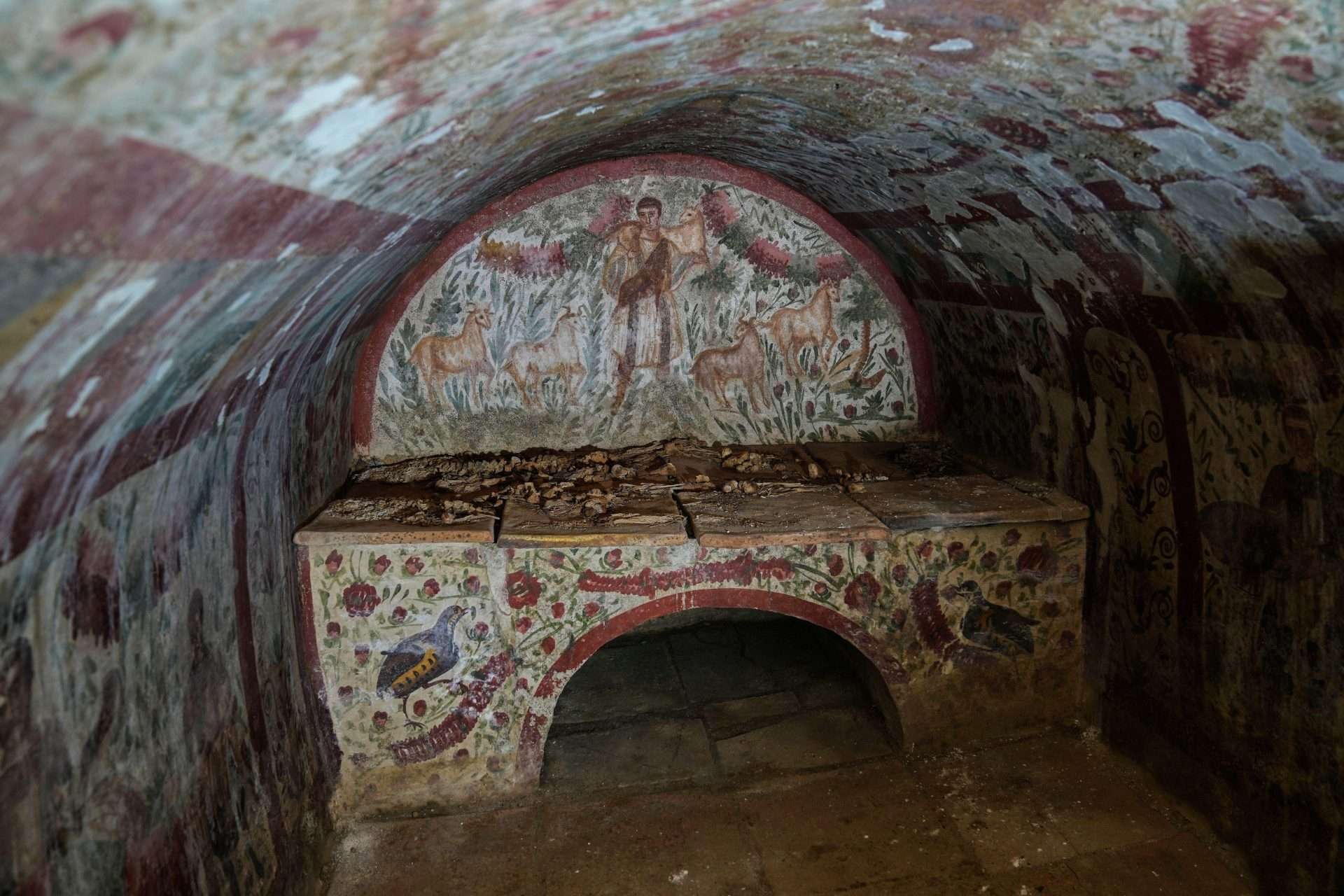
Archaeologists discovered rare fresco of Christ as the Good Shepherd in Hisadere, near Iznik in Turkey.
Khalil Hamra / Associated Press / Alamy
A Hong Kong court convicted the democracy campaigner Jimmy Lai of national security and sedition charges. The 855-page judgment delivered on Monday after a two-year trial claimed there was “clear” evidence that Lai, a businessman and publisher of the pro-democracy Apple Daily, had colluded with foreign powers.
Governments and rights groups around the world condemned the verdict. Lai’s family have reported that the 78-year-old Catholic convert is in poor health and has been denied appropriate medical care as well as access to Holy Communion, though the authorities dispute this. His son Sebastien Lai said his father could be left to die in prison, but remained “a man who lives without regrets”.
Videos created with artificial intelligence (AI) and circulating on YouTube and other social media platforms are using the profiles of Korean Catholic bishops to spread false information or solicit donations, the Korean bishops’ conference warned.
Official videos and photos of Archbishop Peter Chung Soon-taick of Seoul and Bishop Linus Lee Seong-hyo of Masan were digitally altered using AI to produce what looked like genuine statements. “This is a growing trend,” the conference warned through its official outlet.
In November, the bishops issued “Guidelines for correct access to Catholic Media Content”. They urged Catholics to check information with their parish priest or diocese and with the conference website.
Activist priests Fr Flavie Villanueva SVD and Fr Robert Reyes joined a group of anti-corruption advocates in filing a plunder complaint against the Philippines’ Vice President Sara Duterte on 12 December.
They accused the 47-year-old Duterte of misusing around £7.8 million in confidential funds. They asked the Ombudsman to investigate her for plunder, and to endorse its findings to Congress for a new impeachment complaint against her.
Leaders of the Catholic Church are among Duterte’s staunchest critics, having also condemned the bloody war on drugs waged by her father, former president Rodrigo Duterte, from 2016 to 2022. Villanueva and Reyes, themselves opponents of the Duterte drug war, now belong to a reform movement called the Clergy for Good Governance.
Speaking to reporters, Villanueva denied that he and other complainants are angry at the vice president. “We are angry at those who manipulate others, we are angry at lies, we are angry at those who distort the truth. There is no politics here,” said Villanueva. “As a priest and as a member of the Church, the truth has always been enshrined in the Gospel, and that is why I am here.”
Bishops in six Filipino dioceses criticised the proposed construction of a nuclear power plant in Pangasinan Province, north of Manila, citing safety, environmental and moral concerns posing an “unacceptable risk”.
The government project would see a revival of nuclear ambitions in the Philippines, which have been dormant since the 1980s when the Bataan nuclear power plant was decommissioned. Proponents argue that it could provide sufficient energy to meet growing domestic demand, but the bishops warned of the danger of its proximity to an area of seismic activity.
On 4 December, Archbishop Socrates Buenaventura Villegas of Lingayen-Dagupan and Bishop Napoleon Balili Sipalay of Alaminos were among bishops who published a pastoral letter urging investment in “renewable energy infrastructure that will ensure safety, resilience and true long-term development for our people”. They said their region is vulnerable to disasters and that the problem of radioactive waste is irreversible.
Pope Leo appealed for a resolution to the border crisis between Cambodia and Thailand. “I am deeply saddened by the news of the renewed conflict along the border,” he said at the general audience on 10 December, “and I call on the parties to immediately cease fire and resume dialogue.”
The conflict originated in an historic dispute over the colonial-era demarcation of their 500-mile frontier. Cambodian bishops urged all parties to “put down the guns”. Bishop Olivier Schmitthaeusler, the vicar apostolic of Phnom Penh, asked parishes to organise prayers for peace.
Fr Enrique Figaredo Alvargonzález, apostolic prefect of Battambang, described “a moment of great tension”, reporting that “people are very afraid, and over 200,000 Cambodian refugees have been displaced”. Battambang is one of six provinces that have been bombed by drone-launched explosives, airstrikes and tank assaults. Caritas Cambodia organised aid, offering food, water, sanitation, education, and temporary shelters for families in parishes.
In Thailand, three dioceses directly assisted evacuees. The Catholic bishops’ conference and Caritas Thailand asked all dioceses, religious orders and Catholic organisations to support financially.
Military authorities in Myanmar’s Kachin State ordered churches to celebrate Christmas before 20 December to prevent disruption of elections. The advocacy group Christian Solidarity Worldwide (CSW) reported that townships where polling will take place on 28 December were subject to the order. CSW said the junta was perpetrating “a significant violation of freedom of religion or belief” to conduct “a fraudulent election”.
A Catholic priest won a gold medal in an international powerlifting tournament in Thimphu, Bhutan.
“Not for personal glory, but as a visible witness that priesthood and human strength can walk together, and that faith does not compete with discipline, but strengthens,” Fr Denis Dominic Joseph said of the gold medal adorning his cassock, which he had particularly hoped for during the Jubilee.
Fr Joseph, who is assistant parish priest at Saint Ignatius Church, Khadki, Pune and Principal of St Joseph’s Boys High School in the locality, said that his interest in sport stemmed from a desire to evangelise to young people through health and fitness.
He had no coach to assist him. “Mother Mary herself was my coach, my strength, my protector, and my everything,” he said.
India’s Supreme Court accepted a petition from the Catholic Bishops’ Conference of India (CBCI) and others challenging the validity of the Rajasthan Prohibition of Unlawful Religious Conversion Act 2025 on 8 December. Justices Dipankar Datta and Augustine George Masih admitted the petition and ordered the Rajasthan state government to file a reply.
The petitioners contended that the act promulgated on 29 September is the most severe anti-conversion law in the country and that its provisions are “arbitrary, unreasonable, illegal and ultra vires [beyond its constitutional powers]”. The Supreme Court bound the CBCI’s plea with several other similar pending petitions against other anti-conversion laws in various states.
A private university in southern Chennai city terminated a Dalit academic after an internal inquiry found that her anti-war posts during India’s conflict with Pakistan over terror killings in May amounted to “grave misconduct”.
Lora Shantakumar, who worked at the SRM Institute of Technology’s Career Development Centre in Tamil Nadu’s capital city, was dismissed for expressing opposition to the war, termed “Operation Sindoor”, warning against the dangers of conflict and urging leaders to consider its human cost.
The Dalit (“untouchable”) academic maintained that she had posted the messages on her personal account and that they were not directed against the army or the state as alleged. Shantakumar said the allegations were misconstrued and denied her a fair hearing. The committee charged her on five accounts, which they termed as “grave misconduct”.
Another academic Ali Khan Mahmudabad, associate professor at Ashoka University, in Sonepat in the northern state of Haryana, also faced legal challenges and arrest in mid-2025 for statements he made about “Operation Sindoor”.
Church leaders in Goa have questioned the consequences of “unbridled overtourism” after 25 people were killed and 50 injured in a nightclub fire in the western Indian state known for beach tourism. A firework inside the building started a fire on 7 December. Most victims were staff members, while five were tourists.
“It was a preventable mass killing enabled by corruption, greed, and deliberate blindness,” said Fr Victor Ferrão, professor of theology at the Patriarchal Seminary in Goa. He suggested the nightclub’s owners hosted customers in a building with no fire exits and that was routinely overcrowded.
Fr Maverick Fernandes, director of Caritas Goa, said the Church has been campaigning against the ill effects of tourism. “Sadly, the dangers we have feared have become a reality,” he added. Catholics make up 25 per cent of the state’s 1.1 million residents and many work in tourism.
Zimbabwe’s Catholic bishops voiced opposition to an amendment to the Medical Services Bill which they said would legalise abortion.
The government announced the plans which officials hinted were part of broader efforts to address a surge in the rape of underage girls who women’s rights activists say must have access to abortion services. However, bishops say such proposals would lead to wider access to abortion and urged citizens to consult their parliamentary representatives to oppose the amendments.
“As the Church, we are totally against abortion, and we would like to appeal to all people of faith and all those who value life to pray and speak against this evil,” the bishops said in their statement dated 13 December. “To our senators, we make a strong appeal to your consciences,” they said, adding that this was a step back from progress the country had made in abolishing the death penalty last year.
Bishops in South Africa demanded protections for whistleblowers after the assassination of a key witness in a high-profile corruption investigation involving senior political figures from the ruling African National Congress. A government-appointed commission to investigate what is seen as one of the country’s biggest post-apartheid corruption cases has implicated several politicians and businessmen.
“We need, even at this late hour, to commit to dismantling this dysfunctional culture of corruption and the disregard for the common good,” the bishops said on 10 December statement. “We cannot be silent in the face of such acts. Silence becomes complicity in such wicked behaviour. We owe it to those who died in this field of struggle to speak out and do what is right.”
The Vatican’s Secretary of State Cardinal Pietro Parolin visited Cabo Delgado province in Mozambique, where jihadist groups have terrorised the local population.
During his visit to the Muslim-majority region where over 300 Catholics have been killed in eight years of conflict, Parolin delivered a message of solidarity, telling victims that “you are not alone” and that their sufferings “are in the heart of Mother Church”. He spoke about the “heroic witnesses of faith of so many of our brothers and sisters who remained faithful to Christ in these times of pain and strife, and also of those who were killed without denying the name of Jesus”.
Fr Johan Viljoen, the director of the Denis Hurley Peace Institute of the Southern Africa Catholic Bishops’ Conference, told The Tablet that the visit was “a significant affirmation of the Catholic Church’s commitment to the marginalised”.
Pope Leo expressed “deep concern [at] the resumption of fighting in the eastern part of the Democratic Republic of Congo” in his message after the Angelus on Sunday. “While expressing my closeness to the people, I urge the parties in the conflict to cease all forms of violence and to seek constructive dialogue, respecting the ongoing peace process,” he said.
Rwandan-backed rebels continued to advance through South Kivu province displacing thousands of people despite US President Donald Trump’s claim to have brokered an “historic deal” between the governments of DR Congo and Rwanda, which they signed at the White House last week.
The Catholic outlet VoiceAfrique accused Trump of focusing on minerals and ignoring the situation on the ground: “Peace that heals is not proclaimed from afar; it is nurtured at home.” Preaching on Sunday, the Archbishop of Kinshasa Cardinal Fridolin Ambongo urged the warring parties to adopt a Church-backed peace plan rather than the US accords.
Religious leaders asked for Christmas gifts that protect the environment from government representatives at the seventh UN Environment Assembly (UNEA-7) in the Kenyan capital Nairobi on 8-12 December.
During discussions on environmental sustainability, Ashley Kitisya, Laudato Si’ Movement’s Africa Programme Manager, said that during Advent faiths were looking at Christmas giving through the lens of the three planetary crises.
“We can choose gifts that honour both people and the Earth,” she said, voicing faith groups’ concerns about overconsumption, waste, and environmentally harmful practices during the Christmas season.
Kitisya specified plastic pollution, food waste and unnecessary energy use spike during the festive season. “Single-use plastics and unnecessary packaging can be avoided. Promoting locally made, durable, or upcycled gifts reduces pollution and cuts the carbon footprint of Christmas shopping,” she said.
The Global Anglican Future Conference (Gafcon) invited heads of state to attend the first meeting of bishops of the “Global Anglican Communion” on 3-6 March in Abuja, Nigeria. A member of the planning committee told The Tablet they expected “about eight African presidents to attend the opening ceremonies of the meeting”. He continued: “The general secretary of the World Council of Churches, the secretary and other heads of Christian faith across the world are expected to attend the meeting.”
Gafcon has also invited around 500 conservative Anglican bishops to attend the event, which was arranged after the nomination of Sarah Mullally as Archbishop of Canterbury despite some Anglicans’ opposition to female ordination. “We want to respect the word of God as handed down to the founders of the faith. We will never compromise on this, for any reason, we will never lower the standard, and this will set us apart from the rest,” the organiser said.
The Vatican published a book on where Catholics and Methodists “converge” in their beliefs. We Believe in One God: Sixty years of Methodists and Catholics walking together, is written by the Joint International Commission for Dialogue between the World Methodist Council and the Roman Catholic Church (MERCIC).
Presented as “both a record of hope and a call to deeper communion”, it says that there is no “formal” division between Methodism and the Catholic Church, given Methodism began as a revival movement in the eighteenth-century Church of England. Nevertheless, it recognised a need for “healing of memories” and “acknowledgment of past wrongs”.
Archbishop Shane Mackinlay of Brisbane, the Catholic co-chair of MERCIC, and his Methodist counterpart the Revd Edgardo Colón-Emeric, Dean of Duke Divinity School in the US, write that their joint research reveals a “clear convergence in understanding the faith we profess together in the Nicene Creed”.
Archaeologists discovered rare fresco of Christ as the Good Shepherd in Hisadere, near Iznik in Turkey. The image of a youthful, Roman-looking, beardless Jesus wearing a simple tunic in a third-century tomb may be the only known example of this type in Anatolia.
A team of archaeologists from Iznik Museum unearthed the three-sided burial chamber featuring portraits of noble men and women with their slave attendants and plant and bird motifs during the 2025 excavation season.
It is the first Christ image identified within the Hisadere Necropolis – a shared burial ground for both wealthy families of Nicaea and lower-income residents between the second and fifth centuries AD. Among the excavated structures are the distinctive terracotta-roofed chamber tombs for which the city is known.
Before the wider adoption of the cross as Christianity’s universal symbol, the Good Shepherd motif played a key role in expressing faith, indicating protection, salvation and divine guidance. During his first apostolic journey in November, Pope Leo visited Iznik, the site of the First Council of Nicea in 325. Turkey’s President Recep Tayyip Erdoğan presented the Pope with a tile painting of the Good Shepherd.
In an apostolic letter on 11 December 2025, Pope Leo emphasised the importance of archaeology for the study of Christianity: “Christian theology … cannot be fully understood without understanding the places and material evidence that bear witness to the faith of the early centuries.”
The Orthodox Church in the Czech Republic faces insolvency proceedings after some of its priests filed a lawsuit over unpaid wages. The case revealed deep financial problems that could force the Church to sell assets to cover its liabilities.
According to the Seznam Zprávy outlet, the total amount owed by the Orthodox Church to the claimants is tens of thousands of Czech crowns (equivalent to several thousand pounds sterling). The priests said they were forced to resort to courts by the lack of reaction and communication from the Church leadership, amid warnings that more clergy could make similar claims.
The situation was preceded by an attempt by the Orthodox archbishop in the Czech Republic to solve financial difficulties with a large loan. Archbishop Michael of Prague and the Czech Lands asked the diocesan council to approve a loan of 20 million Czech crowns (£720,000) from a private individual at 2 per cent per month to cover debts to the state and employees. However, the council rejected the request citing a complete lack of information on the financial situation of the diocese.
In the meantime, the Czech Ecumenical Council of Churches suspended the Orthodox Church’s membership for one year, citing serious breaches of trust, non-transparent financial management and concerns over possible Russian influence and misuse of church structures for pro-Russian messaging.
The Commission of the Bishops’ Conferences of the European Union (Comece) criticised a ruling by the European Court of Justice (ECJ) requiring all member states to recognise same-sex marriages contracted in the EU.
According to the decision, “member states are … required to recognise, for the purpose of the exercise of the rights conferred by EU law, the marital status lawfully acquired in another member state”. Two Polish men who married legally in Germany were later refused a transcript of their marriage certificate by the Polish authorities on the grounds that Polish law does not allow marriage between persons of the same sex.
In a statement on 9 December, Comece said the ruling “may impact on questions lying at the core of national competences”. The right to marry and the right to found a family are, according to Article 9 of the Charter of Fundamental Rights of the EU states, guaranteed in accordance with the national laws governing their exercise.
The ruling “may foster pressure to amend national family law” where for some member states the definition of marriage forms part of their national identity, Comece said. The statement warned that in the context of polarisation in European societies “such judgements may fuel anti-European sentiments … and be easily instrumentalised for that purpose”.
Priests, seminarians, religious, scouts, young Christian workers and lay people martyred by the Nazis were among the 50 French Catholics beatified in Notre Dame de Paris on 13 December.
They died while providing spiritual help to the 300,000 Frenchmen forced into labour service in Germany during the Second World War on Compulsory Work Service (STO) in 1944-5, travelling with them to say Mass, hear confessions or provide comfort. Many of this “Saint Paul Mission” perished in the concentration camps at Buchenwald, Mauthausen, Dachau and Flossenbürg.
“The Church in France can be proud of its 50 martyrs,” said the Archbishop of Luxembourg Cardinal Jean-Claude Hollerich, who presided over the celebration. Several German bishops attended the ceremony and Hollerich switched from French to German to greet them.
The martyrs, aged 19 to 49, followed an appeal by the French Church and voluntarily enlisted in the STO to provide spiritual support to workers. The Nazis forbade them from practising their faith and they were fully aware of the risk of death. Killed “in hatred of the faith”, in June Pope Leo XIV declared them martyrs.
The Archdiocese of New York established a $300 million fund to pay victims of clerical sex abuse. Officials estimate there are 1,300 outstanding claims against the archdiocese, created when the state legislature created a “look back” period during which victims could file claims beyond the statute of limitations. Six of New York state’s eight dioceses have filed for bankruptcy since the statute of limitations was lifted.
The $300 million fund is one of the largest created by any diocese in the United States. The Archdiocese of Los Angeles has paid a total of $1.5 billion in settlements, by far the largest of any diocese, with several other dioceses furnishing between $50 and $200 million to settle claims.
The Archdiocese of New York also agreed to the appointment of Judge Daniel Buckley as a mediator between the archdiocese and the victims. Buckley negotiated the second of two settlements in Los Angeles.
Meanwhile, a court settlement in Louisiana will require the Archdiocese of New Orleans, which is much smaller than New York, to pay $230 million to victims of clergy sex abuse. In September, Pope Leo XIV named Archbishop James Cecchio as coadjutor in New Orleans Cecchio has extensive fundraising experience.
Archbishop Bernard Hebda of St Paul-Minneapolis, Minnesota celebrated the rite of reparation at Assumption Church in Minneapolis, scene of a mass shooting on 27 August during a Mass to mark the beginning of the school year.
Hebda concelebrated with the parish priest Fr Dennis Zehren. The Mass included the rite which consists of sprinkling the sanctuary, church walls and the people with holy water.
Two schoolchildren, Harper Moyski and Fletcher Merkel, were killed in the attack and 21 people were wounded. The archbishop, in an interview, discussed the many times he had come to join the parishioners of the church in the rosary since the shooting, and would visit with the parishioners.
“And so many of them had come to me and said, ‘Archbishop, when can we get back into the church? We miss adoration,’” Hebda said. “Our church is so good with simple symbolism. I think that’s what I heard at the reception after the Mass.”
He continued: “People were so grateful for the opportunity to come together and to pray, and how significant it was for them to have the Eucharist again in the church, both in the adoration chapel, but then in the tabernacle in the sanctuary.”
Stay updated — add us as a preferred news source on Google:


Help us keep The Tablet’s voice independent, clear and far-reaching.
Founded in 1840, The Tablet is the leading independent English-language Catholic weekly, celebrated for great writing, astute analysis, brilliant arts and books reviews and trustworthy reporting from correspondents in Britain, Ireland, Rome and across the world.
Independent, high-quality journalism is at the heart of what we do. The Tablet does not have deep pockets and we are not funded by rich donors. If you appreciate our work please consider supporting The Tablet’s Development Fund. It only takes a moment and you can cancel at any time.
- Support with £5 per month
- Support with £10 per month
- Support with other amount.

MOST READ ARTICLES
-
1
Pope returns to Vatican after hospital discharge
-
2
Diverse schools that are 100 per cent Catholic
-
3
Under endless skies
-
4
Battling confession fatigue
-
5
Nigerian bishop scorns suggestion of running in presidential election
-
6
Schismatic Spanish nuns strip contents of convent before eviction
FROM THE EDITOR'S DESK