Anglican Communion shaken by conservative plans to break away


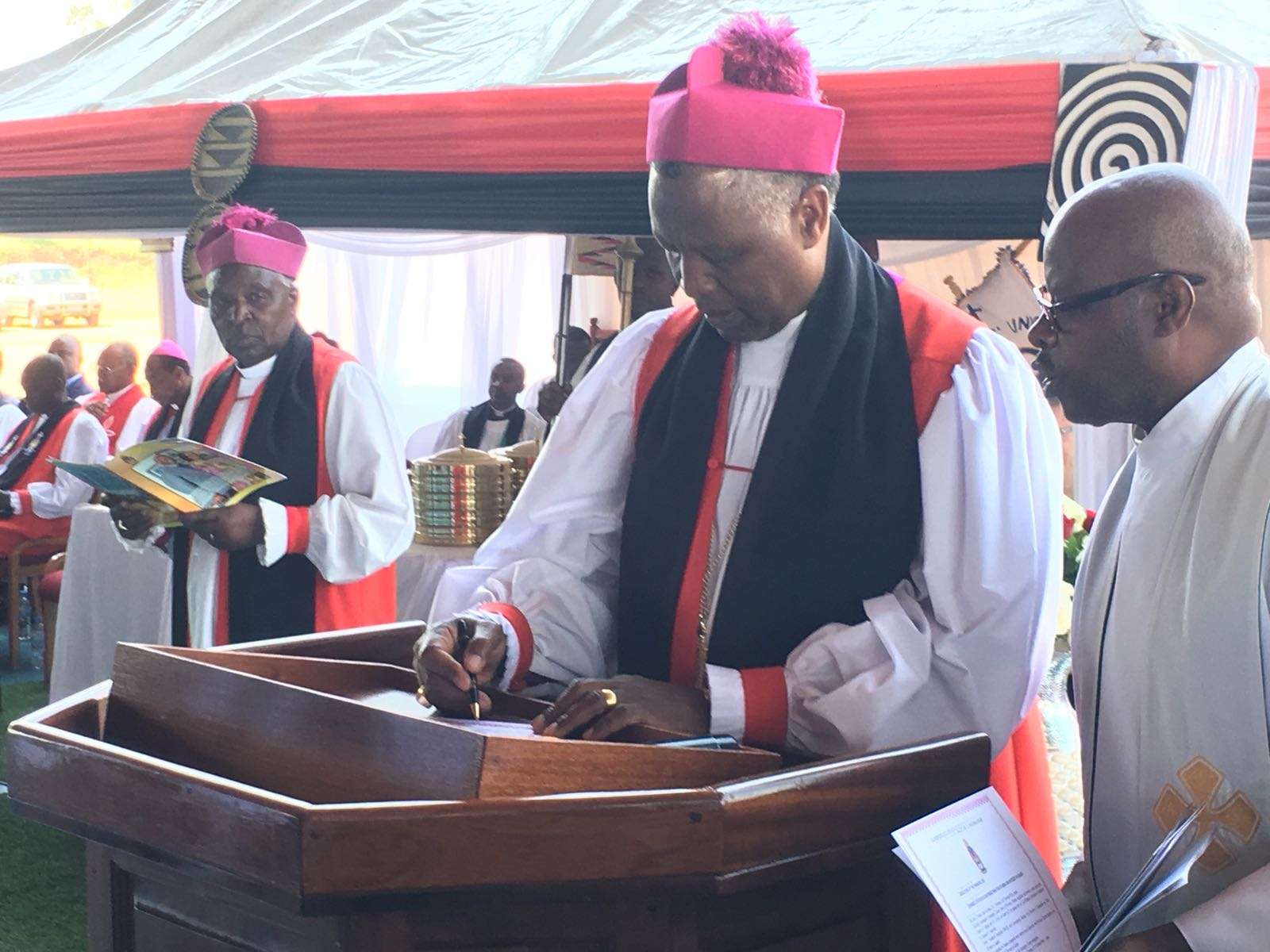
Archbishop Laurent Mbanda, Primate of the Anglican Church of Rwanda, who chairs the Gafcon primates’ council, pictured at his enthronement as primate in 2018
Anglican Archives
Members of the Global Anglican Future Conference said they no longer recognise the Archbishop of Canterbury as a unifying figure and rejected the other ‘instruments of communion’.
Conservative Anglican churches announced plans to break away from the worldwide Anglican Communion following the appointment of Dame Sarah Mullally as Archbishop of Canterbury.
The Global Anglican Future Conference (Gafcon), whose member churches comprise the majority of Anglicans in Africa as well as parts of Asia and the Americas, rejected Mullally after the King approved her appointment on 3 October, citing objections to women’s leadership in the Church.
Last week, Gafcon members said they no longer recognise the Archbishop of Canterbury as a unifying figure and rejected the Anglican Communion’s other “instruments of communion”: the Lambeth Conference, which meets every 10 years with all the bishops from all over the world, the Anglican Consultative Council (ACC) and the Primates Meeting.
At a meeting at the International Christian Teachers Conference Centre in Nairobi on 16 October, led by Archbishop Laurent Mbanda, Primate of the Anglican Church of Rwanda, who chairs the Gafcon primates’ council, the groups’ leaders restated their opposition to Mullally’s appointment and their intention to separate themselves from the Church of England.
Part of this process will involve changes to the liturgy to accommodate only male episcopacy. The Tablet also understands that the group began arrangements to enthrone Archbishop Ndakuba Henry, the Primate of the Church of Nigeria, as head of the movement. Nigeria is the largest Anglican province in Africa, with an estimated 18-22 million members.
In a statement referring to the group’s foundation in Jerusalem in 2008 in response to what it called “the abandonment of the scriptures” by other Anglican leaders, the Gafcon leaders said they met in Nairobi “to fulfil our mandate to reform the Anglican Communion” after “prayerfully advancing towards a future for faithful Anglicans, where the Bible is restored to the heart of the Communion”.
They said the Communion should have “only one foundation of communion, namely the Holy Bible”, rejecting the “instruments of communion” which they said “have failed to uphold the doctrine and discipline of the Anglican Communion”.
“We cannot continue to have communion with those who advocate the revisionist agenda, which has abandoned the inerrant word of God as the final authority and overturned Resolution 1.10, of the 1998 Lambeth Conference.”
Resolution 1.10 of the 1998 conference banned same-sex marriage. Bishops at the 2022 Lambeth Conference refused to reaffirm it, instead acknowledging “disagreement and a plurality of views on the relationship between human dignity and human sexuality” in a “Call on Human Dignity”.
Gafcon’s statement said it had “re-ordered the Anglican Communion by restoring its original structure as a fellowship of autonomous provinces bound together by the Formularies of the Reformation, as reflected at the first Lambeth Conference in 1867”, calling this the “Global Anglican Communion”.
It continued: “Provinces of the Global Anglican Communion shall not participate in meetings called by the Archbishop of Canterbury, including the ACC, and shall not make any monetary contribution to the ACC, nor receive any monetary contribution from the ACC or its networks.
“Provinces, which have yet to do so, are encouraged to amend their constitution to remove any reference to being in communion with the See of Canterbury and the Church of England.
“To be a member of the Global Anglican Communion, a province or a diocese must assent to the Jerusalem Declaration of 2008, the contemporary standard for Anglican identity.”
The statement announced plans to form a Council of Primates to elect a primus inter paris chairman, and to establish the new body formally at the G26 Bishops Conference in Abuja on 3-6 March 2026.
Bishop Anthony Poggo, the secretary general of the Anglican Communion, said divisions between Anglicans “require urgent attention and repair, by means of every instrument available to us”.
In a pastoral letter to Anglican churches on 17 October, Poggo urged them to consider the “Nairobi-Cairo Proposals” for reforms to the Anglican Communion published in December 2024. These include structural changes to the “to account for changes of the last century” and to encourage “a maximal sharing in leadership”.
“The one Church is ever reforming, which means that no institution, meeting, network or association of Christians is static,” said Poggo, a South Sudanese prelate who has served as secretary general since 2022.
“Our life of faithfulness is based in prayer, daily self-renunciation, repentance, and conversion, so that we may receive the mind of Christ and his Spirit, in accordance with holy Scripture. By this pattern of dependence on God and mutual submission to one another, God raises up a faithful, humble, obedient people for his praise, a people capable of taking counsel, making decisions, and sharing the Good News with the world.”
He urged all churches to send representatives to next year’s ACC meeting in Belfast. “Those who are present are the ones who shape the outcomes and resolutions of meetings,” he said.
In an open letter the same day reflecting on her appointment, Archbishop-designate Mullally acknowledged that the Church of England’s decision to allow blessings for same-sex couples was disputed and that “these are matters of deep theological conviction for many across our Communion”.
“I remain committed to listening with humility, and travelling together to the highest degree possible, as we continue to discern the truth of God and to make room for one another,” she said, promoting the Nairobi-Cairo Proposals’ “vision of Anglican life together that, rather than expecting a structural or theological uniformity, envisions space for confessional and geographical groupings set within the shared life of the Instruments of Communion”.
The Church of Ireland, which will host the Belfast meeting, issued a statement on Monday affirming its commitment to communion with the Church of England as defined in the “Preamble and Declaration” adopted in 1871 when it was disestablished. It also asserted that the Church of Ireland “recognises no other body” as the Anglican Communion besides that defined by the Archbishop of Canterbury, the Lambeth Conference, the Primates’ Meeting and the ACC.
“We do not suggest that the Anglican Communion as it has existed in history and continues to exist today is a perfect organisation,” said the statement, issued by the Anglican Archbishop of Armagh and Primate of All Ireland John McDowell and the Anglican Archbishop of Dublin and Primate of Ireland Michael Jackson.
“It is inevitable that those who hold to the Anglican theological method involving Scripture, Tradition and Reason, and working out our discipleship in autonomous but interdependent provinces will not agree on everything,” it said.
“However, praying always for the guidance of the Holy Spirit, we are committed to studying the Scriptures and learning from the insights of the past together with our fellow Anglicans, in communion, around the world.”
Vatican congratulates Mullally as world responds to new archbishop
Safety first – safeguarding and the new Archbishop of Canterbury
Stay updated — add us as a preferred news source on Google:


Help us keep The Tablet’s voice independent, clear and far-reaching.
Founded in 1840, The Tablet is the leading independent English-language Catholic weekly, celebrated for great writing, astute analysis, brilliant arts and books reviews and trustworthy reporting from correspondents in Britain, Ireland, Rome and across the world.
Independent, high-quality journalism is at the heart of what we do. The Tablet does not have deep pockets and we are not funded by rich donors. If you appreciate our work please consider supporting The Tablet’s Development Fund. It only takes a moment and you can cancel at any time.
- Support with £5 per month
- Support with £10 per month
- Support with other amount.

MOST READ ARTICLES
-
1
Pope Leo diagnosed with lung cancer after operation
-
2
Battling confession fatigue
-
3
The Tablet Lecture 2026: Keeping the dream of peace alive
-
4
Vatican confirms Pope’s Latin America travel plans despite operation
-
5
Under endless skies
-
6
Nicaraguan bishops visit Rome as Ortega regime tightens grip
FROM THE EDITOR'S DESK