News Briefing: Church in the World


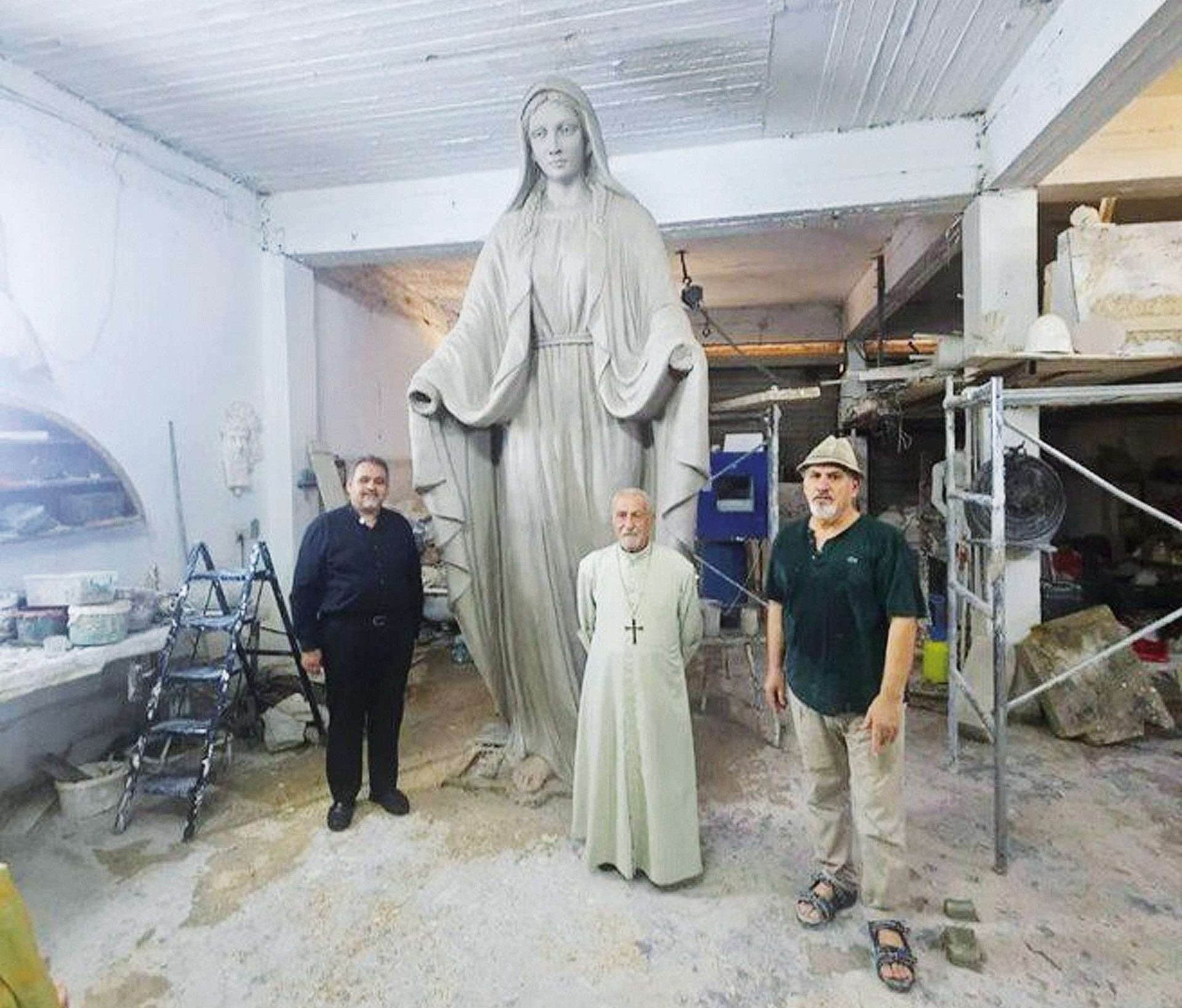
The Shrine of Our Lady of the Sapna Valley in the northern Iraqi village of Inishke will feature a 59-foot statue Mary and the child Jesus.
Fr Samir Khoury / X
Archbishop Timothy Broglio, who leads the Archdiocese for the Military Services of the United States, called for “reconciliation, dialogue, and rebuilding a sense of our common humanity” in a homily in Washington, DC on 11 September.
The afternoon Mass he celebrated in the Crypt Church of the Basilica of the National Shrine of the Immaculate Conception marked the twenty-fifth anniversary of the 9/11 terrorist attacks that killed nearly 3,000 people in 2001.
Other Masses commemorating the day included a vigil Mass at St Patrick’s Cathedral in New York on 10 September and a “Red, White and Blue Mass” at the Cathedral of St Catharine of Siena in Allentown, Pennsylvania, on 11 September.
The Mass in Allentown began at 8:46 a.m., the moment when American Airlines Flight 11 hit the World Trade Centre’s North Tower in New York City. Bishop Mark L. Bartchak of Altoona-Johnstown, Pennsylvania, joined other faith leaders at a ceremony at the Flight 93 National Memorial near Shanksville.
Prior to the Mass with Broglio, the national shrine rang a large bell at 9:37 a.m., commemorating the moment when American Airlines Flight 77 struck the Pentagon.
Sr Mary Haddad RSM, president and CEO of the US Catholic Health Association, said she is worried about the prospect of people losing health care coverage in the wake of federal Medicaid cuts.
Speaking to the specialist outlet Chief Healthcare Executive last week, Haddad discussed the cuts in Medicaid programmes, the rise in uninsured patients seen a Catholic hospitals, and the financial toll on hospitals, as well as the prospect of reduced services.
“These cuts in HR 1 smacked at the very heart of what we’re about,” Haddad said, referring to a sweeping tax and spending package that President Donald Trump signed into law in July 2025.
“And so we continue to work with our members to see how they’re trying to mitigate some of the impact, financial impact this is going to have, and how we’ll continue to serve the people in the communities where we’re present,” Haddad said. “I would say it’s getting worse as we get closer to ‘D-Day’ here, that we begin to feel the dramatic impact of the increase of uncompensated care.”
Haddad said the Medicaid cuts will have a broad impact, but added that they will be especially harmful to people with lower incomes.
A federal judge ordered the state of Illinois not to enforce a physician-assisted suicide law on the Archdiocese of Chicago and a group of Catholic religious sisters while their lawsuit is pending.
The Catholic plaintiffs filed their lawsuit on 3 September arguing that the law, which took effect on 12 September, infringes on their religious liberty. Following the ruling on 11 September, Cardinal Blase Cupich of Chicago said the law should be struck down “permanently”.
Cupich said: “I welcome this decision of the court that stays the enforcement of the provisions of the Illinois End-of-Life Options for Terminally Ill Patients Act that require healthcare providers, against their conscience, to participate in assisted suicide by compelling them to inform patients of the ‘benefits’ of suicide and their ‘right’ to kill themselves, and also help them qualify for lethal drugs, or pass them along to someone willing to help them obtain those drugs. These obligations violate core constitutional protections of freedom of speech and religion.”
He continued: “To be clear, the Church’s objection to this statute is not an attempt to impose Catholic teaching on non-Catholics; it is an effort to stop the state from compelling Catholic health care providers to violate their conscience.”
The Pope has decreed that a Jubilee Year for Our Lady of Guadalupe will start in Mexico on 12 October, marking the fiftieth anniversary of the dedication of the Basilica of Our Lady of Guadalupe in Tepayac, Mexico. The Archbishop of Mexico Cardinal Carlos Aguiar Retes announced the news “with profound joy and gratitude”.
A plenary indulgence will be granted to pilgrims to the basilica, which opened nearly 50 years ago to replace the original basilica built in 1709. This had become too small for the number of pilgrims to the shrine of Our Lady of Guadalupe and was unstable due to subsidence and earthquake damage.
The Diocese of Vinh in Vietnam suspended a 50-year-old social activist priest from ministry for publicly attacking and defaming his bishop on social media. The move follows a penal canonical process against Fr Anthony Dang Huu Nam.
He is accused of violating canon law by using social media to provoke “opposition, hatred and disobedience” towards the authority of Bishop Alphonsus Nguyen Huu Long of Vinh in central Vietnam. Fr Nam previously faced a temporary suspension in 2020 after clashing with the diocesan leadership over some of his homilies focusing on social and political issues.
An outspoken advocate for greater environmental protection, he led the campaign against the Taiwanese-run Formosa steel company which is accused of discharging toxic waste into Vietnam’s sea, seriously polluting the marine environment and damaging livelihoods. He has been subject to a number of death threats.
The Chaldean village of Inishke is planning to build the largest Marian shrine in Iraq. It will feature a 59-foot (18 metre) statue of Our Lady of the Sapna Valley, whose base will contain a chapel and prayer space where pilgrims may light candles.
Sculpted by Thabit Mikhail, the statue will depict Mary and the child Jesus with Middle Eastern features, while Mary’s hair will hang in two plaits, representing Iraqi mothers and grandmothers. The project is financed by people from Inishke in northern Iraq and around the world, and has been in development for more than a decade.
Catholic legislators in Zimbabwe urged parliament to put in place measures to ensure the responsible use of artificial intelligence for the strengthening of governance and support for development.
With backing from the bishops’ conference, the legislators hope to shape Zimbabwe’s AI policy. The country is yet to enact legislation relating to AI and has in recent months sought to set out industry policy that will affect all public sectors.
A meeting under the banner of the International Catholic Legislators Network last week attended by the speaker of parliament discussed “human dignity and artificial intelligence, its challenges, chances and control”. Zimbabwe is one of several African countries grappling with the rise of artificial intelligence and striving to understand the ethical use of the fast-developing technology.
Catholic legislators are expected to lead the drive towards “sound legislation that should encourage scientific and technological creativity while safeguarding fundamental human rights and freedoms,” as Pope Leo said in a message read to the International Catholic Legislators Network. He told them that “your task is not to hinder innovation but to guide it wisely”.
A 58-year-old Zimbabwean priest reported missing was found in the mortuary of a hospital, according to the Archdiocese of Harare. The body of Fr Regis Chikuni was found at Parirenyatwa Hospital, Harare. His disappearance had prompted the archdiocese to appeal for prayers and report the incident to the police.
Religions and traditional leaders from the English-speaking Northwest and Southwest regions of Cameroon have given the government a “strategic road map for peace” in response to Pope Leo XIV’s appeal for peace during his visit to central Africa in April.
The Bishop of Buea, Michael Bibi handed the proposals to the prime minister of Cameroon, Joseph Dion Ngute on 7 September. “We recognised that it was necessary for traditional and religious authorities to work together to see how justice, peace, reconciliation and forgiveness can be restored to our communities,” Bishop Bibi said shortly after the meeting.
Among other things, the document proposes the freeing of separatist leaders who have been detained in connection with the crisis, the demilitarisation of the two Anglophone regions, and an all-inclusive dialogue that should involve separatists at home and abroad.
Bishops also committed to carry the message of reconciliation, forgiveness and peace to their congregations, even as traditional leaders said they would be doing the same in their communities.
Pope Leo XIV urgednearly 4,000 Catholic youths from 16 African countries attending the first West African Youth Day (WAYD) to become “artisans of peace” in a region plagued by violence and instability.
In a video message for those attending the event – whose theme was “Take Courage” – in Accra, Ghana, Pope Leo XIV said: “At a time when so many crises seem to darken your horizon, I wish to encourage you to move forward without losing hope,” he said.
“Be builders of bridges between peoples, cultures, and religions. Through your words and actions, send a strong message to our world, riven by wars and conflicts of all kinds.”
Archbishop Julien Kaboré, the apostolic nuncio to Ghana, reinforced this message, declaring: “You are not a sacrificed generation.” He described young people as assets needed immediately by the Church.
The Ghanaian priest Fr Anthony Amponsah Afriyie challenged participants to use social media for evangelisation rather than chasing popularity, while the vice president of Ghana Professor Naana Jane Opoku-Agyemang urged participants to “never forget the difference you can make” and to establish relationships that go beyond national, ethnic, linguistic and religious boundaries.
“You have also come here to build friendships across borders. That is very important because, ultimately, West African integration will depend on this also,” she said.
Pope Leo XIV named Mgr Mario León Dorado OMI the coadjutor archbishop for Rabat in Morocco to succeed Cardinal Cristóbal López Romero, who stepped back following allegations of sexual abuse.
The cardinal denies the accusations of inappropriate behaviour by several women but suspended his duties on 7 July while a Vatican inquiry is conducted. Two of at least five women accusers have met with a Vatican inquiry team sent to Rabat last month, AFP news agency reported.
Mgr Mario León Dorado OMI, apostolic prefect of Laâyoune-Sahara in Western Sahara, was made the apostolic administrator on 1 August. Lopez Romero, 74, welcomed last week’s appointment, saying in a statement he had asked several years ago for a coadjutor, who will automatically succeed to the diocese on his resignation.
“It is with joy, but also with ‘fear and trembling’, that I receive this nomination,” said Mgr Dorado, 52, who has spent almost 25 years as a missionary in Western Sahara.
The Spanish Bishops’ Conference launched new resources for catechists, including a course to prepare children who are not baptised but wish to make their first Holy Communion, so they can take both sacraments in a single ceremony.
The bishops’ resources refer to the course in a video where a fictional mother discusses their unbaptised child’s desire to make their first Holy Communion. This reflects a situation that is increasingly common in Spain, according to the bishops’ conference’s Commission for Evangelisation. The commission has also written a guide for catechists titled “Jesus is the Lord”.
France’s ministry for culture has added the torchlight procession in the Marian shrine of Lourdes to its list of intangible cultural heritage. The procession, which dates back to 1863, takes place every evening at 9 p.m. from April to November. Up to 10,000 pilgrims carrying candles process from the grotto to the Rosary Square, saying the Rosary and chanting the Lourdes hymn Immaculate Mary.
Curriculum Vitaes that mention a job candidate’s religion – or lack of religious belief – can lower their chances of obtaining an interview, according to research from Ghent University in Belgium.
An examination of 708 applications found that Christians face the most disapproval, followed by atheists, and then Muslims. Researchers said: “No one specific religion or non-religious position is penalised, but the fact a recruiter can attribute one to the candidate at all.” The research also found that the worst fact to mention is volunteering at a church or mosque.
“Recruiters find openly Christian and Muslim candidates slightly more honest, pleasant and thorough,” the researchers said. But they found that recruiters expect their colleagues or clients would be less keen to work with Christians or Muslims, seeing their affiliation as a sign of distance from the majority group. “Recruiters prefer not to see religion in the workplace”, the university concluded.
The bishops of Bosnia and Herzegovina criticised “practices such as outvoting smaller constituent peoples, vote-buying [and] political clientelism” in a message issued before the country’s general election on 4 October. “All those who seek political trust in elections are rightly expected to serve the common good responsibly. Political power is not an end in itself, nor should it be subordinated to personal or party interests”, the bishops said in the statement.
On 11 September, Pope Leo sent a telegram to the Chief Rabbi of Rome to mark the feasts of Rosh Ha-Shanah, Yom Kippur and Sukkot. “I wish to extend to you and to the entire beloved Jewish community of Rome my most heartfelt best wishes on the occasion of the solemn festivals you are about to celebrate” the Pope wrote to Dr Riccardo Di Segni.
He hoped the festivals might prove “a source of abundant blessings from the most high and a reason for joy. May the arrival of Rosh Ha-Shanah bring with it the promise of a peaceful renewal and the sweetness of an auspicious beginning; may the sacred silence of Yom Kippur be an occasion for peace and inner light; may the festival of Sukkot be filled with joy, gratitude and fellowship,” he wrote.
Pope Leo granted additional space in Vatican City State to the Vatican archive and library. He has asked for a new building to be constructed whose costs will be borne by the Governorate of Vatican City State and the Apostolic Archive and Library.
In a chirograph dated 14 September, the Pope said that the new building was needed owing to the “considerable increase over recent decades in the Holy See’s bibliographic holdings”, as well as the increase in “the documentary production of its Institutions”.
Stay updated — add us as a preferred news source on Google:


Help us keep The Tablet’s voice independent, clear and far-reaching.
Founded in 1840, The Tablet is the leading independent English-language Catholic weekly, celebrated for great writing, astute analysis, brilliant arts and books reviews and trustworthy reporting from correspondents in Britain, Ireland, Rome and across the world.
Independent, high-quality journalism is at the heart of what we do. The Tablet does not have deep pockets and we are not funded by rich donors. If you appreciate our work please consider supporting The Tablet’s Development Fund. It only takes a moment and you can cancel at any time.
- Support with £5 per month
- Support with £10 per month
- Support with other amount.

MOST READ ARTICLES
-
1
Pope returns to Vatican after hospital discharge
-
2
Diverse schools that are 100 per cent Catholic
-
3
Under endless skies
-
4
Battling confession fatigue
-
5
Nigerian bishop scorns suggestion of running in presidential election
-
6
Schismatic Spanish nuns strip contents of convent before eviction
FROM THE EDITOR'S DESK


