‘Freedom of religion must mean freedom for all,’ says Eastern Orthodox leader on UK visit


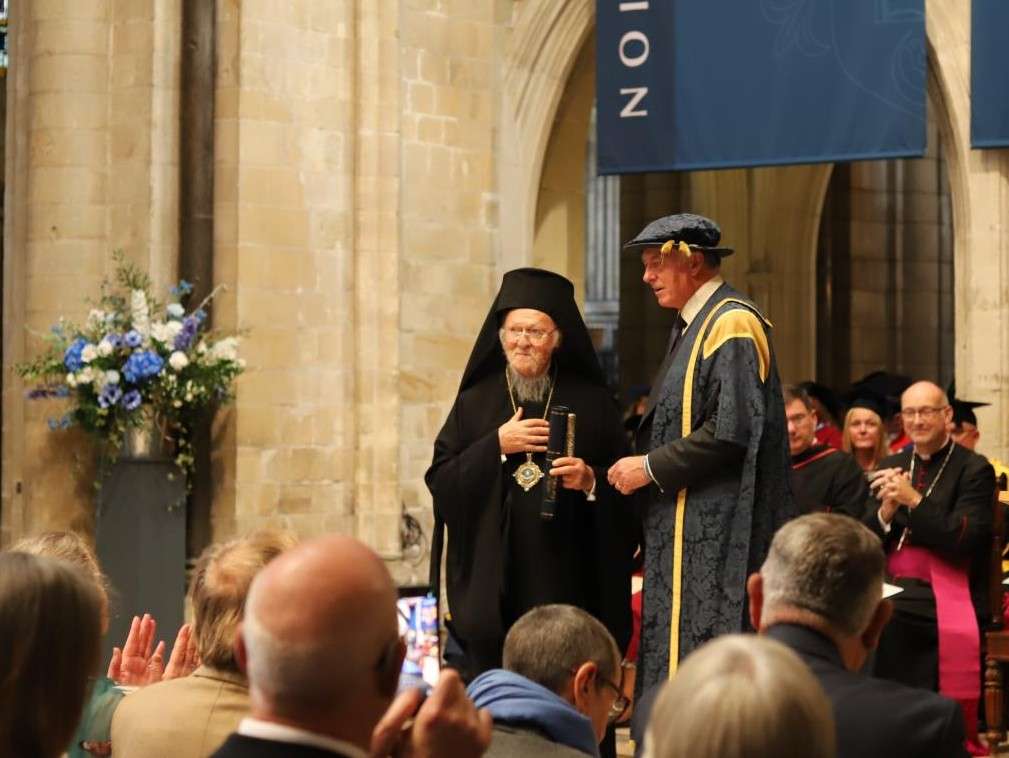
The Ecumenical Patriarch of Constantinople receiving his honorary doctorate from the University of Chichester.
University of Chichester
‘The Orthodox understanding of human dignity and communion can enter into dialogue with international law: the answer is not to retreat from the language of human rights but to deepen it.’
Interfaith dialogue seeking the common good rather than one-sided advantage can build peace more effectively than any number of diplomatic treaties, the Ecumenical Patriarch of Constantinople Bartholomew I told a gathering at the University of Oxford.
Patriarch Bartholomew, the “first among equals” recognised by 300 million Eastern Orthodox Christians, referenced Orthodox dialogue with the See of Rome, with the Anglican Communion, and with Jewish and Muslim leaders as a fruitful path to peace, speaking at the University Church of St Mary the Virgin at a lecture hosted by Oxford’s Centre for Law and Religion.
He arrived in the United Kingdom on Monday for a week-long visit, during which he will meet with King Charles III at Balmoral Castle, as well as receiving an honorary doctorate from the University of Chichester and visiting the Patriarchal Monastery of St John the Baptist in Essex.
Patriarch Bartholomew addressed Oxford students and staff on the subject of “religious liberty in contested ecosystems: law, religion and foreign policy in a new international order”.
Irene Tracey, the vice-chancellor of the university, said it was a great honour, privilege and delight to welcome Patriarch Bartholomew, praising his activism for the environment and interfaith and peace efforts.
She referenced his “remarkable contribution to church unity and building bridges between faiths” and said he has been the “most prominent religious leader to mainstream the protection of the environment”, known as the green patriarch.
Most importantly, she said his activism for nature is based on his conception of it as “interconnected and interdependent”, making it inseparable from his concern for human rights, religious freedom and cultural heritage, including for religious minorities in Turkey and the Middle East.
Patriarch Bartholomew said: “That so venerable and so English an institution should welcome the first-ranking hierarch of the East is a parable of the subject we are addressing today.”
Stressing the power of ecumenical collaboration, he said all people of faith are called to “build bridges of cooperation and solidarity” in “a world that is increasingly divided”.
“Faith has a pivotal role in mobilising institutions and societies. Living tradition of faith permits us to speak boldly about such contemporary challenges as human rights, religious freedom and the environment.”
Referencing Thomas Cranmer, who was executed in Oxford under the reign of Mary I, Patriarch Bartholomew asked: “What does a person owe to conscience, and what does society owe to a person who cannot give their conscience up?”
He said the deepest question any legal system must ask is: “What is a human being and what is owed to him? Law is not a way of exerting power, but a communion around people who remain free.”
He lamented that in the “new and disordered international order”, the “hard-won language of religious freedom” has become a “mere tool of statecraft, whereby states turn a blind eye at instances of persecution committed by their allies”.
“Faiths must reject claiming freedom for themselves alone, but call for freedom for all. Anything else is not religious liberty but its weaponisation.”
Patriarch Bartholomew condemned the fusing faith to national identity so as to exclude minorities and foreigners, as well as the deliberate use of religious identity as an instrument of war.
He expressed “profound sorrow” at the ongoing war against Ukraine, which Moscow frames as a “holy war”, and said “conflating the Church of Christ with the interests of anyone country” is a “heresy”.
“Any crime committed in the name of religion is a crime committed against religion itself,” he continued. “No faith is immune from such concerning trends.”
There is a need for greater religious literacy in order to oppose the instrumentalisation and weaponisation of religion in politics, he said.
He called for foreign policy to put endangered and vulnerable minorities of any faith at its centre, referencing in particular the Christians of Syria and Palestine: “The disappearance of Middle Eastern Christians would impoverish entire human family.”
Patriarch Bartholomew said that while Orthodoxy did not produce the language of subjective rights that came out of the Wars of Religion in the West, it must not be too quick to dismiss them.
“The Orthodox understanding of human dignity and communion can enter into dialogue with international law: the answer is not to retreat from the language of human rights but to deepen it.
“The human is an icon of God, in communion not isolation. Freedom is fulfilled in the ability to love one’s neighbour and stranger. To be a person is to exist in relation, like the Trinity, so rights without solidarity can leave people alone and isolated.”
He said this does not mean the Orthodox should be against human rights, referencing Charles Malik, one of the key drafters of the United Nations’ Universal Declaration of Human Rights, who was also a Greek Orthodox Lebanese Arab Christian and later the Lebanese representative to the UN, president of the Commission on Human Rights, and president of the UN General Assembly.
Malik pushed back against a purely individualistic, atomised conception of the human person, insisting that people are always embedded in relationships rather than being isolated units of pure autonomy.
“What we do for the Earth is intimately connected to international politics, human rights and world peace. They are not separate concerns competing for the world’s limited attention. The flourishing of all depends on the intricate web of life.”
He said the ecological crisis cannot be solved by a treaty or technology alone, as important that both are, but only by metanoia: a change of heart.
“The poor always suffer first. It is futile to ask humanity to limit its appetite by calculation alone: only love and humility can do that. We need to learn to care whether a stranger’s grandchild has access to clean water.
“None of us can afford to live as though the rest of the world did not exist. We need to recognise the universal dignity of all people.
“Human beings and the Earth are not raw materials for the ambitions of the powerful. They are not problems to be managed or possessions to be controlled, but a gift capable of transfiguration, like the water of Cana.”
Vatican advisory document develops eco-spirituality rejecting ‘despotic dominion’ over creation
Vatican calls for interfaith solidarity to address extremism and conflict
Pope commits to ‘fraternal dialogue’ for unity with Orthodox
Stay updated — add us as a preferred news source on Google:


Help us keep The Tablet’s voice independent, clear and far-reaching.
Founded in 1840, The Tablet is the leading independent English-language Catholic weekly, celebrated for great writing, astute analysis, brilliant arts and books reviews and trustworthy reporting from correspondents in Britain, Ireland, Rome and across the world.
Independent, high-quality journalism is at the heart of what we do. The Tablet does not have deep pockets and we are not funded by rich donors. If you appreciate our work please consider supporting The Tablet’s Development Fund. It only takes a moment and you can cancel at any time.
- Support with £5 per month
- Support with £10 per month
- Support with other amount.

MOST READ ARTICLES
-
1
Pope returns to Vatican after hospital discharge
-
2
Diverse schools that are 100 per cent Catholic
-
3
Under endless skies
-
4
Battling confession fatigue
-
5
Nigerian bishop scorns suggestion of running in presidential election
-
6
Schismatic Spanish nuns strip contents of convent before eviction
FROM THE EDITOR'S DESK


