Fossil fuel companies ‘complicit’ in increasing death and destruction from climate disasters, says Christian Aid


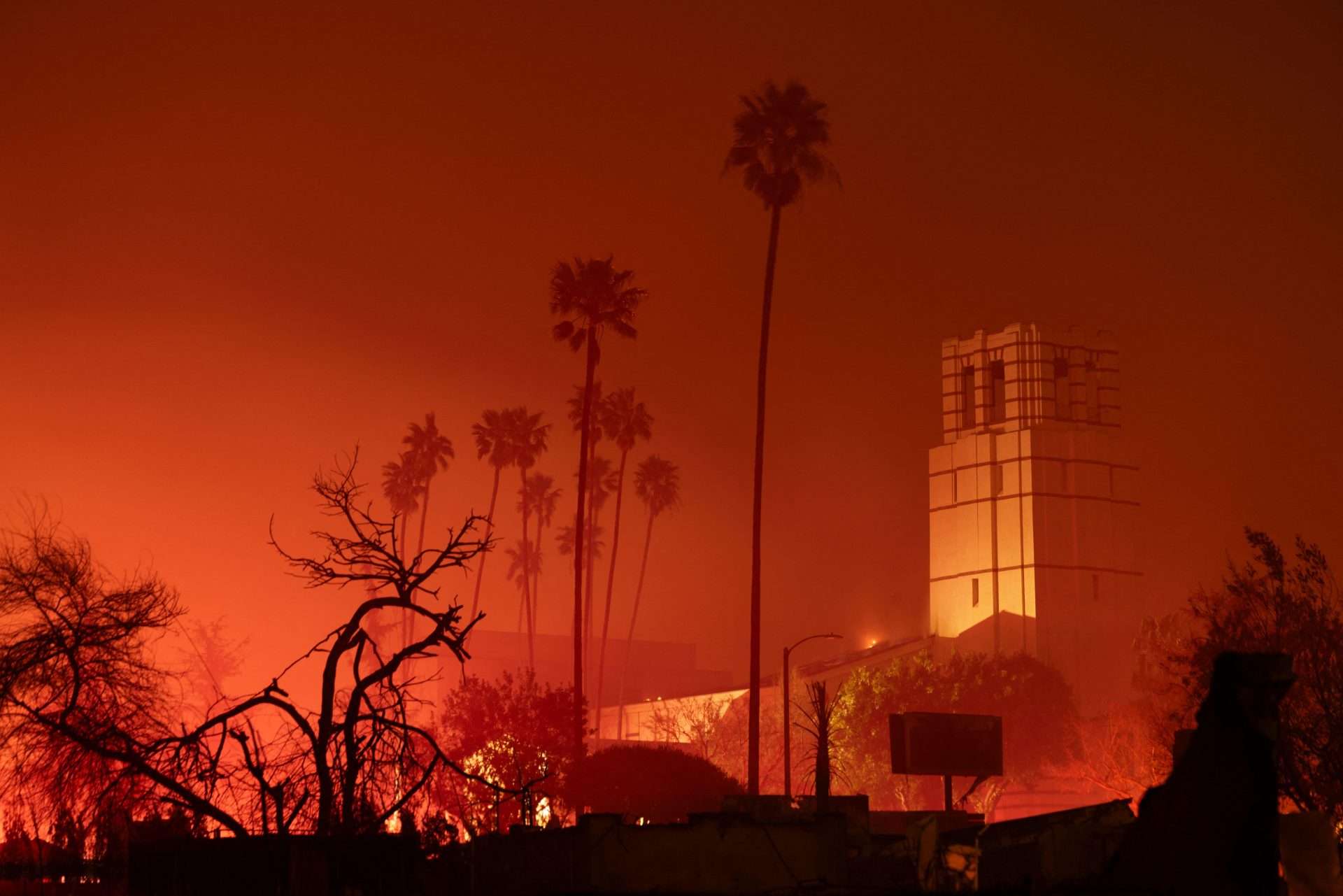
Altadena, California, USA - January 8, 2025: Aided by extreme Santa Ana wind conditions, the Eaton Fire engulfs a church in downtown Altadena.
Matt Gush, Alamy
‘In 2025, the intensity of extreme weather reached new heights: heatwaves pushing the limits of human adaptation, record-breaking hurricanes and typhoons overwhelming disaster response systems, and a brutal combination of extreme rainfall and severe droughts.’
The ten most financially costly climate disasters in 2025 each caused more than $1 billion in damage, with combined losses topping $122 billion, according to a new report released by ecumenical humanitarian charity Christian Aid, which provides aid during disasters and helps communities adapt to climate change.
The chief executive officer of Christian Aid, Patrick Watt, said, “The suffering caused by the climate crisis is a political choice. It is being driven by decisions to continue burning fossil fuels, to allow emissions to rise, and to break promises on climate finance. In 2026, world leaders must act – supporting communities already adapting at a local level, and providing the resources urgently needed to protect lives, land and livelihoods.”
The figures are calculated primarily using loss estimates published by insurance company Aon, and Christian Aid stressed that this means they are likely to be underestimates, with the real cost to people’s lives and livelihoods much higher.
Climate disasters in poorer countries, such as flooding in Nigeria and the Democratic Republic of Congo and droughts in West Asia, do not appear among the costliest disasters purely because the insurance coverage in these countries is much more limited.
The research found that wildfires in California alone caused more than $60 billion in damage and more than 400 deaths, which along with flooding in Texas and other disasters made the United States the country with the costliest climate damage.
This is partly because, as the wealthiest country and biggest historical fossil fuel emitter, it has more expensive infrastructure and more insurance coverage – even though the loss of life and livelihoods from climate disasters has been higher in poorer countries.
Watt said, “This transition to an economy powered by renewables is inevitable, but the critical challenge is whether it will move fast enough, and fairly enough, to protect the poorest people. Rich countries must do far more to finance the clean energy transition and to support communities to adapt to a changing climate.”
Cyclones and floods in Southeast Asia killed more than 1,750 people and caused $25 billion in losses, while floods in China displaced thousands and caused $11.7 billion in damage.
Brazil was affected by devastating drought, the Philippines by typhoons, and Bolivia, Peru, Colombia, and Ecuador by deadly floods.
Watt said, “These climate disasters are a warning of what lies ahead if we do not accelerate the transition away from fossil fuels. They also underline the urgent need for adaptation, particularly in the global South, where resources are stretched and people are especially vulnerable to climate shocks.
“People in the global South are already experiencing permanent loss and damage from a crisis they did little to cause. This is why it is vital that adequate resources are channelled into the Fund for Responding to Loss and Damage.”
The Fund for Responding to Loss and Damage is a part of the financial mechanism of the United Nations Framework Convenient on Climate Change that was started at COP28 in 2023 and exists to help vulnerable low-income nations respond to loss caused by extreme weather resulting from climate change.
Joe Ware and Oliver Pearce, the authors of the report, said, “Despite the mounting evidence of the damage caused by the continued reliance on fossil fuels, the world remains on a path of unchecked consumption.
“As we witness cities drying up, uncontrollable fires destroying homes, and tornadoes wiping out entire communities, the consequences of inaction are undeniable. With every year of delayed action, the losses continue to grow.
“New studies not only link greenhouse gas emissions to climate change, but also directly connect fossil fuel companies to specific, deadly weather events. 213 heatwaves this century have now been attributed to greenhouse gas pollution from major fossil fuel producers – individual oil, coal, and cement companies, as well as some countries.”
Ware and Pearce referred to a study published in scientific journal Nature in September 2025, which demonstrated that climate change made 213 heatwaves reported in the past twenty-five years more likely and more intense.
The researchers identified 180 major fossil fuel and cement producers that “substantially contributed” to the disasters and found that one quarter of these events would have been “virtually impossible” without climate change.
Ware and Pearce also referenced research from the Grantham Institute at Imperial College London, which found that climate change-driven heatwaves in summer 2025 led to an estimated 16,500 additional deaths compared to a world without fossil fuel-driven warming.
They concluded: “Water shortages have worsened, displacement is rising, and the cost of inaction continues to escalate. Without urgent emissions reduction, the price of inaction will only grow steeper, both financially and in human suffering.
“Fossil fuel companies, large and small, are complicit in the deaths and suffering caused by the disasters they help fuel. Yet, this same killing and destructive industry continues to receive billions in investments and public subsidy to accelerate expansion rather than limit it.”
Stay updated — add us as a preferred news source on Google:


Help us keep The Tablet’s voice independent, clear and far-reaching.
Founded in 1840, The Tablet is the leading independent English-language Catholic weekly, celebrated for great writing, astute analysis, brilliant arts and books reviews and trustworthy reporting from correspondents in Britain, Ireland, Rome and across the world.
Independent, high-quality journalism is at the heart of what we do. The Tablet does not have deep pockets and we are not funded by rich donors. If you appreciate our work please consider supporting The Tablet’s Development Fund. It only takes a moment and you can cancel at any time.
- Support with £5 per month
- Support with £10 per month
- Support with other amount.

MOST READ ARTICLES
-
1
Pope returns to Vatican after hospital discharge
-
2
Diverse schools that are 100 per cent Catholic
-
3
Under endless skies
-
4
Battling confession fatigue
-
5
Nigerian bishop scorns suggestion of running in presidential election
-
6
Schismatic Spanish nuns strip contents of convent before eviction
FROM THE EDITOR'S DESK


