Vespers at Westminster Cathedral celebrate Newman for Christian Unity Week


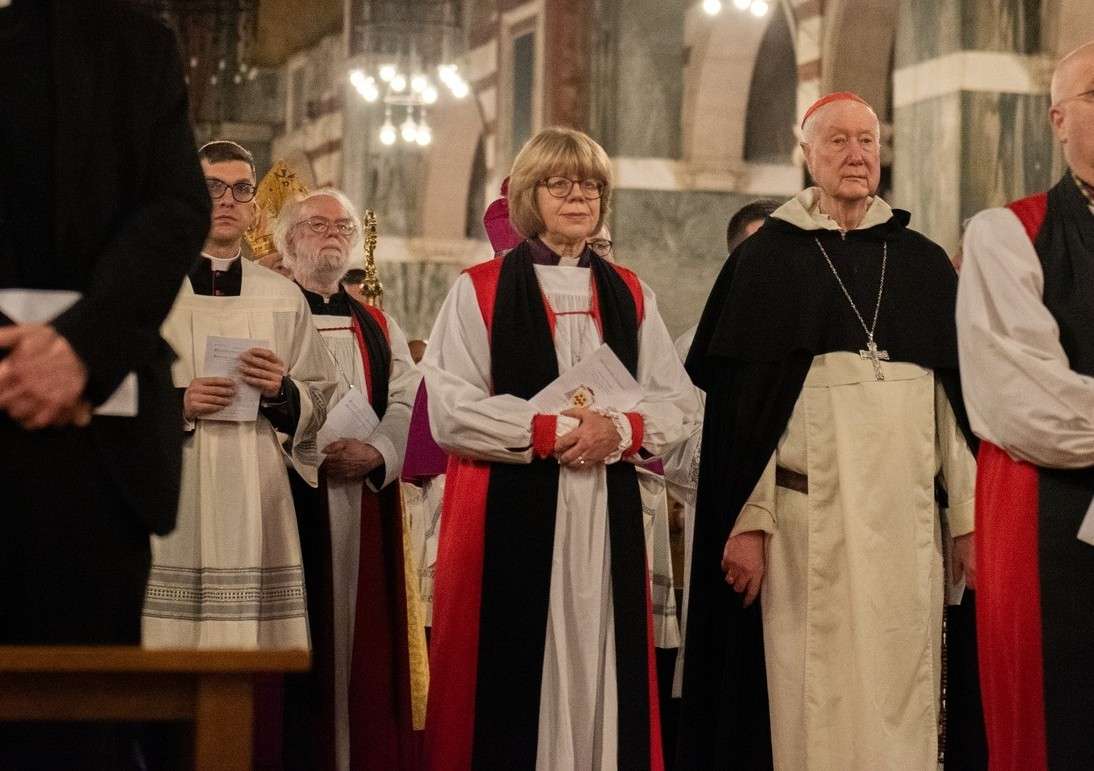
Former Archbishop of Canterbury Rowan Williams, Archbishop of Canterbury-elect Sarah Mullally, and Cardinal Timothy Radcliffe at the service at Westminster Cathedral.
Diocese of Westminster
St John Henry Newman teaches all Christians how to live intelligently in an unbroken tradition of teaching and living in the Body of Christ, said Rowan Williams.
Solemn Pontifical Vespers were celebrated at Westminster Cathedral on 20 January in thanksgiving for the proclamation of St John Henry Newman as a Doctor of the Church and to mark the Week of Prayer for Christian Unity, which takes place from 18 to 25 January.
The theme for the Week of Prayer for Christian Unity 2026 is “One hope, one calling”, drawn from Ephesians 4:4: “There is one body and one Spirit, just as you were called to the one hope of your calling.”
The service was presided by Cardinal-Archbishop of Westminster Vincent Nichols, who was joined by former Archbishop of Canterbury Rowan Williams, Archbishop of Canterbury-Elect Dame Sarah Mullally, the Archbishop of York Stephen Cottrell, and other ecumenical representatives and senior clergy, including some who were involved in the cause for Newman’s proclamation as Doctor of the Church.
St John Henry Newman (1801-1890), who was received into the Catholic Church from the Church of England in 1845 and is known for his contribution to theology (especially patristics), literature, and educational theory, was declared a Doctor of the Church and co-patron of Catholic education alongside St Thomas Aquinas by Pope Leo XIV on 1 November 2025.
Westminster Cathedral hosted the choir of St Paul’s Cathedral for the service, in which Newman’s hymns “Lead, Kindly Light” and “Praise to the Holiest” were sung and the “Prelude” and “Angel’s Farewell” from The Dream of Gerontius were played.
In the sermon, Lord Williams quoted Newman, who said: “My soul is like a burning glass – cold itself, it transmits heat to others.”
He said this feeling has also been expressed by other “manifestly great servants of God”, from John Wesley to St Theresa of Calcutta, “who have admitted their own chill or darkness, but have continued in their lives of sacrificial service because they know the kindling of grace comes from elsewhere.”
“If Newman’s soul felt like that, we can be sure it was warmed by other sacrifices and witnesses from outside. This is one of the paradoxes of sanctity: no one possesses holiness themselves alone.”
Lord Williams emphasised that holiness can take many forms: service to the abandoned and suffering, contemplation, clarity of insight, or excitement and adventurousness in understanding the faith.
Newman’s charism, for which he is celebrated as a Doctor of the Church, was, in the words of Matthew 13:52, to “bring forth out of his treasure things new and old”: to “enter into the sinews, the very breath and blood of the doctrinal traditions”, finding his way to “the inner workings, the inner sense of doctrine”.
Being declared Doctor of the Church recognises “not somebody who is a particularly clever theologian like a kind of posthumous Doctor of Divinity”, but “one who teaches us how to live intelligently in the Body of Christ”: “deep knowledge of God the Father in the Body of Christ, mediated by an unbroken tradition of teaching and living.”
Lord Williams said that Newman’s “singular genius” was to see doctrinal language as “a necessary epiphenomenon or overflow of the life in which the grace of the Holy Trinity was coming alive”: “the first Christians were so absorbed in living out the faith that they didn’t yet have the time or the need to stand back and reflect on how to speak about it.”
Newman understood Nicaea as “the culmination of a slow and painstaking search for words”. He was inspired by a nostalgia for the Early Church: “a world where there were no words to express the faith except active adoration”.
He knew that “The deeper we live in the life of the Trinity, the more eloquence we will find, but it is an eloquence that is sometimes best expressed by silence and reticence – another paradox of holiness.”
Lord Williams said that Newman was compelled and fascinated by the mystery of how we come to certainty and commitment. He knew that “Nobody is martyred for a syllogism, but conviction and commitment are real and come as our hearts are warmed from outside ourselves, by the self-gift of God.”
He understood “how deeply understanding and imagination go together. He saw the intellect not as a highly sophisticated organ for processing facts, the way we now see AI, but as an imaginative leap of the understanding into another world, in which our love is healed and completed.”
Lord Williams said Newman’s legacy defies straightforward characterisation. He could be called a “conservative” for his emphasis on the importance of “conserving the wisdom that has been received”, but he could also be called a “liberal” – albeit a word he disliked – for devoting his “thinking and imagining” to “a world set free from illusion, self-deceit, oppressive power, and trivial thinking and feeling.”
“So to whom does he belong? He belongs to Christ. He is a saint and a Doctor because of that belonging, secured by the Spirit in the place where both silence and speech make sense.”
Pope Leo XIV declares St John Henry Newman a Doctor of the Church
Pope declares Newman co-patron of Catholic education for ‘whole person’
St John Henry Newman and the cost of conscience
Stay updated — add us as a preferred news source on Google:


Help us keep The Tablet’s voice independent, clear and far-reaching.
Founded in 1840, The Tablet is the leading independent English-language Catholic weekly, celebrated for great writing, astute analysis, brilliant arts and books reviews and trustworthy reporting from correspondents in Britain, Ireland, Rome and across the world.
Independent, high-quality journalism is at the heart of what we do. The Tablet does not have deep pockets and we are not funded by rich donors. If you appreciate our work please consider supporting The Tablet’s Development Fund. It only takes a moment and you can cancel at any time.
- Support with £5 per month
- Support with £10 per month
- Support with other amount.

MOST READ ARTICLES
-
1
Pope returns to Vatican after hospital discharge
-
2
Diverse schools that are 100 per cent Catholic
-
3
Under endless skies
-
4
Battling confession fatigue
-
5
Nigerian bishop scorns suggestion of running in presidential election
-
6
Schismatic Spanish nuns strip contents of convent before eviction
FROM THE EDITOR'S DESK


