News Briefing: Church in the World


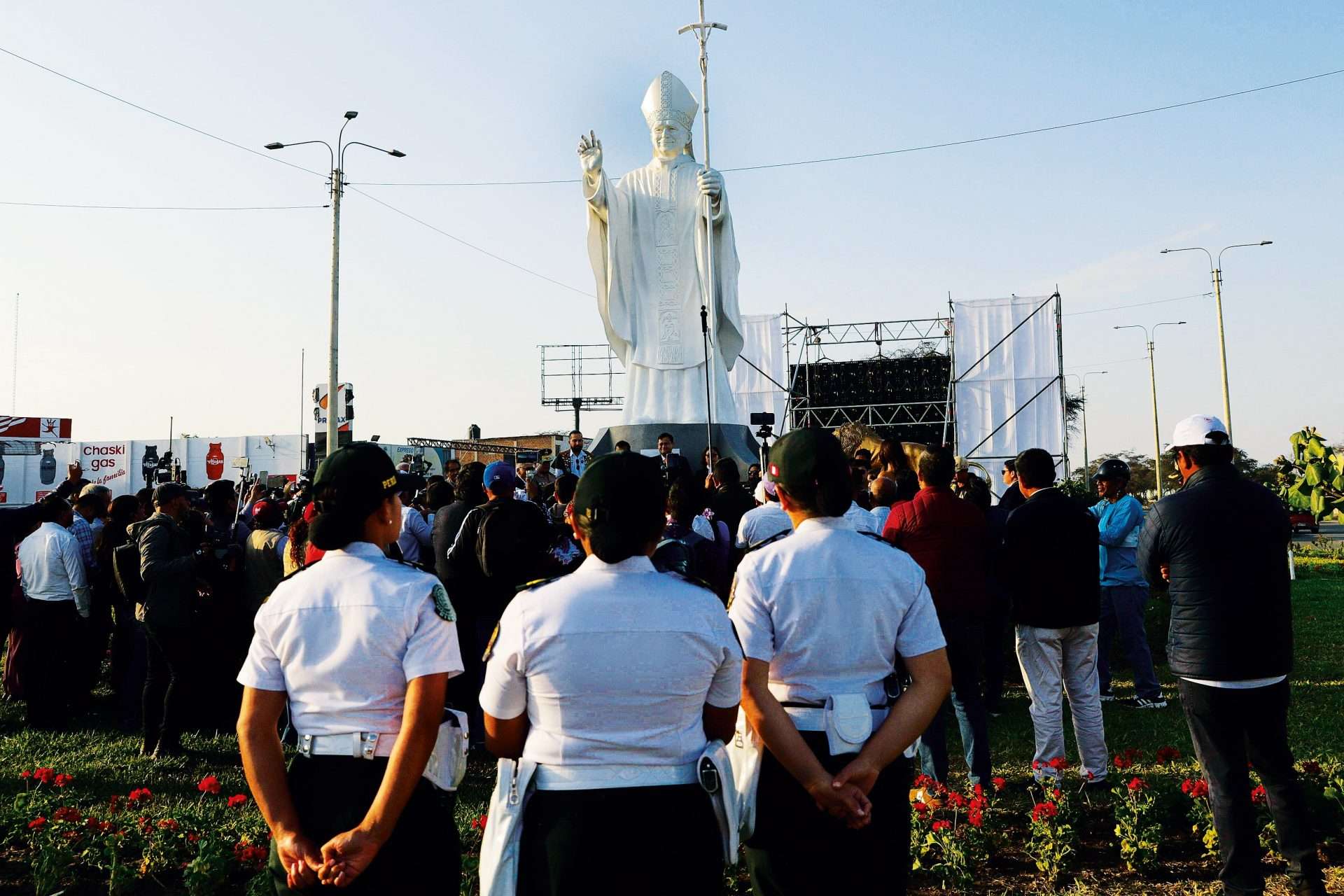
A five-metre-high fiberglass statue of Pope Leo XIV was unveiled in the city of Chiclayo in northern Peru where he was formerly bishop.
Manuel Medina, Associated Press / Alamy
More than 200 religious sites, including churches, mosques and Buddhist monasteries, have been damaged, destroyed or looted in Myanmar’s civil war since 2021. The data, published by a coalition of civil society organisations, corresponds to that of Catholic sources documenting the war damage suffered by religious communities.
“The main perpetrators of the destruction are the forces of the military junta, who have inflicted significant damage in the Sagaing and Magwe regions, as well as in Chin and Kayah states, through indiscriminate airstrikes, artillery, and drone attacks,” one source reported.
Myanmar’s bishops have demanded respect for the protection of places of worship required under international law. Catholic churches hit or damaged include Sacred Heart Church in Mindat, which was intended to be the cathedral for the new Diocese of Mindat and was bombed in February 2025, and St Patrick’s Cathedral in Banmaw, Kachin State, which caught fire in March 2025.
Besides the damage to religious communities, the violence has harmed over 400 health facilities while more than 240 educational institutions have been destroyed. Others have been occupied and converted into military bases.
The Catholic bishops of India mourned the 13 people killed in a bomb attack in Delhi. On the evening of 10 November, a suicide bomber blew up a car laden with explosives at a signal on a busy road close to a metro station and the Red Fort, a seventeenth-century monument built by the emperor Shah Jahan.
The Catholic Bishops’ Conference of India (CBCI) said “our thoughts and prayers are with all those who are experiencing immense pain at this time. We also pray for the speedy recovery of the injured.”
The bomber Dr Umar ul Nabi, an assistant professor in General Medicine, was allegedly part of a network plotting terror strikes. His purported accomplices were mostly fellow doctors, some serving at Al Falah University at Faridabad in northern Haryana state.
The bishops urged Catholics to be “vigilant and report any suspicious activity to the police without delay” following the attack. “Let us remain united as one community,” the CBCI statement said, “let us maintain peace and work together to ensure the safety and well-being of all citizens. Let us continue to pray for peace and security in our beloved nation.”
A priest from Argentina freed three Christian families from debt bondage in Pakistan. Fr Rico from the Order of St Elijah told the Catholic News Agency he had paid Muslim businessmen a sum equivalent to $1,700 for the families’ freedom. He freed 11 people in Pakistan with the assistance of a lay Spaniard who returned to Catholicism in 2024.
“These people were born into slavery. They had never known freedom,” the priest said. “They were not allowed to attend Christian services nor receive sacraments. On the very day of being released from bondage, I was able to give them the sacraments, including baptism. It was a day of dual liberation.”
Both men also freed nearly 200 Christians in Pakistan last year, five of whom were female sex slaves. They are launching a project called PaX meaning both “Peace” and “Pakistan Christendom” to help the freed slaves earn a living and lodge in a secure place where they can practise their faith without danger.
Fr Rico received a letter after his most recent visit to Pakistan from a convert who said his own family had beaten him. “They even broke the crucifix you had gifted me,” he said, explaining he had chosen to pray for them instead of fighting back. “I now deeply understand what it means to carry the cross of Our Lord as a Christian, and I take pride in this cross,” wrote the convert.
The Latin Patriarchate of Jerusalem reported that “pilgrims are slowly returning to the Holy Land, and though their numbers are still small compared to what we were used to, their presence is a sign of hope”.
A statement from the patriarchate described how “the joy on the faces of shop owners and locals says it all – a part of this land’s identity and spirit is coming back”. The Patriarch Cardinal Pierbattista Pizzaballa said pilgrimages are important for encounter “with the small Christian community that has suffered greatly in these years”.
Communities in the West Bank suffered continued violence from illegal settlers destroying property including olive groves. Last week, the UN human rights office (OHCHR) condemned increasing attacks on Palestinians and forcible displacement of thousands. It said that Israel’s assertion of sovereignty over the occupied West Bank and its annexation of parts of it were in breach of international law.
Occasional Israeli airstrikes continue in Gaza, where local health authorities said 260 people have died in attacks during the five weeks since the ceasefire between Israel and Hamas. Many Palestinians living in camps were flooded during heavy rains last weekend. While responding to the weather, the Holy Family parish issued a message saying: “It’s thunder and not bombing, finally a natural sound in Gaza.”
The Catholic bishops of Sudan and South Sudan said they were “deeply disturbed by the ongoing devastating conflicts and the dishonoured peace agreements in both nations, especially with the worsening situation in 2025”, in a statement from their joint conference.
They issued it after meeting in the South Sudanese city of Malakal last week to discuss current conflict and peace developments in the two countries under the theme “Building Peace, Healing Wounds and Strengthening Unity”.
They urged the warring parties in Sudan to implement the May 2023 Jeddah Declaration, which reaffirmed the need for dialogue and unity to alleviate the suffering of the Sudanese people. The also called for the full implementation of the 2018 Revitalised Agreement on the Resolution of the Conflict in South Sudan “to build trust among the people and begin a sincere dialogue”.
The UN issued a warning on 11 November that the power-sharing and security provisions in the agreement were failing. The bishops warned that “instead of pursuing dialogue, selfish interests have unleashed violence, aggravating humanitarian crises, community-based hatred, widespread displacement, the misappropriation of public funds, hunger, and the looming threat of famine”.
Catholic bishops in Kenya urged the government to pay all arrears owed to Church-run hospitals, as well as medical facilities run by other religious organisations and private enterprise, so they can continue to offer basic services.
The government incurred the debts through the National Hospital Insurance Fund (NHIF), which it has since changed to Social Health Assurance (SHA). The fund, a state corporation, provided health insurance coverage to citizens since 1966. The bishops said the hospital were unable to offer basic services due to delayed payments.
“The lingering inefficiencies of SHA will eventually cost us dearly,” warned the bishops in a statement on 13 November after their plenary meeting in Donum Dei Spirituality Centre in Karen, Nairobi. “We ask that the matter of huge [unpaid] NHIF dues be fast-tracked and paid by government. Many faith-based hospitals are on the brink of closing due to unpaid claims.”
Religious leaders in Malawi condemned a high court ruling that upheld a minor’s right to an abortion in the case of sexual abuse. On 28 October Judge Michael Tembo upheld an earlier ruling from a case brought by a 14-year-old girl denied an abortion at a public health facility after she was raped.
While local activists celebrated the ruling, a statement signed by the Malawi Conference of Catholic Bishops, the Malawi Council of Churches, the Evangelical Association of Malawi and the Muslim Association of Malawi warned that it set “a worrying precedent for the protection of both mothers and unborn children”.
They argued that “decisions of such magnitude, touching on fundamental moral and ethical principles must not rest solely in the opinion of a single judge but must reflect the conscience of the nation”, while insisting that they remained “aware of the hardships faced by women and girls”.
The statement claimed that “current laws already provide adequate protection for both mothers and unborn children” and any expansion of provision “would open the door to abortion on demand, which aligns with the long-term objectives of global pro-abortion movements”.
Terrorists killed around 20 people in a hospital run by the Little Sisters of the Presentation in eastern Democratic Republic of Congo. Fighters from the Allied Democratic Forces (ADF), allied to the Islamic State, attacked the health centre operated by the Diocese of Butembo-Beni in the town of Byambwe, North Kivu.
Fr Giovanni Piumatti, an Italian missionary who worked in the diocese, told Vatican News that they killed people in and around the hospital and set it on fire. He condemned the world’s “shameful silence” about ADF atrocities over the past three years.
Two seminarians kidnapped in southern Nigeria in July were released after a third died while being held hostage. The Diocese of Auchi in Edo State announced the release of two of the students – Japhet Jesse and Joshua Aleobua – abducted from its minor seminary, but said the third, Emmanuel Alabi, died “in the course of the ordeal”.
Bishop Gabriel Dunia of Auchi “expressed his deep pain and sorrow over the loss of the young seminarian and has called on security agencies to intensify efforts toward protecting the lives and property of all citizens”, said a statement on 4 November. “The Diocese of Auchi remains committed to the values of faith, peace, and justice, trusting in God’s infinite mercy to bring comfort to the bereaved family, the seminary community, and all those affected by this tragedy.”
Bishop Dunia “cautioned political leaders against turning a blind eye on the worsening insecurity situation in the nation, urging them instead to prioritise the safety and well-being of the people over political ambitions ahead of the 2027 elections”, the statement said.
The Anglican Church of Nigeria began preparations for the first meeting of the leaders of the Global Anglican Communion in Abuja planned for 3-6 March 2026.
The Nigerian primate Archbishop Henry Ndakuba is expected to emerge as the leader of the movement which declared a break with the Anglican Communion after the appointment of Dame Sarah Mullally as Archbishop of Canterbury in October.
A committee on new liturgy and robes preparing for the Abuja meeting said it was “working to set a standard and Bible-based liturgy solely based on reordering the Anglican Communion on the recorded words of God in the Bible”. A senior clergyman who did not want to be named told The Tablet that “God who created men and women did not make a mistake in ordering only male priests. The Bible is clear and unambiguous about this, and we are not going to compromise about this.”
The secretariat of the Global Anglican Future Conference (Gafcon) issued invitations to Anglican bishops around the world to attend the meeting in Abuja, while seeking funds to cover the travel costs of those wishing to attend.
Gafcon’s chairman Archbishop Laurent Mbanda of the Anglican Church of Rwanda visited Nigeria last week to inspect the preparations. A training conference is scheduled to run ahead of the main conference from 28 February to 6 March.
Ghana’s bishops said ethnic politics have caused harm and divisions in the country and called for urgent dialogue among communities affected by “political polarisation” that “threatens the common good”.
Parts of the country have suffered ethnic conflicts, with the Ghana Red Cross reporting that 31 people were killed during clashes in the country’s north-west in August, while tens of thousands of others fled to neighbouring countries.
“The increasing ethnocentrism in our nation grieves the heart of God who created all people in his own image,” the bishops said in a statement after their 7-14 November plenary. “Historical instances, both in Ghana and across our continent, where ethnic sentiments were weaponised with devastating and genocidal consequences must never be repeated.”
They suggested that politicians are using ethnicity to divide communities, noting that such sentiments were voiced during disputed national polls and post-election violence.
“These crises reveal that peace cannot be assumed but must be actively cultivated through inclusive engagement, mediation and collaboration among traditional authorities, government institutions, civil society, and religious bodies,” the bishops added, urging “political leaders, traditional authorities, and media personalities, to exercise maximum restraint in speech”.
The Pope established the canonical legal status of the Apostleship of the Sea as the body responsible for the Church’s care for “people of the sea”.
In a chirograph dated 6 November and published on 13 November, he confirmed its status and approved its statutes “with the fervent desire that the spiritual care of the Church in the field of maritime pastoral care may continue with enthusiasm and generosity”.
The Apostleship of the Sea, which now operates under the name Stella Maris, has worked with Church approval since the 1920s and is now a dependency of the Dicastery for Promoting Integral Human Development, but did not hitherto have its own canonical legal personality.
The Kolping Society, the international Catholic social and development organisation founded in Cologne by Bl Adolph Kolping in 1850, said members of the Alternative für Deutschland (AfD) could not participate in its work.
The German section of the society approved a statute change to allow the exclusion of members who express in word and deed “that they hold beliefs that are incompatible with the values of Kolping Germany or contradict the mission statement adopted by the National Convention”, with AfD membership classified as such.
“Kolping Germany stands for an open, supportive and humane society,” said Ursula Groden-Kranich, the outgoing federal chairwoman of the association. “Anyone who takes human dignity and the basic values of the Gospel seriously cannot support policies that marginalise, divide and stir up fear.”
Kolping is the latest Catholic organisation in Germany to distance itself from the AfD. Other groups to make similar statements include the League of German Catholic Youth (BDKJ), the Families Union of Catholics and the two leading Catholic women’s organisations.
At their spring assembly the German bishops said: “Right-wing extremist parties and those that run rampant on the fringes of this ideology [cannot] be a place of political activity for Christians and are also not electable. Moreover, the dissemination of right-wing extremist slogans – including racism and anti-Semitism in particular – is incompatible with full-time or voluntary service in the church.”
A Spanish bishop addressed an open letter to the singer Rosalia in response to the Catholic themes and symbols in her album Lux.
“You appear to experience art as a spiritual journey, where creation is a form of pilgrimage towards the transcendent” wrote Bishop Xabier Gómez of Sant Feliu de Llobregat, the Catalan diocese where the singer’s family resides. “Without loosing your moorings, reaching the port you long for will not be easy,” added Gómez, a Dominican who has led the diocese since October 2024.
He said he found the lyrics of the 33-year-old singer, who is not baptised, “disconcerting” but that they also “opened” him up to a possible dialogue on “the complexity of human experience”.
Sixty-two Spanish priests received awards for the help they gave their neighbourhoods in Valencia following severe flooding in 2024. At the “Alter Christus” prize-giving ceremony, the Archbishop of Valencia Enrique Benavent said: “The greatness of the priestly vocations is living it out as a surrender of one’s life. That is how we can be ‘other Christs’ for our world.”
During the event held at the school of Nuestra Señora del Socorro (Our Lady of Succour) in Benetússer, which was affected by the flooding, Archbishop Benavent added: “The greatness of the priestly ministry is found in the humility with which a priest lives it out. And when, amid this humility, a priest does not lose his joy, then he is living out his ministry authentically, as he only seeks to serve the Lord.”
The prize-giving organised by Regnum Christi, which includes priests and lay Catholics of the Legionaries of Christ, was held outside Madrid for the first time since it began 12 years ago. A further seven priests from the Dioceses of León, Terrassa, Córdoba, Madrid, Astorga and Barcelona also received the award.
Pope Leo gave 62 indigenous artefacts from the Vatican Museums to the Canadian bishops’ conference, which plans to return them to their respective native communities.
A joint statement from the Vatican and the Canadian bishops after an audience with the Pope on 15 November said he “desires that this gift represent a concrete sign of dialogue, respect and fraternity” following Pope Francis’ historic apology to Canadian indigenous in 2022 for the Church’s role in the destruction of their identity.
Missionaries originally sent the artefacts – including masks, etchings and an Inuit kayak – for an exhibition in Rome in 1925 which became the basis of the Vatican’s “Anima Mundi” ethnographic collection.
The Antilles Episcopal Conference expressed “grave concern” at the deployment of US naval and military assets in the southern Caribbean, warning of “the potential implications this poses for the socio-economic, political, and humanitarian well-being of our region and its people”.
The bishops called for dialogue and cooperation “to ease geopolitical tensions and foster lasting peace”. While acknowledging the destructive effects of the narcotics trade on Caribbean societies and families, they opposed any disregard for the sovereignty of independent nations, emphasising that “war or the threat of war is never the right solution”.
About 10,000 US troops have been deployed to the region in recent months and the Trump administration authorised at least 10 strikes in September and October on civilian watercraft it alleged were engaged in drug trafficking. The bishops condemned both the scourge of drugs and the arbitrary use of lethal force.
A five-metre-high fiberglass statue of Pope Leo XIV was unveiled in the city of Chiclayo in northern Peru, the capital of the diocese where he was once bishop. It stands at a roundabout that local authorities plan to rename the “Papal Oval”.
Created by the Peruvian artist Juan Carlos Ñañake and a team of five over a period of months, the statue weighs half a ton. It is part of a new tourist route called “Paths of Pope Leo XIV” designed to showcase places connected to his pastoral work in Peru, a country he first visited in 1985 as an Augustinian missionary.
In 2014, Pope Francis appointed Fr Robert Prevost OSA as apostolic administrator of Callao in northern Peru. Subsequently, he was made Bishop of Chiclayo, dubbed the “city of friendship”.
Stay updated — add us as a preferred news source on Google:


Help us keep The Tablet’s voice independent, clear and far-reaching.
Founded in 1840, The Tablet is the leading independent English-language Catholic weekly, celebrated for great writing, astute analysis, brilliant arts and books reviews and trustworthy reporting from correspondents in Britain, Ireland, Rome and across the world.
Independent, high-quality journalism is at the heart of what we do. The Tablet does not have deep pockets and we are not funded by rich donors. If you appreciate our work please consider supporting The Tablet’s Development Fund. It only takes a moment and you can cancel at any time.
- Support with £5 per month
- Support with £10 per month
- Support with other amount.

MOST READ ARTICLES
-
1
Archbishop of Cardiff-Menevia meets with other worldwide Catholic Church leaders to discuss liturgy
-
2
Let there be light
-
3
World Humanitarian Day: aid workers face a ‘crisis of protection’
-
4
Ruling allows French private hospitals limited exemption from assisted suicide
-
5
A tract for our times
-
6
The wisdom of the saints
FROM THE EDITOR'S DESK