News Briefing: Church in the World


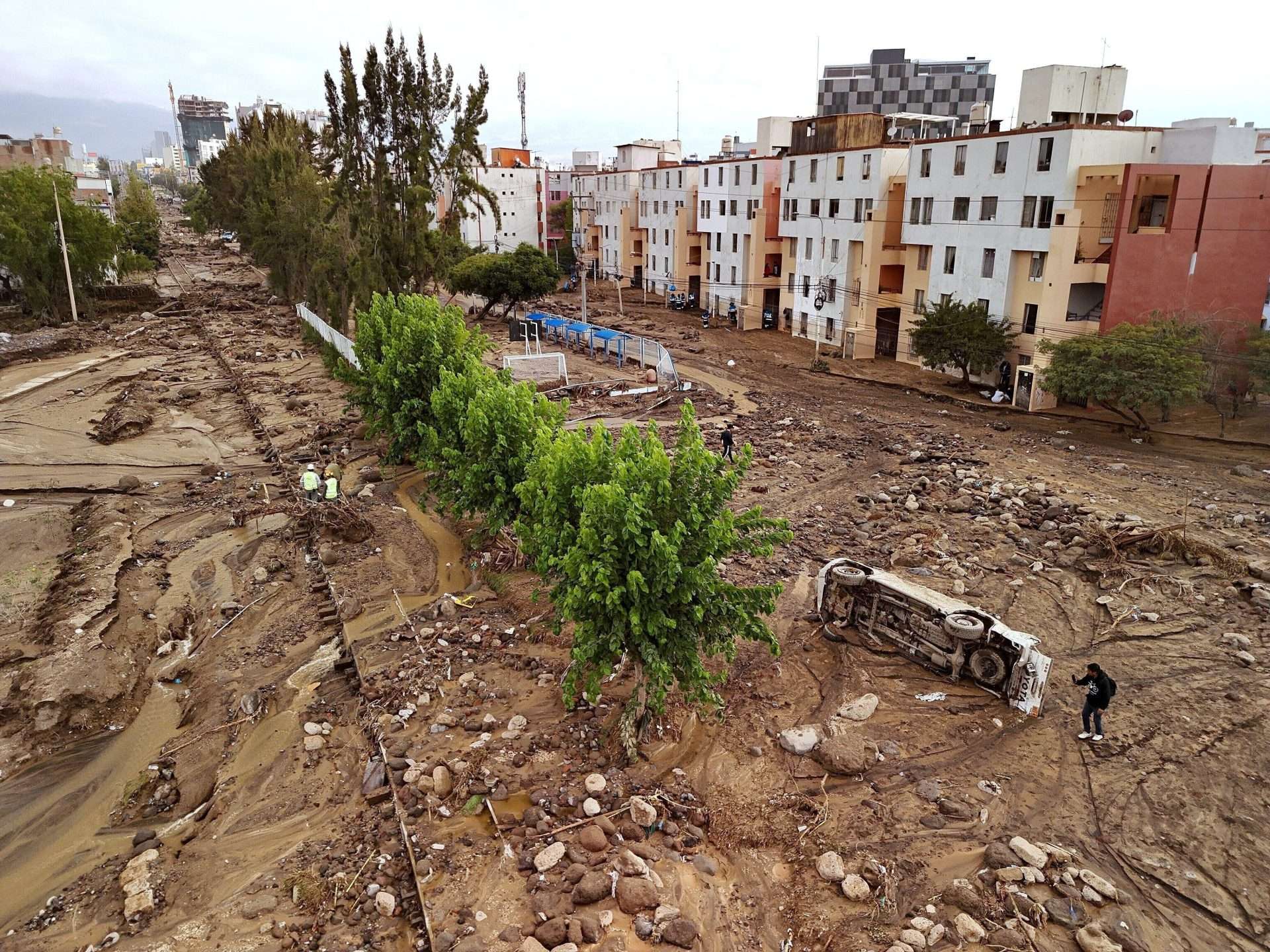
The Peruvian bishops called for prayer and support for the people of Arequipa after the region suffered severe weather and flooding.
Jose Sotomayor / Associated Press / Alamy
Church leaders in Flores, a Catholic-majority island in eastern Indonesia, demanded stronger efforts to combat human trafficking following the rescue of 13 young women who allegedly suffered exploitation at a nightclub in East Nusa Tenggara Province.
Priests, religious sisters, seminarians and human rights campaigners joining protests calling for a thorough investigation and firm legal action concerning alleged abuses at nightclubs. Church representatives urged authorities to strengthen oversight of entertainment venues and enforce existing anti-trafficking laws more effectively.
The women, aged between 17 and 26, are originally from West Java. They sought protection in January after reportedly enduring physical violence, sexual exploitation and serious labour abuse, receiving sanctuary at a safe house operated by Tim Relawan untuk Kemanusiaan Flores (TRUK-F), a humanitarian network supported by the Society of the Divine Word and the Holy Spirit Missionary Sisters.
Sr Maria Fransiska Imakulata SSpS, chairwoman of TRUK-F, said Indonesia has laws intended to prevent trafficking and protect victims, yet implementation remains inconsistent. “Victims are not always treated with dignity – at times, they are even stigmatised,” she said.
The Archbishop of Dhaka Bejoy N. D’Cruze, OMI, president of the Catholic Bishops’ Conference of Bangladesh, welcomed the victory of the Bangladesh Nationalist Party in elections on 12 February widely noted for their peaceful conduct.
In a letter to the new Prime Minister Tarique Rahman, Archbishop D’Cruze praised the “spontaneous and festive atmosphere” in which citizens cast their ballots, calling it a moment of “joy and optimism” after years of uncertainty. He voiced hope that the new leadership would govern with “dedication and wisdom”, advancing social harmony and safeguarding the dignity of people of all religions and castes.
The archbishop noted the longstanding contribution of Christians to national development through education, healthcare and social services, and urged the government to prioritise the needs of marginalised communities.
Christian lay leaders also reacted to the election results with cautious optimism. Anil Leo Costa, secretary general of the Bangladesh Christian Forum, told The Tablet that he hopes the new government will strengthen human rights protections and uphold the country’s tradition of communal harmony.
While Christians have yet to see one of their own elected to parliament, Costa expressed hope that at least one Christian woman might be appointed to a constitutionally reserved seat, giving the community a stronger voice.
The Catholic Bishops’ Conference of India (CBCI) condemned a case of racial abuse against migrant women from northeastern states.
“Such repeated incidents in different parts of our country are unacceptable and a blot on our rich and diverse cultural heritage,” it said in a statement on 26 February. It was responding to an incident on 20 February when three women from Arunachal Pradesh and Tripura states were subject to racial slurs, abused and threatened by neighbours.
Harsh Singh and his wife Ruby Jain were upset as some debris had fallen on their floor while the women were getting electrical work done in their apartment. A purported video of the incident circulating on social media shows the couple using racist remarks against the women. A police report was filed and the couple arrested.
There have been numerous, sometimes violent incidents of racial abuse of people from the ethnically and geographically distinct northeast. The CBCI asked the federal and state governments to educate the public about the diverse cultures, languages and traditions of the region.
The Sri Lankan government gave an award to the Catholic writer Marcus Jayaweera, the 74-year-old author of three books.
These include a volume on environmental justice and another tracking the quest for justice after the 2019 Easter Sunday bombings. He is also a songwriter, journalist and poet, known for his advocacy for fishermen, for whom he has supported co-operative banks and worked on housing schemes for fishing families.
“This recognition is not mine alone,” Jayaweera said while receiving the Kala Bhushana State Award in Colombo in January. “It belongs to the people – their lives, sufferings and faith – which have shaped everything I write.”
Advocacy groups in Pakistan warned that Christians and other minorities are endangered by the escalating hostilities in the Middle East. After protesters stormed the US consulate in Karachi in response to the death of the Iranian supreme leader Ayatollah Ali Khamenei, Christian groups said they could be treated as supporters of the West and face attacks.
Meanwhile, Pope Leo called for an end to fighting between Pakistan and Afghanistan. “I urgently appeal for a return to dialogue,” he said after the Angelus on Sunday. “Let us pray together that harmony may prevail in all conflicts throughout the world. Only peace, a gift of God, can heal the wounds between peoples.”
Pax Christi International published a second denunciation of the US-led “Board of Peace” after its first meeting.
Following its original statement on 23 January, on 26 February it complained that the initiative “continues to exclude Palestinians from meaningful participation, prioritising external control, technocratic authority and profit-driven reconstruction over human dignity, justice and community well-being”.
After the meeting of the board on 19 February, “our concerns have been confirmed and further intensified”, it said.
Pax Christi called on heads of state to speak out clearly about the board’s structural deficiencies and the exclusion of Palestinians. They should insist that “any reconstruction or stabilisation initiative is grounded in human rights, international law and inclusive governance, with protections against displacement, speculative land grabs, and gentrification-driven dispossession”.
It urged the Church and Pope Leo “to keep raising a clear moral voice for an unarmed and disarming peace that defends justice, human dignity and the Palestinian people’s right to self-determination”.
The Synod of the Ethiopian Orthodox Tewahedo Church warned that the tradition of religious co-existence in the country is under threat, after 21 Orthodox Christians were killed in the latest in a spate of massacres.
The killings have taken place in the Arsi area in Oromia, the homeland of the majority-Muslim Oromo people. The most affected areas are Arsi East and Arsi West. Last week, leaders of the church said their followers in the region did not feel safe and appealed to the government to improve security.
The killings are attributed to a militant group linked to the Oromo ethnic community known as the Oromo Liberation Group. The group’s stated goal is to establish an Oromia State, but the Orthodox church leaders said the motives of the killings could be linked to religious hatred.
“The constitutional rights of members of the Orthodox Church to live in any part of the country and their right to worship must be respected,” the synod said, according to Ethiopian reports.
It said hundreds of its members have been killed in the region and churches burned and looted. Some have been abducted from their home and shot, with some incidents involving the brutal killing of family members.
Kenya’s Catholic bishops launched their Lenten Campaign with a call to defend human dignity, strengthen national cohesion and ensure preparedness for the 2027 general elections.
A statement delivered by the chairman of the Kenya Conference of Catholic Bishops Archbishop Maurice Muhatia Makumba of Kisumu called on leaders and citizens “to choose justice over injustice, unity over division, service over self-interest and peace over conflict”.
The Lenten Campaign takes the theme “Building a Just, Peaceful and United Kenya: Upholding Human Dignity”. The bishops warned against election campaigns characterised by inflammatory rhetoric, ethnic polarisation and violence.
“Politics must never become a battlefield for personal ambition at the expense of national cohesion,” Archbishop Muhatia said. Encouraging democratic renewal, the bishops called on young people to register as voters, participate in civic discourse and consider leadership roles.
A South African bishop attributed the decline of religious vocations in the country to to the lack of formation structures in Catholic schools that used to serve as incubators for future clergy.
These concerns come as the country battles high youth unemployment, juvenile delinquency and drug use which advocacy groups blame on the failure of the education system and economic decline.
The Bishop of Queenstown Siphiwo Devilliers Paul Vanqa SAC, who serves as liaison bishop for youth at the Southern African Catholic Bishops’ Conference (SACBC), called for the Church needs to encourage spiritual formation from school level if it is to grow vocations.
Bishop Vanqa said the Church no longer has the same access to schools and formal structures for faith education it once had.
“We now have to rely on our own communities, our parishes and our families,” he said after an SACBC meeting with youth chaplains and diocesan coordinators. “Formation must become the responsibility of everyone in the Church. If we want to form our youth, we must all be part of that mission.”
The National Episcopal Conference of Congo (CENCO) concluded its standing committee meeting on 28 February with a solemn expression of regret at the persistent and worsening security situation that has gripped the country.
According to CENCO president Archbishop Fulgence Muteba of Lubumbashi, the bishops carried out a detailed analysis of the crisis, lamenting the “recurring insecurity” in the east, where the Congolese Armed Forces are fighting the M23 rebellion, which he noted is “supported by Rwanda”.
At least 20 different armed groups have been fighting for the control of the immense natural resources of the Democratic Republic of Congo. Recent efforts by the Trump administration to guarantee peace in exchange for the region’s critical minerals have been criticised because they could potentially fail to benefit the Congolese people.
While attention has been focused on the east, Archbishop Muteba also drew attention to ethnic rivalries in the western DR Congo that pit the Yaka against the Teke ethnic groups as they battle over land. The conflict that started in 2022 has killed over 5,000 people.
CENCO urged dialogue and reconciliation among the Congolese people, and said the Church is always available to facilitate dialogue. In his closing remarks, Archbishop Muteba emphasised the Church’s dual focus on addressing national crises while maintaining its internal governance and pastoral mission.
Togolese bishops raised concerns about the celebration of Mass in private homes and fears that wealthy Catholic are paying to subvert church processes.
The Episcopal Conference of Togo (CET) issued a statement last week prohibiting private house Masses, ruling that “it is forbidden to celebrate the Holy Mass in families and in private houses unless, in very special circumstances, on formal authorisation of the ordinary”.
They said that “the Eucharistic celebration will be held in a sacred place unless, in a particular case, the need requires something else. In this case, the celebration must be held in a decent place.”
The CET emphasised that “the Eucharistic assembly is not selective according to the criteria of affinity or sensitivity. On the contrary, it is open to all without exception.”
Africa’s water crisis is not the result of scarcity but of a “profound moral failure” driven by systemic mismanagement, inequality and injustice, religious leaders from across the continent said.
They issued an indictment during a high-level side event at the African Union, coordinated by the Symposium of Episcopal Conferences of Africa and Madagascar (SECAM). Approximately 319 million people in sub-Saharan Africa lack access to reliable drinking water, and the continent faces a water and sanitation investment gap exceeding $30 billion.
“Water is a shared natural heritage and a common good entrusted to humanity, whose governance must prioritise equity, intergenerational justice, ecological integrity and preferential care for the most vulnerable,” states the declaration, signed by SECAM’s president Cardinal Fridolin Ambongo alongside other religious leaders.
The document demanded a radical shift in continental water governance, integrating core values of human dignity, solidarity and responsible stewardship. By leveraging the extensive reach of religious communities, the initiative aims will support the African Union’s 2063 Water Vision to ensure that the most vulnerable are no longer left behind.
More than five months after the executive of the Spanish bishops’ conference met Pope Leo in Rome, the bishops responded to a public dispute over the Pope’s warning to them about the politicisation of religion.
It is understood that Leo explicitly warned the bishops about the danger that the far-right party Vox could use Christianity for its own ends. Although the conference would only confirm that he spoke about the politicisation of religion, the Catholic magazine Vida Nueva confirmed a report by the daily El País that Leo explicitly mentioned Vox.
The bishops’ decision in January to drop their reservations and sign an agreement with the government to compensate victims of sexual abuse related to the Church, and their public support for a government plan to regularise immigrants, may have been prompted by such a warning, since both measures were attacked by Vox leader Santiago Abascal.
Abascal commented last week that the reports about the Pope’s warning were “an invention by a bishop who collaborates with immigration”. Pope Leo is expected to address the Spanish parliament during his visit to Spain in June.
An academic who linked opposition to abortion to white supremacy has declined her appointment as director of the Liu institute for Asia and Asian studies at Notre Dame University, following protests across the United States.
Susan Ostermann’s appointment was criticised by Bishop Kevin Rhoades of Fort Wayne-South Bend Indiana, who said: “Professor Ostermann’s extensive public advocacy of abortion rights and her disparaging and inflammatory remarks about those who uphold the dignity of human life from the moment of conception to natural death go against a core principle of justice that is central to Notre Dame’s Catholic identity and mission”.
Rhoades led the praying of the rosary in a protest on campus attended by lay Catholics. He garnered the support of the president of the US Conference of Catholic Bishops, Archbishop Paul Coakley of Oklahoma City.
“At present, the focus on my appointment risks overshadowing the vital work the institute performs, which it should be allowed to pursue without undue distraction,” said Ostermann in a statement declining the post.
A federal judge on approved the final order that allows the Diocese of Syracuse, New York, to emerge from bankruptcy on 25 February. The order begins the process of distributing $176 million to hundreds of sexual abuse survivors.
Bishop Douglas Lucia of Syracuse published a letter to the local Catholic community on the day of the order. “Beyond doubt, my heart continues to break for the damage that abuse has inflicted on the Church and its members,” Lucia said. The diocese filed for bankruptcy in June 2020 as it faced a growing number of sex abuse-related lawsuits. More than 400 claims were filed.
“I know the wait has been a significant burden for those who filed claims,” Lucia said, “and I am aware of the heaviness this has placed on the hearts of the faithful who have been scarred by this chapter in our local Church.”
The Peruvian bishops’ conference expressed deep regret after the Arequipa region in southern Peru suffered severe weather last week, causing destruction of infrastructure, displacement and deaths. It offered practical support to affected families and asked for prayer, unity and “mutual support” to address “painful realities”.
Bishop Carlos Enrique García Camader of Lurin, president of the conference, said “we join in the prayers for the deceased in Arequipa and for the communities of the districts severely affected by the landslides and storms”.
Peru declared a state of emergency for nearly half the country’s districts following severe rainfall and flooding triggered by rising ocean temperatures, which authorities link to the El Niño climate phenomenon. Aid agencies organised emergency shelters and the distribution of tents, blankets and food. A military helicopter crashed during a rescue operation, killing all 15 onboard.
The bishops of Australia issued a statement on the cost of living, social justice and the Common Good.
“Across Australia, many of our sisters and brothers are burdened by the rising cost of life’s necessities. For some, this means skipping meals, delaying medical care or living without secure housing,” said the Archbishop of Perth Timothy Costelloe SDB, president of the Australian bishops’ conference, in the introduction to the statement.
These are not just economic statistics – they are human stories of struggle and resilience. As disciples of Jesus, we cannot turn away from these realities,” he continued.
More than one in three Australian households experienced food insecurity last year, according to the statement. “The cost-of-living crisis has resulted in so many Australians going without food and medication and even the safety of having a home. The Church cannot ignore what is fundamentally at odds with what God intended,” it said.
Stay updated — add us as a preferred news source on Google:


Help us keep The Tablet’s voice independent, clear and far-reaching.
Founded in 1840, The Tablet is the leading independent English-language Catholic weekly, celebrated for great writing, astute analysis, brilliant arts and books reviews and trustworthy reporting from correspondents in Britain, Ireland, Rome and across the world.
Independent, high-quality journalism is at the heart of what we do. The Tablet does not have deep pockets and we are not funded by rich donors. If you appreciate our work please consider supporting The Tablet’s Development Fund. It only takes a moment and you can cancel at any time.
- Support with £5 per month
- Support with £10 per month
- Support with other amount.

MOST READ ARTICLES
-
1
Archbishop of Cardiff-Menevia meets with other worldwide Catholic Church leaders to discuss liturgy
-
2
Let there be light
-
3
World Humanitarian Day: aid workers face a ‘crisis of protection’
-
4
Ruling allows French private hospitals limited exemption from assisted suicide
-
5
A tract for our times
-
6
The wisdom of the saints
FROM THE EDITOR'S DESK