News Briefing: Church in the World


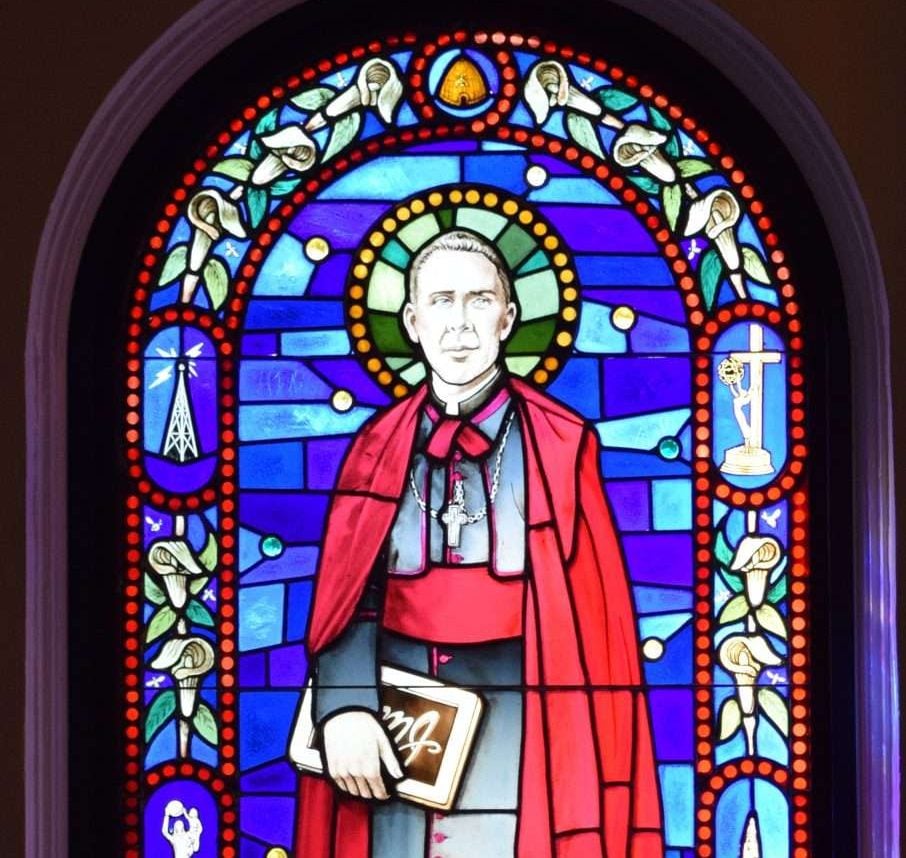
The Holy See granted permission to proceed with the beatification of Archbishop Fulton J. Sheen, portrayed in a window in a church in Mundelein, Illinois.
Fr Gaurav Shroff / flickr / Creative Commons
More than 1,000 activists and concerned citizens attended a Church-sponsored conference in Guadalajara to discuss efforts to stem widespread violence and rights abuses in Mexico.
The three-day National Dialogue for Peace met in early February at ITESO, The Jesuit University of Gualalajara. It was the second conference held as part of a movement launched by the Jesuits’ Mexican province in 2022 with the support of the local Catholic hierarchy following the murder of two Jesuit priests that year in Chihuahua.
The Archbishop of Guadalajara Cardinal Francisco Robles Ortega attended the conference, as did Bishop Hector Perez Villarreal, an auxiliary in the Archdiocese of Mexico City who is secretary general of the Mexican bishops’ conference.
Cardinal Robles urged participants to “sow seeds of peace in every corner of the country, from the family, the street, the school, the neighbourhood and the workplace”.
At least 15 pilgrims including three children died when their pilgrimage bus veered off the road on a curve and overturned in northeastern Brazil on 3 February.
The passengers had been taking part in the pilgrimage of Our Lady of Candelaria, a religious festival in the state of Ceará that attracts tens of thousands of devotees every 2 February. The bus, carrying 60 people, was part of a convoy from the city of Coité do Noia in Alagoas to Juazeiro do Norte in Ceará, a journey of 350 miles which normally takes around eight hours.
The incident happened on the final stretch of the return trip. Governor Paulo Dantas of Alagoas declared three days of official mourning across the state “in this moment of great pain”.
The Salesians of Don Bosco announced a new mission in Vanuatu, in the southwestern Pacific. A team of three priests – from the Philippines, Democratic Republic of Congo and Indonesia – arrived in December 2025 with plans to study the local culture before launching a Salesian project to respond to the needs of young people in the country.
On the feast of Don Bosco on 31 January, they celebrated Mass in Vanuatu’s main church, followed by a lunch prepared by local people according to Vanuatu tradition and visits to nine communities with an image and a relic of Don Bosco. One Salesian reported: “The way people venerated the relic, with great devotion and prayer, deeply moved us. Local communities flocked to welcome ‘Don Bosco’s visit’, and many people approached us for confession after five or even 10 years.”
A court in Hong Kong sentenced the Catholic democracy campaigner and publisher Jimmy Lai to 20 years in prison for national security offences. Lai, 78, was convicted in December on charges of sedition and conspiracy to collude with foreign forces, after five years in detention. Rights groups condemned the sentence as an attack on press freedom. Lai’s daughter Claire said the length of the sentence could mean “he will die a martyr behind bars”.
The Archbishop of Colombo Cardinal Malcolm Ranjith criticised a Sri Lankan politician’s remark about a Buddhist monk and an alleged police assault on a Catholic priest, saying both display disrespect religious leaders.
“There is a growing tendency among those in power to deny religious leaders the right to speak and act on problems facing the nation,” Ranjith said at a special prayer service held in the capital on 4 February to mark Sri Lanka’s seventy-eighth Independence Day.
Agriculture minister K. D. Lal Kantha reportedly called a Buddhist monk a “savage” for expressing opposition to the government’s controversial educational reforms. The plans to introduce sex education and decriminalise homosexuality have met strong opposition from Buddhist and Catholic clergy.
Meanwhile, during the alleged assault on Colombo priest Fr Milan Priyadarshana on 2 January, policemen allegedly told the priest that “you people are destroying this country with your cassocks and robes”. The Church has filed a complaint with the government and demanded an investigation.
Cardinal Ranjith said such disrespect was “a serious challenge to the very existence of religion, which is recognised and protected by the constitution”.
Bishops in Zimbabwe called on Catholics to voice their opposition to proposals to legalise abortion. In a letter read in all Zimbabwean parishes on Sunday, as senators prepared to vote on the bill on Tuesday, the bishops said the legislative measures were an assault on “African and Christian moral heritage”.
The bill’s promoters said it was intended to allow young victims of rape to procure an abortion, but the bishops warned it would open other opportunities for violating the sanctity of life.
The proposed legislation will make “abortion readily available, including without the knowledge or consent of parents or guardians in the case of minors, and even without spousal involvement”, the bishops said. They called it “a grave trivialisation of an act that entails the deliberate ending of a human life solely because that life is incapable of defending itself,” and urged opposition to the bill which they said amounted to the “legalisation of the elimination of unborn children”.
The bishops said they were willing to cooperate “in developing supportive legislation that offers morally acceptable alternatives to abortion and sustained support for vulnerable women and children”.
The Catholic Bishops of Sierra Leone condemned the rising number of violent incidents against the Church. In a statement last week, they “unequivocally condemn the chain of attacks against the clergy, religious and the looting of mission properties in our dioceses”.
Declaring that “enough is enough”, the statement concluded with a call for police to take measures to prevent further acts of violence. They referred to the murder of a priest and the wounding of another during 2025.
The bishops reaffirmed their “unwavering solidarity with the priests, Religious and lay faithful who have been traumatised by armed robberies, invasion of their residences and the systematic looting of mission properties intended for the service of the poor and needy”.
These incidents have deprived the vulnerable and poor in local communities of essential services, they said.
A Cameroonian Jesuit urged Pope Leo not to add Cameroon to the itinerary for his planned visit to Africa this year.
In a letter addressed to the Pope, Fr Ludovic Lado SJ said a papal visit would effectively endorse President Paul Biya’s regime. He said Biya remained in power because he rigged the presidential election 12 October and does not have any form of legitimacy, while the post-electoral crisis has seen violence, deaths and severe repression.
“The dozens of victims recorded were killed by bullets fired on unarmed civilians by an army that has become a militia in the pay of one man,” Fr Lado said, accusing the state of showing “tragically little concern for the dignity of human life in our country, especially that of the poorest”.
He said a papal visit should only take place when Cameroon has “rediscovered a climate of justice, peace, and reconciliation, with legitimate authorities”. Bishops in Angola and Equatorial Guinea have confirmed that they expect a visit from the Pope in 2026.
Pope Leo expressed “sorrow and concern” at violence in Nigeria after a wave of killings. Speaking after the Angelus on Sunday, the Pope said he hoped the authorities will “continue to work with determination to ensure the safety and protection of the life of every citizen”.
Around 130 died within 48 hours during attacks last week across Kwara and Benue states in the North Central region and in Katsina in the northwest of the country.
The Catholic Bishops Conference of Nigeria (CBCN) denounced a “relentless wave of killings and abductions”. In a statement published on Saturday, the bishops warned that violence and impunity were turning the country into “a field of grief” and eroding the foundations of governance.
“Nigeria cannot afford to normalise bloodshed or treat mass killings as routine tragedies,” said the statement, titled “The Cry of the Innocent: Stop this Slaughterhouse in Nigeria!”
On the day the statement was published, terrorists attacked Holy Trinity Parish in the Diocese of Kafanchan, in Kaduna State, and abducted eleven people including Fr Nathaniel Asuwaye. Three others were killed during the attack.
A parish priest in southern Nigeria barred female members of his congregation from receiving communion dressed in gowns.
Fr Sylvester Umoette, parish priest of the Assumption Catholic Church in Ukana Iba, Essien Udim Local Government Area of Akwa Ibom State, reportedly introduced a dress code for women requiring them to wear the traditional attire of the Annang people. The church’s congregation spans Annang, Ibibio, Efik, Ekid, Igbo and other ethnic groups.
Aggrieved parishioners told The Tablet that women wearing gowns were denied communion on the grounds that they are “dressed like Efik women”. One said: “The priest has insisted that women must dress strictly in traditional Annang attire, specifically two wrappers and a blouse, to be eligible for communion.”
A female congregant described the practice as humiliating and divisive. “This has nothing to do with indecent dressing. You can wear a long gown, fully covered, and still be denied communion. It is painful and embarrassing,” she said. A spokesman for the Church authorities distanced them from the priest’s policy.
A theologian called for a new approach to the formation of candidates for religious life, warning that rigidity was forcing seminarians out amid dwindling vocations in parts of Africa.
Fr Stan Chu Ilo, coordinator of the Pan-African Catholic Theology and Pastoral Network (Pactpan), spoke on a webinar on 31 January under the theme “Formation and Formators in a Synodal Church: A Bold Theological and Pastoral Rethink”. He said that many of the problems that lead to seminarians’ dismissal could be resolved by another approach.
“There are many wreckages that we have created as a result of the kinds of formation that sometimes lack the face of Jesus Christ. People are discarded as if to say they’re wrecks,” said Fr Ilo, a priest of the Diocese of Awgu in Nigeria and a senior research professor at the Centre for World Catholicism and Intercultural Theology at DePaul University, Chicago.
The number of Christians in Turkey declined from 20 per cent of the population to two tenths of a per cent in the last century, according to a report by the Assyrian International News Agency.
Few countries have seen such a drastic decline in their Christian population. The Turkish Republic is founded on principles of secularism, but current statistics say that 99 per cent of the roughly 87 million Turkish citizens identify as Muslim.
Many Christians have left the country in the face of hostility, though a small resilient Orthodox population remains, typically Armenian, Assyrian or Greek. Some Christian refugees from countries such as Afghanistan, Iran and Syria also live in Turkey. There are an estimated 25,000 to 33,000 Catholics in Turkey, including the Latin, Chaldean, Armenian and Syriac rites.
In November 2025, Pope Leo visited Turkey on his first foreign journey since becoming Pope, travelling to Ankara and Istanbul as well as marking the 1700th anniversary of the First Council of Nicaea.
The Church in the Netherlands became the latest to record a recent leap in adult baptisms, registering a 40 per cent increase in 2024 compared to the previous year.
However, the overall number of new Catholics went down in 2024, the latest year for official figures, because there was a seven per cent decrease in infant baptisms.
“Although these numbers are small compared to the total number of child baptisms, the increase in adult membership is significant,” a Church statement said. Over 500 adults and 6,100 infants were baptised in 2024.
There was also a decline in other sacraments, with a seven per cent drop in numbers for first communion and a five per cent drop in confirmation. “These percentages remain in line with the downward trend of previous years,” the statement said.
With over 18 million people, the Netherlands is one of the most secular countries in Europe. There were 3.45 million Dutch Catholics in 2024, or about 19 percent of the population. About 14 per cent belong to Protestant churches while 56 per cent profess no religion.
“Declines are part of a long-term trend, but the sharp increase in adult membership stands out as a clear exception,” said a Church statement quoting statistics gathered by the research agency Kaski.
Unesco officially inscribed the Bollandist Library in Brussels and its Acta Sanctorum – a three-century study of the lives of the saints – into its “Memory of the World” list.
Belgian Jesuits in Antwerp began writing the study in 1603, and according to his followers Fr Jean Bolland SJ first published two volumes as the Acta Sanctorum in 1643, starting what became “a gigantic encyclopedia of all the saints of the East and West”.
Rigorously academic, the multilingual hagiography collection includes correspondence with experts and copies of medieval manuscripts. Gathered over the centuries, it now makes up 300 volumes in all. There are nearly 60,000 pages on the lives and practices of over 1,100 saints and major world religions.
Fr Bolland’s name is now on a Brussels library while the generations of priests and laymen who have continued the collection form the Société des Bollandistes. Twice a year, their journal Analecta Bollandiana updates the latest historical studies.
Sexual violence is an endemic problem within the Catholic scout movement in Germany, according to a report released last week. The study of the Deutsche Pfadfinder*innenschaft Sankt Georg (DPSG) presented in Cologne on 5 February found it was “a house that is damaged in its foundations”, said the project’s director Sabine Maschke from the University of Gießen.
She said that “the association is rife with sexual violence … Community, power, closeness and spiritual superstructure opened the door to sexual violence against children and young people.” Scouting is a “hyper-including community”, which “extends far beyond leisure activity and volunteering” and emulates family-like structures where boundaries can be blurred easily, the report said.
Sebastian Becker, a federal co-chair of the DPSG, said that the association was prepared to conduct self-appraisal and that time would tell what its consequences would be – even extending to the dissolution of the association. “It is our association … that has failed, not individual persons alone, but we as an institution,” said DPSG federal co-chair Annkathrin Meyer.
To members of the organisation she said: “I encourage you to enter into critical dialogue, to talk and discuss with each other and to work together to ensure that the protection of children and young people plays a larger part.”
Pope Leo appointed Bishop Stanislav Pribyl of Litomerice as the next Archbishop of Prague, who traditionally ranks first among Czech bishops.
He will succeed Archbishop Jan Graubner, who was appointed to lead the Archdiocese of Prague in 2022 as a temporary measure replacing Cardinal Dominik Duka. Pribyl will take up the post on 25 April. The 55-year-old, one of the youngest archbishops in Prague’s history, has the episcopal motto Pax vobis.
“I am particularly concerned about peace within the Church. In my opinion, striving for it must be the first step,” Pribyl told Radio Vaticana. “It is not just a matter for the church and the Prague archdiocese. It often seems that when we come to an idea, we first examine who said or wrote it and then evaluate the content accordingly. Everything is too ad hominem.”
The Solicitor General of the United States filed a friend-of-the-court brief on 30 January urging the US Supreme Court to stop Colorado from excluding Catholic preschools and families from the state’s universal preschool funding programme.
“The United States has a substantial interest in the preservation of the free exercise of religion,” the brief said. “It also has a substantial interest in the enforcement of rules prohibiting discrimination by government funding recipients.”
The case of St Mary Catholic Parish v Roy names as defendants Lisa Roy, executive director of the Colorado Department of Early Childhood, and Dawn Odean, director of Colorado’s Universal Preschool Programme.
In 2022, Colorado’s Department of Early Childhood established a programme to provide all preschoolers in the state with 15 hours of free education per week at a private or public school of their parents’ choice in the year before kindergarten. When implementing the programme, however, the state denied funding to parents who send their children to religious schools.
The US Court of Appeals for the Tenth Circuit upheld Colorado’s restriction on funding for religious schools. The Supreme Court is likely to decide whether to hear the case in spring 2026.
“We’re grateful the Solicitor General recognised what’s at stake here and added his voice to a growing chorus urging the Supreme Court to hear this case,” said Nick Reaves, senior counsel at the Becket Fund and lead attorney for the preschools and families.
Pope Leo XIV accepted the resignation of Archbishop Samuel Aquila of Denver and named Bishop James Golka of Colorado Springs, Colorado as his successor.
Aquila, who has led the Archdiocese of Denver since 2012, submitted his resignation when he turned 75 on 24 September 2025, as required by canon law. Introducing Golka to reporters on 7 February, Aquila described him as “a man of prayer, with a deep love for Jesus and the Blessed Mother”.
“He understands well many of the challenges that we face today in our country and world, with immigration, the precarious global situation, and all of the challenges undermining the dignity of human life,” Aquila said. “He approaches all of these through the lens of the Gospel.”
Golka, 59, who has served as Bishop of Colorado Springs since June 2021, will become the ninth Archbishop of Denver when he is installed 25 March at the Cathedral Basilica of the Immaculate Conception.
Pope Leo XIV met members of Courage International, a ministry devoted to helping LGBTQ Catholics to “live a chaste life”. Bishop Frank Caggiano of Bridgeport, Connecticut, chairman of the Courage International Episcopal Board, attended the private audience at the Vatican on 6 February.
“The opportunity to share with the Holy Father the works of the apostolate, to provide pastoral accompaniment to persons who experience same-sex attraction but who strive to live chaste lives or to accompany family members who have a loved one who identifies as LGBTQ, was a momentous occasion,” said a statement from Courage International.
Its executuve director Fr Brian Gannon said: “The Pope was very gracious, a very good listener. We talked about the importance of chastity, how it heals and strengthens and restores the person. The Pope was obviously very encouraging.”
He added that Pope Leo had talked about “what real freedom is – not the unbridled freedom that the world offers but rather mastering our passions and being in complete surrender to the will of God”. It was the first time Courage International, which was founded in 1980 and has more than 160 chapters in fifteen countries, had met with a pope.
The Diocese of Peoria, Illinois said the Holy See had granted permission to proceed with the beatification of Archbishop Fulton J. Sheen. Famed for his preaching on radio and television from the 1930s to the 1960s, Sheen’s cause opened in 2002 and Benedict XVI declared him Venerable in 2012. Pope Francis recognised the miracle required for his beatification in 2019, but it was delayed by concerns he could be implicated in a New York abuse report.
Stay updated — add us as a preferred news source on Google:


Help us keep The Tablet’s voice independent, clear and far-reaching.
Founded in 1840, The Tablet is the leading independent English-language Catholic weekly, celebrated for great writing, astute analysis, brilliant arts and books reviews and trustworthy reporting from correspondents in Britain, Ireland, Rome and across the world.
Independent, high-quality journalism is at the heart of what we do. The Tablet does not have deep pockets and we are not funded by rich donors. If you appreciate our work please consider supporting The Tablet’s Development Fund. It only takes a moment and you can cancel at any time.
- Support with £5 per month
- Support with £10 per month
- Support with other amount.

MOST READ ARTICLES
-
1
Archbishop of Cardiff-Menevia meets with other worldwide Catholic Church leaders to discuss liturgy
-
2
Let there be light
-
3
World Humanitarian Day: aid workers face a ‘crisis of protection’
-
4
Ruling allows French private hospitals limited exemption from assisted suicide
-
5
A tract for our times
-
6
The wisdom of the saints
FROM THE EDITOR'S DESK