War will only destabilise the region further, Middle East experts warn


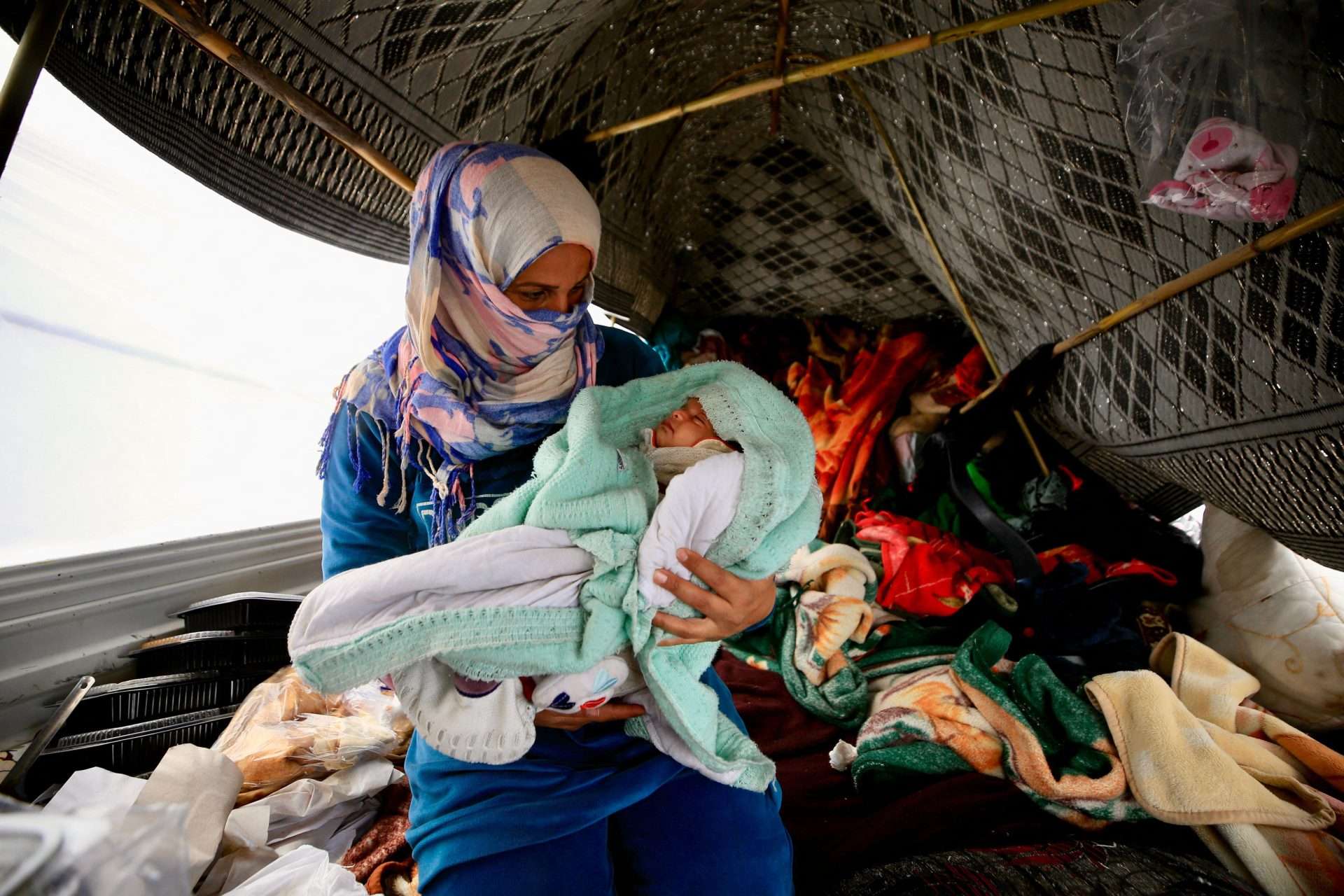
A displaced woman holding her baby is seen inside a tent in Sidon, Lebanon, 15 March, 2026. The Lebanese Health Ministry said on Sunday that 2,105 people have been injured and 850 killed by ongoing Israeli attacks since 2 March.
Ali Hashisho/Xinhua/Alamy Live News
‘Peace is promoting dialogue, peace is getting to know the other, peace is always seeking the good of the other,’ said Bishop James Curry. ‘That is always the vocation of the Christian in any circumstance.’
The wounds created by the war in Iran will “exacerbate the wounds and mistrust that already exist in the region”, auxiliary bishop of Westminster and lead bishop for the Holy Land James Curry has said.
In a special episode of the Middle East Analysis podcast produced by the Catholic bishops’ conference of England and Wales, Bishop Curry echoed Pope Leo XIV’s plea for an end to the hostility and to pay attention to the suffering of innocent people and Cardinal Pietro Parolin’s warning that “justice has given way to brute force”.
The language that the White House and some diplomats are using with reference to the war in Iran is “appalling”, “reducing people’s suffering to a game”, Bishop Curry continued.
“It’s sometimes difficult to know what’s true in the fog of war, but the reality is the suffering of people who are in many ways innocent. Iran is a country of a 90 million people. Notwithstanding the concerns we all have about how it is run and its influence in the region, we constantly have to look to see how the innocent are being protected.”
Dr Harry Hagopian, international lawyer and former consultant on the Middle East and North Africa for the bishops’ conference, said in the podcast, “This is not a legal war. It is a war without goals, without an end goal, without an objective. When you start a war without having an end goal defined, that war is going to stray into very dark imponderables.
“What about the human cost of this war? It is not only to count how many people have died in Iran, how many US soldiers have died, how many people have died across the whole region – the human cost is also the incredible destruction that is being wrought upon Iran, which has a civilisation going back millennia.”
“When the war ends, there will have to be a rebuilding of trust among peoples, a rebuilding of civic structures. The international community will have to play their part to rebuild trust,” Bishop Curry continued.
He said said that, as well as the US and Israeli attack on Iran, Israel’s attack on Lebanon is also destabilising the region further and that there are knock-on effects across the Holy Land, especially with regards to access to food and aid.
“War robs us of the future. The vast amounts of money that are being spent on armaments and war will not be recouped. It could have been spent on education, on peacebuilding, on peace enforcement. The peacemakers are the ones who pick up the pieces once the war is over. In the meantime, we constantly have to keep open the door to the possibility of peace.”
“Peace is an active activity,” Bishop Curry said. “It is not the absence of war. Peace is promoting dialogue, peace is getting to know the other, peace is always seeking the good of the other. That is always the vocation of the Christian in any circumstance.”
Stay updated — add us as a preferred news source on Google:


Help us keep The Tablet’s voice independent, clear and far-reaching.
Founded in 1840, The Tablet is the leading independent English-language Catholic weekly, celebrated for great writing, astute analysis, brilliant arts and books reviews and trustworthy reporting from correspondents in Britain, Ireland, Rome and across the world.
Independent, high-quality journalism is at the heart of what we do. The Tablet does not have deep pockets and we are not funded by rich donors. If you appreciate our work please consider supporting The Tablet’s Development Fund. It only takes a moment and you can cancel at any time.
- Support with £5 per month
- Support with £10 per month
- Support with other amount.

MOST READ ARTICLES
-
1
Would the Church miss us?
-
2
Nicaraguan bishops visit Rome as Ortega regime tightens grip
-
3
Church from the 1950s receives £1 million government grant for new roof
-
4
Nurturing young Catholics in STEM
-
5
Pope Leo thanks staff at Mass in Gemelli Hospital
-
6
Henri Nouwen: Christ’s acrobat
FROM THE EDITOR'S DESK