Two bishops appointed amid fresh scrutiny of China-Vatican deal


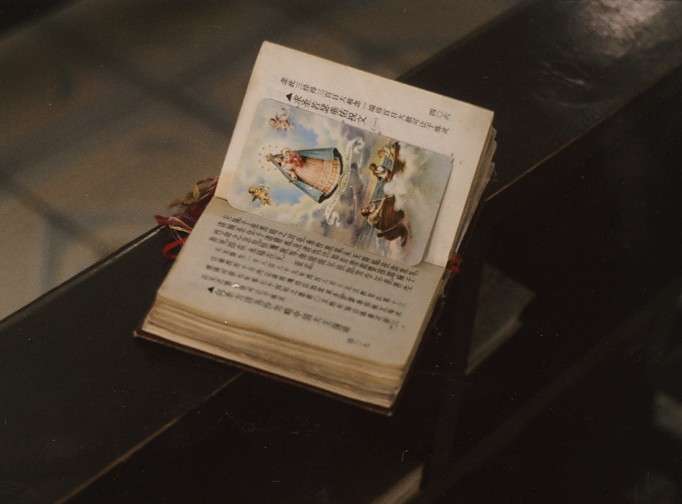
A missal in a Catholic church in Kangding, Sichuan province
Michael Wood / flickr / Creative Commons
Bishop Liu Honggang and Archbishop Luo Beizhan are the seventeenth and eighteenth appointments under the terms of the Holy See’s provisional agreement with the Chinese authorities, which was renewed for four years in 2024.
The Holy See’s agreement with the Chinese authorities on episcopal appointments came under renewed scrutiny after the consecration of two new bishops.
On 31 August, the Holy See announced that Fr Paolo Liu Honggang had been ordained that day as Bishop of Datong in northern Shanxi province, reporting that Pope Leo had appointed him on 10 August.
Bishop Liu Honggang, 56, had served as diocesan administrator since the death of Bishop Thaddeus Guo Yingong in 2005. Born near the provincial capital Taiyuan, he was ordained a priest of the diocese in 1996.
On 8 September, the Holy See announced the episcopal ordination of Fr Andrea Ding Yang as Archbishop of Chongqing, in southwest China, following his appointment by Pope Leo on 28 July. The municipality of Chongqing has a population of more than 30 million.
Born in Chongqing in 1981, Archbishop Ding Yang attended seminary in Beijing and was ordained a priest of the diocese in 2007. He pursued further studies at the University of St Joseph in Macao from 2009 and 2011, and in 2014 studied at the Pontifical University of the Holy Cross in Rome.
There has been no bishop in Chongqing since the death of Bishop Peter Luo Beizhan in 2001. Although Pope Leo bestowed the title of archbishop on Fr Ding Yang, the Chinese authorities do not recognise metropolitan sees and referred to him as a bishop.
At both the consecrations in Datong and Chongqing, local representatives of the Chinese Bishops’ Conference – an official body not recognised by Rome – read a decree approving the appointment without reference to the Pope.
Liu Honggang and Luo Beizhan are the seventeenth and eighteenth bishops appointed under the terms of the Holy See’s “provisional agreement” with the authorities in Beijing, which was renewed for four years in 2024.
They are the ninth and tenth bishops appointed in China since Pope Francis’ death in April 2025, including two “elected” before the election of Pope Leo whose appointments he subsequently approved.
The agreement has been a subject of controversy since it was first signed in 2018, with critics warning that it abandons “underground” bishops historically appointed by the Pope whom the Chinese authorities refused to acknowledge.
The historian Anthony E. Clark wrote on The Catholic World Report website last month that one such bishop in Fujian province had told him of at least 10 new bishops “secretly consecrated” to serve the “underground” community.
Meanwhile, a Catholic group promoting friendship between the United States and China reportedly cancelled an academic’s invitation to speak after pressure from the Chinese government.
According to the National Catholic Register, in June this year the leadership of the US-China Catholic Association (USCCA) informed Fenggang Yang, a Chinese-born sociologist at Purdue University, that he would not be giving a keynote address at the organisation’s biennial conference.
In correspondence sent to Yang, copies of which were obtained by the Register, several members of the USCCA’s board of directors and leadership said Chinese officials requested that he be removed from the programme.
“We are afraid of being blacklisted and not allowed to visit China again. We also have two board members in China. They could get into trouble,” wrote Peter Tan, chair of the USCCA’s board.
Yang, who is director of the Centre on Religion and the Global East at Purdue University, had accepted an invitation to speak at the USCCA’s conference, held from 31 July to 2 August at the University of St Thomas in Houston.
He told the Register that he was prepared to deliver a non-political speech titled “Transforming Guanxi: Chinese Christian Transnational Ties and the Making of Social and Spiritual Capital”.
The fate of Catholicism in China since the death of Mao Zedong
The rise of China is Pope Leo’s pre-eminent challenge
Stay updated — add us as a preferred news source on Google:


Help us keep The Tablet’s voice independent, clear and far-reaching.
Founded in 1840, The Tablet is the leading independent English-language Catholic weekly, celebrated for great writing, astute analysis, brilliant arts and books reviews and trustworthy reporting from correspondents in Britain, Ireland, Rome and across the world.
Independent, high-quality journalism is at the heart of what we do. The Tablet does not have deep pockets and we are not funded by rich donors. If you appreciate our work please consider supporting The Tablet’s Development Fund. It only takes a moment and you can cancel at any time.
- Support with £5 per month
- Support with £10 per month
- Support with other amount.

MOST READ ARTICLES
-
1
Pope returns to Vatican after hospital discharge
-
2
Diverse schools that are 100 per cent Catholic
-
3
Under endless skies
-
4
Battling confession fatigue
-
5
Nigerian bishop scorns suggestion of running in presidential election
-
6
Schismatic Spanish nuns strip contents of convent before eviction
FROM THE EDITOR'S DESK


