Myanmar government urged to ‘silence the guns’ for earthquake relief


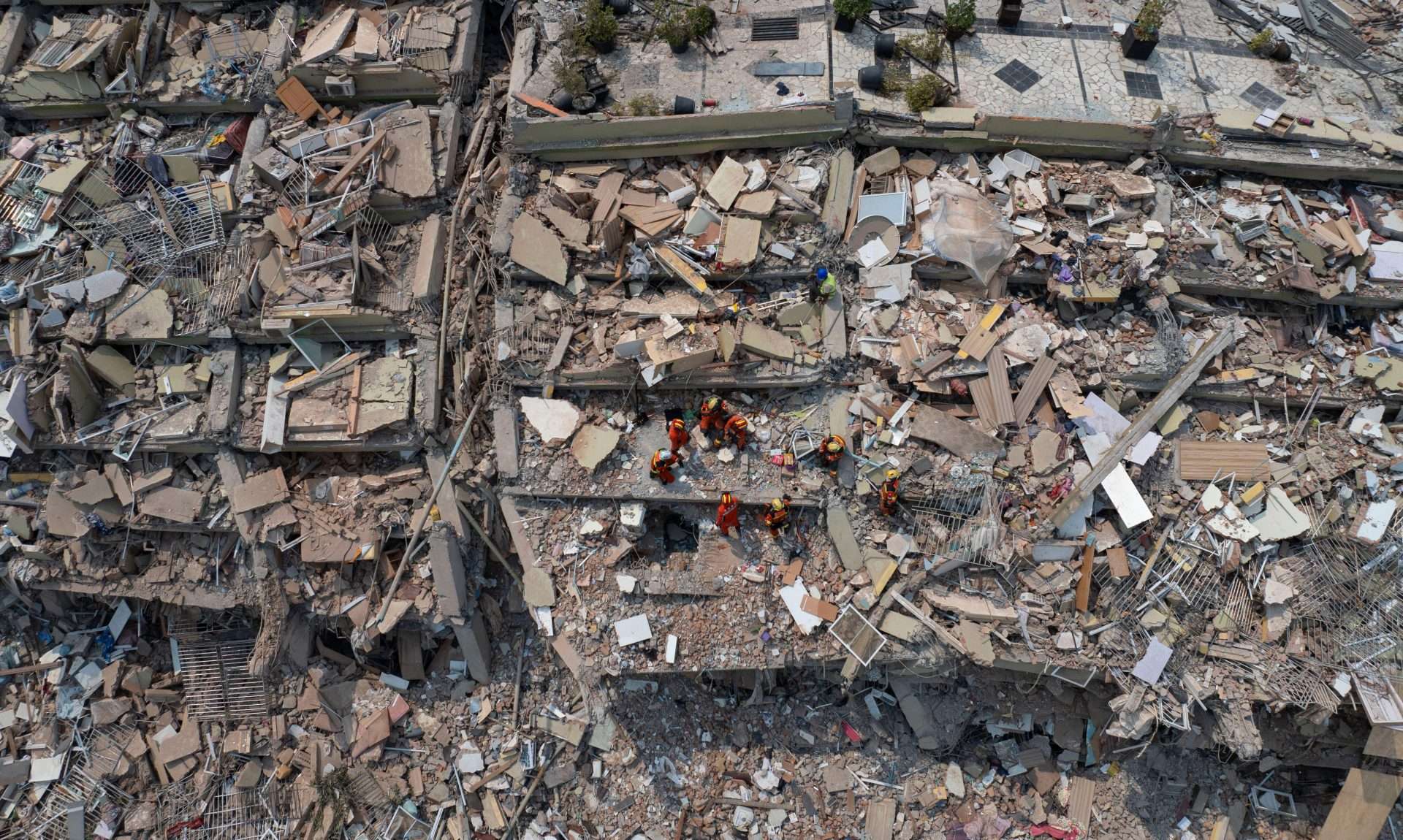
Rescue teams working amid wreckage in Mandalay on 1 April.
Cai Yang / Xinhua / Alamy
The military government continued bombing rebel-controlled areas, even after declaring a ceasefire last week.
Heavy rainfall obstructed relief efforts in Myanmar last weekend, as official reports for the death toll from the 7.7-magnitude earthquake on 28 March neared 3,500 with hundreds more still missing.
The quake destroyed roads, bridges and other infrastructure, while its aftershocks and continued fighting between government forces and rebels have hampered the supply of aid to survivors left vulnerable to disease and extreme weather.
The city of Sagaing, near the epicentre, and Mandalay, Myanmar’s second city with more than 1.7 million residents, both suffered particularly severe damage. Many people have slept outdoors since the earthquake after their houses were destroyed or damaged.
Around 45 minutes of heavy rain and strong winds on the evening of 5 April hit tent shelters in Mandalay, soaking people and their belongings because of a shortage of tarpaulins. Some collapsed buildings threatened to subside, making the recovery of bodies even more dangerous. Following more showers the next day, the temperature climbed to 37°C. Aid workers warned that rainy conditions and heat increase the risk of disease outbreaks in displacement camps.
The Archbishop of Yangon Cardinal Charles Maung Bo, the president of the Bishops’ Conference of Myanmar, reported that in central Myanmar nearly 20 per cent of the population is homeless. He said “fear has forced them to sleep on the streets, exposed to the scorching sun … and the people are in a state of physical and psychological prostration”. He said that Myanmar needed an end to violence and a ceasefire “is now all the more urgent to facilitate humanitarian aid. So far, this call has gone unheeded. Now is the time to silence the guns, provide food and medical supplies, and treat the injured.”
The military government continued bombing rebel-controlled areas, even after declaring a ceasefire last week. The UN described these air strikes as “completely outrageous and unacceptable”. The UN Special Rapporteur Tom Andrews said it was “nothing short of incredible” that the military was continuing to “drop bombs when you are trying to rescue people after the earthquake”.
Bishops in the Philippines backed the appeal for a ceasefire to facilitate humanitarian aid, said the president of the Filipino bishops’ conference Cardinal Pablo Virgilio David of Kalookan.
On 3 April Cardinal David, who is vice president of the Federation of Asian Bishops’ Conferences, met Myanmar’s Chin Human Rights Organisation, which posted a photo of the meeting on social media and expressed gratitude “for his unwavering support and solidarity with the people of Chin State and Myanmar in our pursuit of human rights, including our quest for justice through legal avenues in his home country”.
Cardinal Bo describes ‘crushing anxiety’ in Myanmar after earthquake
Myanmar’s Christians pray for peace on coup anniversary
The Archbishop of Mandalay Marco Tin Win was among those forced from their homes by the earthquake, after his cathedral and the bishop’s residence suffered structural damage.
“We encouraged and comforted frightened children and people on the streets,” he reported. “Many sought refuge in the church complexes that are still accessible. With our modest means, we share water, food, and shelter with them while we await further external assistance.”
The archbishop said three of the 40 churches in the Archdiocese of Mandalay had collapsed, and all suffered damage, with about 25 no longer safe for safe entry. The St John Paul II Chapel belonging to the Salesian community in Mandalay “suffered extensive damage, with its facade and parts of the walls collapsing”, and a Salesian-run building housing street children “sustained significant damage”.
The grounds of the Sacred Heart Cathedral in Mandalay “have become a refuge for earthquake victims, regardless of ethnicity or religion – they are Christians, Buddhists, Muslims, and Hindus, and parishioners have worked hard to alleviate the suffering of the victims”, said Fr Peter Kyi Maung, vicar general of the archdiocese. Rescue workers include its Mandalay Catholic Emergency Rescue Team.
Archbishop Win said the response to the earthquake had united people “regardless of ethnicity, faith, or social class”, and that witnessing the solidarity and charity toward one another has been “beautiful”. He said “it consoles us to see that the entire Church does not abandon us, neither nationally nor universally, even the Pope prays for us and gives us comfort and hope”.
General Min Aung Hlaing, the head of the military junta which overthrew Myanmar’s democratic government in 2021, met the prime ministers of India and Thailand at a regional summit in Bangkok on 4 April. Shunned by most world leaders since leading the coup, Hlaing was accused of exploiting the disaster for diplomatic gain.
A meeting between the countries of the Association of Southeast Asian Nations, from which Myanmar is excluded, is also scheduled to take place soon and will likely see Myanmar representatives attending to discuss regional humanitarian assistance.
Around 45 per cent of the 3.8 million people already displaced by the civil war live in the earthquake-affected areas. The UN renewed its call for “unhindered access for humanitarian agencies to assist communities in urgent need of assistance”.
Caritas organisations in Australia and Japan are amongst those organising shelter kits, drinking water and emergency food rations, blankets, kitchen sets, and mosquito nets in partnership with UN agencies. In the UK, Janet Symes, Cafod’s Head of Region for Asia and Middle East, said the aid agency was “increasingly concerned by the rising death toll and growing humanitarian needs” and was working through the 15-member Disasters Emergency Committee in response.
The DEC launched an appeal last week which raised £12.5 million by Monday, with donations from the public matched by the UK government up to £5 million. Cardinal Vincent Nichols commended “the swift response of Cafod, the Church in Myanmar and the DEC in providing essential aid”.
Labour ‘compassion’ is mere sentimentality
An enigmatic nation: travels in Burma
Stay updated — add us as a preferred news source on Google:


Help us keep The Tablet’s voice independent, clear and far-reaching.
Founded in 1840, The Tablet is the leading independent English-language Catholic weekly, celebrated for great writing, astute analysis, brilliant arts and books reviews and trustworthy reporting from correspondents in Britain, Ireland, Rome and across the world.
Independent, high-quality journalism is at the heart of what we do. The Tablet does not have deep pockets and we are not funded by rich donors. If you appreciate our work please consider supporting The Tablet’s Development Fund. It only takes a moment and you can cancel at any time.
- Support with £5 per month
- Support with £10 per month
- Support with other amount.

MOST READ ARTICLES
-
1
Pope returns to Vatican after hospital discharge
-
2
Diverse schools that are 100 per cent Catholic
-
3
Under endless skies
-
4
Battling confession fatigue
-
5
Nigerian bishop scorns suggestion of running in presidential election
-
6
Schismatic Spanish nuns strip contents of convent before eviction
FROM THE EDITOR'S DESK