Cardinal Bo describes ‘crushing anxiety’ in Myanmar after earthquake


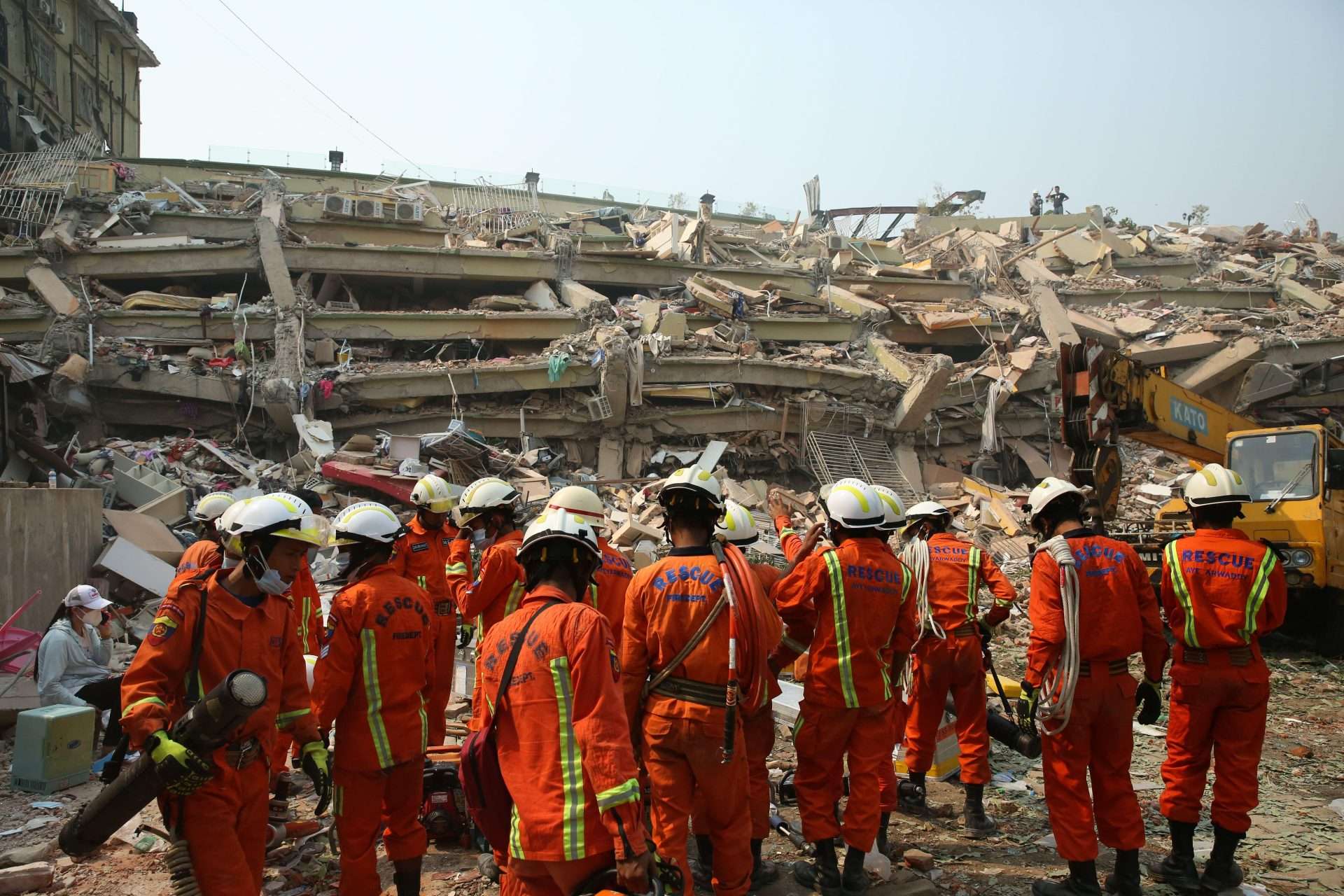
Rescue workers in Mandalay on 30 March, as estimates for the number of victims of the earthquake increased.
Myo Kyaw Soe / Xinhua / Alamy
Fr Girish Santiago, the Jesuit Regional Superior of Myanmar, said that ‘Myanmar has never been more vulnerable’.
The Archbishop of Yangon Cardinal Charles Maung Bo called for “urgent humanitarian support and unimpeded access to the affected people” after a 7.7-magnitude earthquake struck Myanmar. He also appealed “for the ceasefire by all the groups in hostility” to allow a humanitarian response.
Cardinal Bo, the president of the Myanmar bishops’ conference, was travelling from Taunggyi in Shan State when the earthquake hit the central areas of the country on the afternoon of 28 March. A second, registered at 6.4 magnitude, struck 12 minutes later, and aftershocks continued. Bo reported that craters appeared in the road, cars were tumbled around and motorcyclists thrown off their vehicles.
“It was a scary moment for all of us, even on the open spaces,” he told Vatican News, but his main concern was that “all along the road, we could see the crushing anxiety of ordinary people”.
On Monday the ruling junta said at least 2,000 people were confirmed dead and more than 3,000 injured, but the regime’s restrictions on reporting meant full details were slow to emerge. Six regions declared a state of emergency.
Cardinal Bo said that “the earthquake came at a very sad time for our people” with “areas affected already facing multidimensional crises of conflict, the collapse of the economy, and huge displacement”.
He formed the Myanmar Earthquake Response Church Initiative (MERCI) to coordinate appeals and relief work. “We are consoled by the sign of support from the Church partners and the unwavering and deeply touching message from the Vatican and our Vatican representative here,” said Bo.
In a telegram last Friday, Pope Francis offered his closeness to the populations of Myanmar and Thailand, recalling the widespread displacement already affecting Myanmar, with over three million people internally displaced and more than a third of the nation’s population in need of urgent humanitarian assistance.
Cardinal Bo said Church personnel and religious groups could be an efficient channel for bringing food, medicine and shelter to meet urgent needs. He called for a “humanitarian corridor” allowing the “free flow of supplies” coming from other countries. In an appeal to the junta, he said: “Let all those who come to our country to help be welcomed and provide all security to reach the most affected people.”
Cafod was among the UK agencies launching appeals. Caritas Internationalis, through diocesan offices and Karuna Mission Social Solidarity, its national member in Myanmar, mobilised emergency teams to Mandalay, one of the worst-affected areas.
It reported that “buildings have crumbled, roads are impassable, and communication lines are down, making rescue efforts dangerously difficult”. In the worst-hit areas, “families are homeless, without food, water, or medical care” and there is “urgent need for medicines, emergency shelters, and sanitation facilities, as thousands are forced to sleep on the streets, exposed and vulnerable”.
International rescue teams joined the disaster relief effort, with several countries sending assistance to Myanmar, with the UK pledging £10 million in aid.
Cardinal Bo urges Myanmar Catholics to be ‘messengers of peace’ despite bombings
Fr Girish Santiago, the Jesuit Regional Superior of Myanmar, wrote on social media that “Myanmar has never been more vulnerable”.
“The devastating earthquake is the latest in a relentless series of tragedies – COVID, coup, economic collapse, conscription laws, floods, and now this,” he said. “The suffering is unimaginable, with countless displaced internally and as refugees.”
He travelled to the worst affected areas to assess the damage, and after visiting Taungngu and Mandalay described the scenes as “heartbreaking: no electricity, scarce water, overcrowded shelters”. He asked for “solidarity – through prayers, awareness, and aid – [so] we can bring light to these shadows”.
Other Church sources reported “death and destruction”, especially in Mandalay, where the Higher Education College was badly damaged. Students have been sleeping on the ground outside in fear of further aftershocks. Rescue workers removed rubble with their bare hands to find survivors.
The earthquake destroyed at least 20 churches including Mandalay’s St Joseph Church, which was more than 100-years-old, and St Michael’s Church. More were badly damaged in Mandalay, Shan State, Karen State and Bago Region, but many still organised assistance for newly homeless families in their vicinity.
Many other religious buildings were destroyed, including the Ma Shi Khana Pagoda in Sagaing, founded in the fourteenth century. The collapse of Buddhist monasteries killed many, including at Mandalay’s U Hla Thein monastery, where 270 monks had been taking a religious exam. Others died in mosques during Friday prayers. Nearly 50 mosques in Mandalay and Sagaing collapsed, many of them nineteenth-century constructions.
Within hours of the earthquake and its appeal for international aid, the military regime resumed its bombing campaign against rebels in parts of the country, provoking UN outrage. The junta continued to deny requests for entry by foreign media seeking to cover the disaster, with a government spokesman citing difficulties with accommodation, power outages and water shortages as well as the busy rescue operations.
Pax Christi International extended “unwavering solidarity to the people of Myanmar and Thailand during this devastating time”. It said Myanmar’s people “have endured long-standing hardships, and these natural calamities further threaten to exacerbate the already severe human rights violations faced by many”, calling for “global solidarity and continued advocacy to ensure that life-saving assistance reaches all those in need”.
Myanmar’s Christians pray for peace on coup anniversary
The next conclave could turn to the East
Stay updated — add us as a preferred news source on Google:


Help us keep The Tablet’s voice independent, clear and far-reaching.
Founded in 1840, The Tablet is the leading independent English-language Catholic weekly, celebrated for great writing, astute analysis, brilliant arts and books reviews and trustworthy reporting from correspondents in Britain, Ireland, Rome and across the world.
Independent, high-quality journalism is at the heart of what we do. The Tablet does not have deep pockets and we are not funded by rich donors. If you appreciate our work please consider supporting The Tablet’s Development Fund. It only takes a moment and you can cancel at any time.
- Support with £5 per month
- Support with £10 per month
- Support with other amount.

MOST READ ARTICLES
-
1
Pope returns to Vatican after hospital discharge
-
2
Diverse schools that are 100 per cent Catholic
-
3
Under endless skies
-
4
Battling confession fatigue
-
5
Nigerian bishop scorns suggestion of running in presidential election
-
6
Schismatic Spanish nuns strip contents of convent before eviction
FROM THE EDITOR'S DESK


