Holy Land Christians ask pilgrims to return as ceasefire rebuild begins


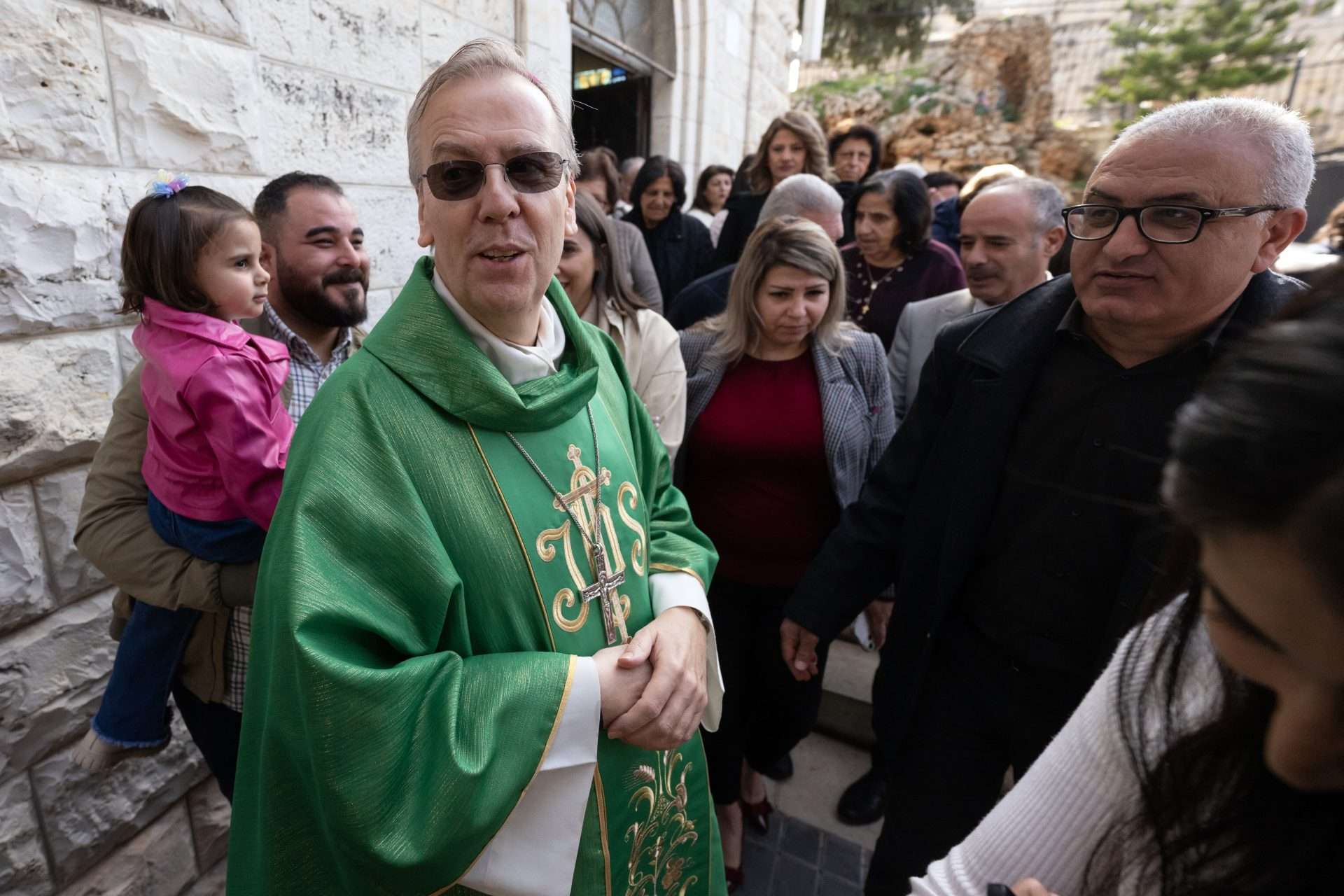
Bishop Nicholas Hudson after a Mass in the Church of Our Lady of Seven Sorrows in Aboud on Sunday.
Catholic Church in England and Wales / Mazur
Bishop Nicholas Hudson said he was struck by the lack of pilgrims on the streets of both Jerusalem and Bethlehem.
The Holy Land Coordination, a delegation from international bishops’ conferences, landed in the Holy Land for a five-day visit as the ceasefire brokered between Hamas and Israel in Gaza came into effect.
Bishop Nicholas Hudson, an auxiliary in the Archdiocese of Westminster and coordinator of the delegation, greeted the ceasefire with cautious optimism, as he and the other bishops – including Bishop James Curry, another auxiliary in Westminster, and Archbishop William Nolan of Glasgow – prayed for peace in the Church of the Nativity in Bethlehem.
“I prayed that aid might now be allowed to flow into Gaza – poor, beleaguered Gaza – and that people on both sides of the conflict might now be able to rebuild their lives,” said Bishop Hudson.
On 20 January, Gaza’s parish priest Fr Gabriel Romanelli IVE told the Latin Patriarchate of Jerusalem that “the sound of explosions and drones has finally stopped” and that some of those sheltering in the parish compound “to check on their homes or what remained of them”.
“Some discovered their homes were completely destroyed, while others have yet to locate their homes or even recognise the neighbourhoods they once lived in,” he said. “People are desperately seeking aid to address severe shortages of essentials like water, fuel, and food. The hardship is palpable, but so is hope and endurance, as the community holds onto the possibility of returning to some kind of normality.”
Fr Romanelli said aid agencies were providing food to thousands of families, while the parish continued its prayer and pastoral work including schooling for children approaching their secondary school Tawjihi exams. “This provides a much needed sense of hope,” he said.
The Holy Land Coordination delegates visited two projects in Bethlehem: St Martha’s House, a day care centre for elderly Christian women, and the Bethlehem Care and Hospice Trust, a Catholic charity offering compassionate care to those with life-limiting illness.
Bishop Hudson said he was struck by the lack of pilgrims on the streets of both Jerusalem and Bethlehem: “It brought home to me how hard it has been for places like Bethlehem these last 15 months, not to have pilgrims come to be with them, not to be able to support them economically – whether in cafés or shops – or to support St Martha’s House, or the hospice team. They were all saying the same thing, ‘You’re the first people who have come for such a long time. Thank you for coming. We need you to come more often.’”
Church welcomes ‘first step’ of ceasefire in Gaza
Palestinian Christians seek ‘turning point’ in Holy Land conflict
The Latin Patriarch of Jerusalem Cardinal Pierbattista Pizzaballa told the delegation that its support was much appreciated and a testament to the universal Church’s solidarity with the Church in the Holy Land. In a message from the Church of the Holy Sepulchre on 20 January, Cardinal Pizzaballa and the Custos of the Holy Land Fr Francesco Patton appealed for Christians to return to the Holy Land on pilgrimage.
The delegation visited the Tent of Nations, a Palestinian farm near Bethlehem where Daoud Nassar and family “refuse to be enemies” as they struggle to preserve their farm from being confiscated amidst regular seizure of Palestinian agricultural lands by Israeli settlers.
Fr Paul Lansu, a board member of Pax Christi International participating in the visit, said the delegation expressed their solidarity with the family through the challenges they face. Pax Christi has urged support for the Nassar family by spreading their message of nonviolence and demanding an end to threats of illegal seizure of their land.
Pax Christi International welcomed the ceasefire agreement to halt the violence and the release of hostages as “a rare moment of hope amid the suffering in Gaza where over 46,000 lives have been lost, countless families displaced, and infrastructure destroyed, leading to famine and disease”.
It lamented that in the West Bank, illegal settlements and settler violence are forcing Palestinian communities from their homes, saying “the scale of this trauma is unimaginable” and appealing for “the beginning of meaningful dialogue grounded in justice, equality, and the dignity of all people”. It said, “humanitarian aid must reach those in need, international law upheld, and illegal settlements ended”, and “we remain committed to a future where both Palestinians and Israelis live in peace, security, and mutual respect”.
Christian Aid also welcomed the ceasefire last week between Israel and Hamas but warned that “a sustainable peace is not possible until the illegal occupation of Gaza, and the West Bank – including East Jerusalem – is ended and Palestinians and Israelis are treated as equals”.
Stay updated — add us as a preferred news source on Google:


Help us keep The Tablet’s voice independent, clear and far-reaching.
Founded in 1840, The Tablet is the leading independent English-language Catholic weekly, celebrated for great writing, astute analysis, brilliant arts and books reviews and trustworthy reporting from correspondents in Britain, Ireland, Rome and across the world.
Independent, high-quality journalism is at the heart of what we do. The Tablet does not have deep pockets and we are not funded by rich donors. If you appreciate our work please consider supporting The Tablet’s Development Fund. It only takes a moment and you can cancel at any time.
- Support with £5 per month
- Support with £10 per month
- Support with other amount.

MOST READ ARTICLES
-
1
Pope returns to Vatican after hospital discharge
-
2
Diverse schools that are 100 per cent Catholic
-
3
Under endless skies
-
4
Battling confession fatigue
-
5
Nigerian bishop scorns suggestion of running in presidential election
-
6
Schismatic Spanish nuns strip contents of convent before eviction
FROM THE EDITOR'S DESK