Francis thanked Gaza parish in final call on Holy Saturday


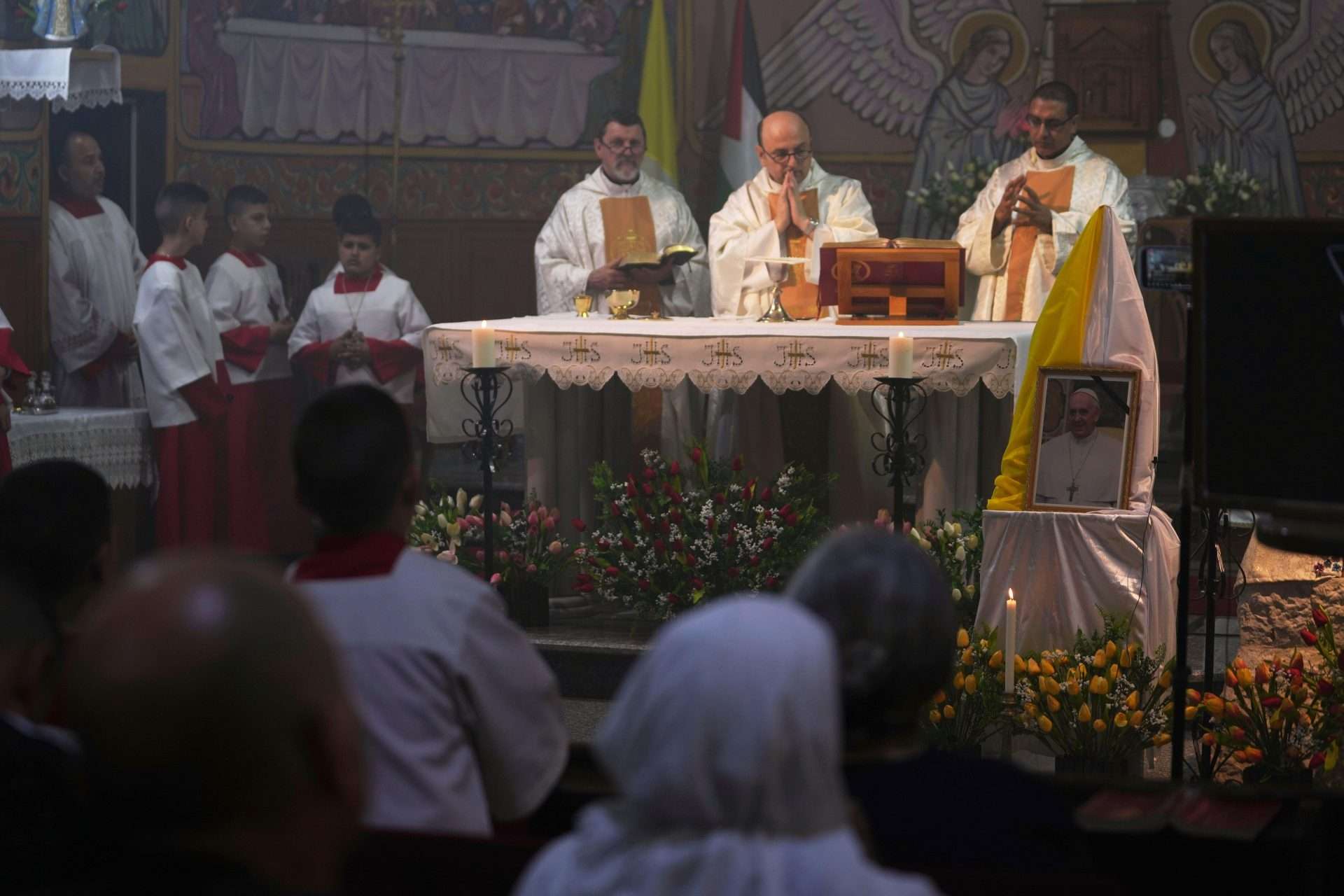
The Holy Family Parish in Gaza held a Mass on Monday to commemorate Pope Francis after learning of his death.
Jehad Alshrafi / Associated Press / Alamy
‘In Easter we celebrate the Resurrection, the triumph of life and love, and in these days Pope Francis has been called finally to see the face of God,’ said Cardinal Pierbattista Pizzaballa.
Pope Francis thanked the Holy Family Parish in Gaza “for all we made here” in his final call on Saturday, its parish priest said.
Fr Gabriel Romanelli IVE, speaking outside his church after the announcement of the Pope’s death on Easter Monday, said Francis had asked them to pray for him “and gave the blessing for all the people, for the Christian community and for all the citizens in Gaza”.
He said the Pope had called the parish “every day” when he was well for a year-and-a-half.
George Antone, the head of the parish’s emergency committee, said Pope Francis was “a saint who taught us every day how to be brave, how to keep patient and stay strong”.
“We lost a man who fought every day in every direction to protect this small herd of his,” he said. “He used to tell each one: I am with you, don’t be afraid.”
The Pope renewed his prayers for peace in the Holy Land in his Urbi et Orbi message on Easter Sunday. He appealed “for an immediate ceasefire in the Gaza Strip, for the release of the hostages … and for access to humanitarian aid”.
He called on the international community to act and “come to the aid of a starving people that aspire to a future of peace” and expressed his closeness to the people of Gaza where “the terrible conflict continues to cause death and destruction and to create a dramatic and deplorable humanitarian situation”.
Olga Cherevko, of the UN aid coordination office (OCHA), warned last weekend that in Gaza, “mass casualty events are now the norm, and hospitals treating trauma patients are doing so amid severe shortages of critical supplies, including medicine”. She added that “supplies that we had are rapidly running out, and we’re running out of food, medicine, shelter, and every other life-critical item if the situation does not change immediately.”
“Gaza was one of the symbols of his pontificate,” said the Latin Patriarch of Jerusalem Cardinal Pierbattista Pizzaballa in a message following Pope Francis’ death on Monday. “He was always close to the poor. He was always against the war – ‘War is a defeat’, he repeated this continuously – and he worked for peace. And the other point is the dialogue, between different religions, different cultures. This has always been the heart of his pontificate and all of what he was doing and thinking.”
Cardinal Pizzaballa said there was a “very interesting, very significant connection” in the Pope’s death after Easter Sunday.
“In Easter we celebrate the Resurrection, the triumph of life and love, and in these days Pope Francis has been called finally to see the face of God,” he said. “Now we have to pray for him. Surely now he is praying for us.”
‘We choose life, despite being surrounded by death’
The patriarch said all the churches and religious communities in Gaza were joining the Latin Patriarchate in mourning the Pope, who was “a religious leader for all the world”. Pizzaballa was to lead a Requiem Mass for the Pope in the Church of the Holy Sepulchre on Wednesday.
At the church’s Easter Sunday Mass, Cardinal Pizzaballa had warned of “a possible further deterioration of the political situation and the worsening humanitarian catastrophe that is unfolding, especially in Gaza”. He prayed especially for “our small community [at the Holy Family Parish], which for many months has become a sign and symbol of solidarity and hope, a small boat anchored to life, in a sea of pain and suffering.”
He insisted that “even though there are so many problems and difficulties that beset us, let us affirm with serene confidence and clear determination that nothing keeps us trapped in our tombs, that we are a living Church that does not give up in the face of the stones that lie before us.”
Holy Week celebrations in the West Bank faced severe restrictions from the Israeli authorities. Any Palestinian living outside East Jerusalem required a military permit to attend liturgies in the city, but only 6,000 permits were issued for the 50,000 Christians – mostly Catholic or Greek Orthodox – in the West Bank beyond East Jerusalem.
Local sources reported that the security services erected checkpoints around the Church of the Holy Sepulchre and obstructed the movement of worshippers – including Archbishop Adolfo Tito Yllana, the apostolic nuncio to Israel and apostolic delegate to Jerusalem and Palestine – detaining them at checkpoints and denying access to the church.
Pope appeals against ‘logic of fear’ in Urbi et Orbi message
A homily for the Easter Vigil – the night of our Passover
Stay updated — add us as a preferred news source on Google:


Help us keep The Tablet’s voice independent, clear and far-reaching.
Founded in 1840, The Tablet is the leading independent English-language Catholic weekly, celebrated for great writing, astute analysis, brilliant arts and books reviews and trustworthy reporting from correspondents in Britain, Ireland, Rome and across the world.
Independent, high-quality journalism is at the heart of what we do. The Tablet does not have deep pockets and we are not funded by rich donors. If you appreciate our work please consider supporting The Tablet’s Development Fund. It only takes a moment and you can cancel at any time.
- Support with £5 per month
- Support with £10 per month
- Support with other amount.

MOST READ ARTICLES
-
1
Archbishop of Cardiff-Menevia meets with other worldwide Catholic Church leaders to discuss liturgy
-
2
Let there be light
-
3
World Humanitarian Day: aid workers face a ‘crisis of protection’
-
4
Ruling allows French private hospitals limited exemption from assisted suicide
-
5
A tract for our times
-
6
The wisdom of the saints
FROM THE EDITOR'S DESK