Pope appeals against ‘logic of fear’ in Urbi et Orbi message


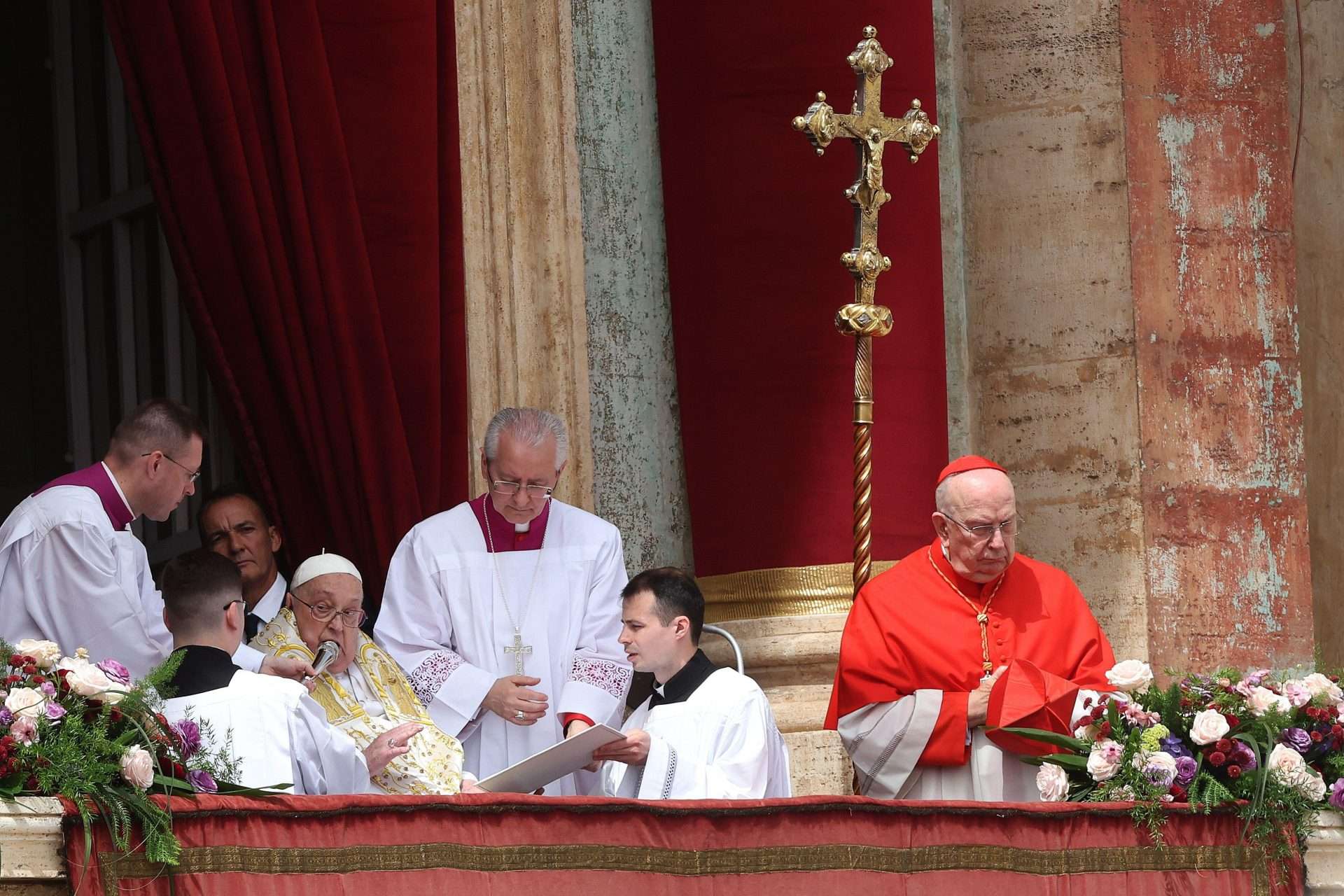
Pope Francis delivered the Urbi et Orbi blessing on Easter Sunday, though he asked an assistant to read out his address.
Marco Iacobucci / SOPA Images via ZUMA Press Wire / Alamy
Earlier in the morning, Pope Francis held a brief private meeting with the US Vice President J.D. Vance at the Casa Santa Marta.
Pope Francis decried the numerous conflicts across the world and appealed to world leaders “not to yield to the logic of fear” in his Easter message on Sunday.
The Pope’s traditional blessing, urbi et orbi, was read by Archbishop Diego Ravelli, the Master of Pontifical Liturgical Celebrations, in the presence of the 88-year-old pontiff in St Peter’s Square.
Francis, who arrived at the central loggia of the basilica in a wheelchair, greeted the faithful with a brief “brothers and sisters, Happy Easter” before asking Archbishop Ravelli to read the message on his behalf.
“I appeal to all those in positions of political responsibility in our world not to yield to the logic of fear which only leads to isolation from others, but rather to use the resources available to help the needy, to fight hunger and to encourage initiatives that promote development,” he said.
Earlier in the morning, Pope Francis held a brief private meeting with the US Vice President J.D. Vance at the Casa Santa Marta, according to the Holy See Press Office.
The meeting, which lasted only a few minutes, provided an opportunity for the two to exchange Easter greetings.
Vice President Vance met Cardinal Pietro Parolin on Saturday to discuss international relations, religious freedom, and humanitarian concerns.
The Pope’s Easter address focused particularly on war-torn regions, including Ukraine, the Holy Land, Myanmar, and various parts of Africa.
Regarding Gaza, where “the terrible conflict continues to generate death and destruction and to create a dramatic and deplorable humanitarian situation”, Francis called for decisive action: “I appeal to the warring parties: call a ceasefire, release the hostages and come to the aid of a starving people that aspires to a future of peace!”
He also lamented the “growing climate of anti-Semitism throughout the world” while expressing closeness to “the sufferings of Christians in Palestine and Israel, and to all the Israeli people and the Palestinian people”.
The Pope’s message emphasised that “there can be no peace without freedom of religion, freedom of thought, freedom of expression and respect for the views of others”. He added that peace is also impossible without “true disarmament”, warning against the “race to rearmament” that threatens global stability.
Reflecting on the spiritual significance of Easter, Francis reminded the faithful that Christ’s resurrection represents “the basis of our hope” and that “hope does not disappoint”. He characterised this hope not as “an evasion, but a challenge” that “does not delude, but empowers us”.
The message concluded with the Pope’s customary invocation for peace: “Let us entrust ourselves to him, for he alone can make all things new.”
This year’s Easter celebration held particular significance as it coincided with the 1700th anniversary of the Council of Nicaea and was celebrated on the same day by Catholics and Orthodox Christians following the Julian calendar.
After the blessing, Pope Francis greeted pilgrims around St Peter’s Square from the popemobile – the first time he has used the vehicle since his hospitalisation.
‘Intelligence of the cross’ frees us to love, says papal preacher
Pope Francis: a prophet of hope in a despairing world
Stay updated — add us as a preferred news source on Google:


Help us keep The Tablet’s voice independent, clear and far-reaching.
Founded in 1840, The Tablet is the leading independent English-language Catholic weekly, celebrated for great writing, astute analysis, brilliant arts and books reviews and trustworthy reporting from correspondents in Britain, Ireland, Rome and across the world.
Independent, high-quality journalism is at the heart of what we do. The Tablet does not have deep pockets and we are not funded by rich donors. If you appreciate our work please consider supporting The Tablet’s Development Fund. It only takes a moment and you can cancel at any time.
- Support with £5 per month
- Support with £10 per month
- Support with other amount.

MOST READ ARTICLES
-
1
Under endless skies
-
2
Leo pleas for besieged Ukrainian town in call with Putin
-
3
Battling confession fatigue
-
4
Restless statelessness
-
5
Pope Leo thanks staff at Mass in Gemelli Hospital
-
6
Study finds German dioceses failed to guard against spiritual abuse in lay groups
FROM THE EDITOR'S DESK