‘Drip-feed’ aid to Gaza is ‘political tool’, says Cafod


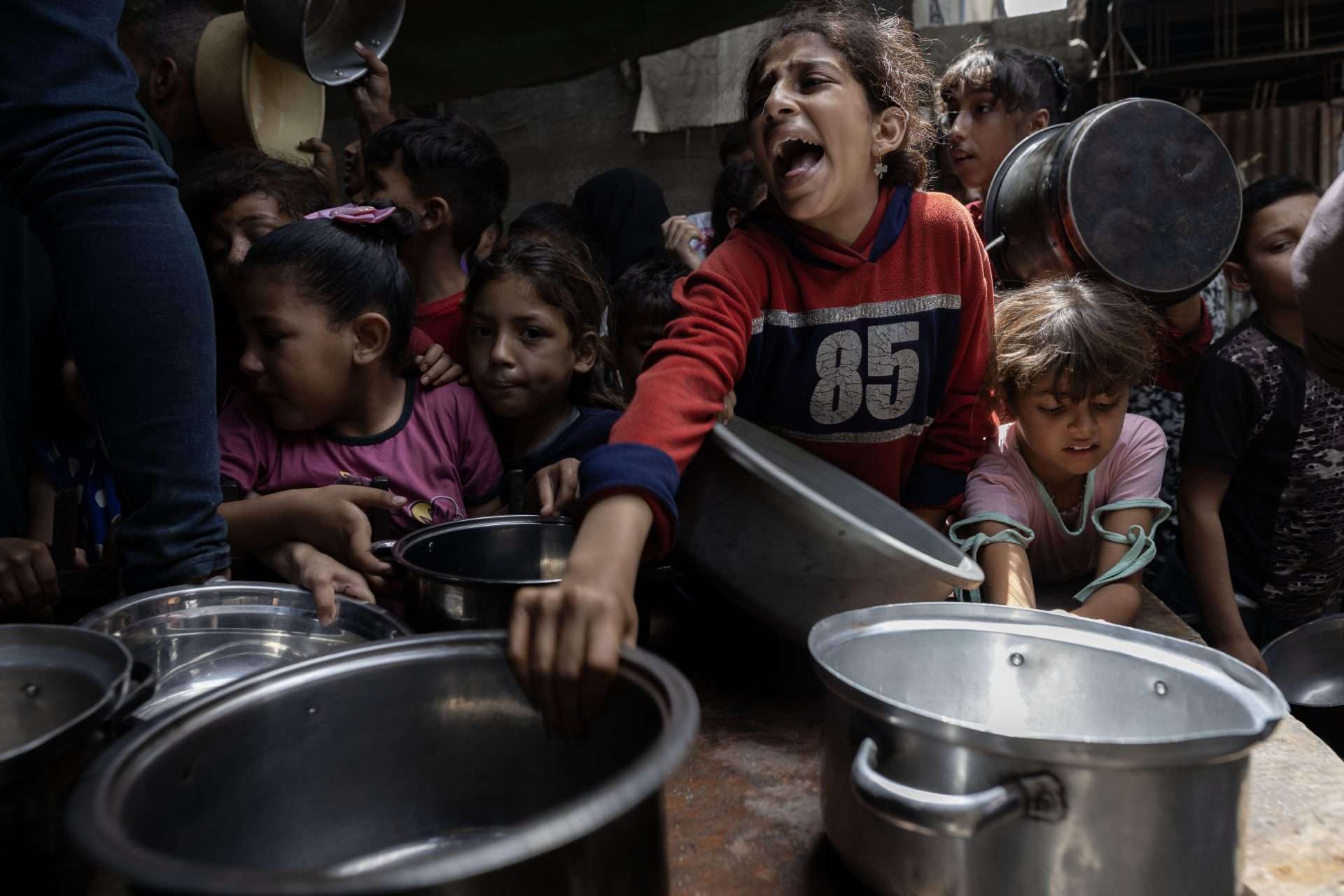
Palestinians in Gaza receive food at a displacement camp in Gaza City on 18 May.
Saher Alghorra / ZUMA Press Wire / Alamy
Vehicles carrying aid supplies have been waiting on the Gazan border for nearly three months while Israel blockaded the territory.
Cafod said that “drip-feeding” aid into Gaza while Israeli forces launched an intensified ground offensive was “not a humanitarian response”.
Responding the Israel’s announcement that it would allow limited food supplies into the territory during its latest operations, Cafod’s country representative for the Middle East Elizabeth Funnell said it was merely “announcing a minimal drip-feed of supplies into a humanitarian crisis to deflect international criticism whilst launching a military offensive”.
She said that “aid must never be used as a political tool”, adding that “bombing and starving a population and restricting their access to aid is a violation of international law”. Vehicles carrying aid supplies have been waiting on the Gazan border for nearly three months while Israel blockaded the territory.
“It is appalling that the international community is standing by and letting people be slaughtered,” said Funnell. “They must stand up and show their commitment to protect communities who have endured so much for so long.”
Cafod expressed concern for the safety of its partners, after airstrikes over the weekend hit areas close to two medical points run by Caritas Jerusalem, providing primary health care to communities. It said its partners were urgently reassessing the locations of aid delivery points for safety. Last week, the main medical centre run by Caritas Jerusalem was reopened, providing primary healthcare services.
The humanitarian crisis in Gaza is “at breaking point, with the Integrated Food Security Phase Classification, supported by the UN, warning of an imminent famine”, Cafod reported.
One of the aid agency’s partners, running a community kitchen, said: “I am glad that our community kitchen is still producing some meals, it’s poor nutritionally due to lack of supplies, but better than nothing. It’s real starvation – they try to call it other things to make it sound better but no, all of us in Gaza are hungry at the end of the day.”
Gaza’s health ministry said more than 53,000 people had died since the start of Israel’s campaign following the terror attacks of 7 October 2023 in which Hamas killed 1,200 people and took 251 hostages. The ministry, run by the Hamas authorities, reported that 464 people died in Israel Defence Forces (IDF) strikes last week.
On Monday, Pax Christi International was among the organisers of an international webinar for the Global Solidarity for Peace in Palestine coalition, on “Palestinian Religious Voices: Calling for an End to War”. Three Holy Land bishops and around 140 people took part.
The Latin Patriarch Emeritus of Jerusalem Michel Sabbah reflected that “the Churches are listening and trying to speak out” but they are not able to access the media effectively.
Bishop Emeritus Munib Younan, for many years the leader of the Evangelical Lutheran Church in Jordan and the Holy Land, thanked participants for still believing in peace based on justice.
“This encourages us to continue our struggle for peace based on justice,” he said, emphasising international solidarity. He said it saddened him that “many of the Churches around the world have been quiet, but we are thankful for the Churches that have raised their voices”.
He urged the international community “to assume its rule in bringing justice to Palestinians”, adding that Palestinian Christians – now less than one per cent of the Holy Land’s population – “still have a role for building peace and justice in Palestine”. He called for participants in the meeting “to pray for us and work for peace based on justice”.
Last week, the bishops of the Church of Norway – represents Lutherans, the largest Christian denomination in the country – issued a statement protesting at the unfolding events in Gaza and the West Bank.
“A ceasefire must be restored, hostages must be released, humanitarian organizations must be allowed to deliver food and medicine to Gaza, and the violence against the Palestinian population of the West Bank must be brought to an end,” they said, adding that “at this time, it is also necessary to increase pressure on the Israeli government to halt what appears to be an intentional policy of ethnic cleansing”.
The conference is a member of the World Council of Churches (WCC) which this week launched a campaign titled “Stop annexation, end the occupation” to advocate for a just peace in Palestine and Israel. The campaign, organised through the WCC’s Ecumenical Accompaniment Programme in Palestine and Israel, runs from 21 May to 11 June.
Church groups demand humanitarian access to Gaza
Palestinians rendered ‘invisible’, say Christian leaders
Stay updated — add us as a preferred news source on Google:


Help us keep The Tablet’s voice independent, clear and far-reaching.
Founded in 1840, The Tablet is the leading independent English-language Catholic weekly, celebrated for great writing, astute analysis, brilliant arts and books reviews and trustworthy reporting from correspondents in Britain, Ireland, Rome and across the world.
Independent, high-quality journalism is at the heart of what we do. The Tablet does not have deep pockets and we are not funded by rich donors. If you appreciate our work please consider supporting The Tablet’s Development Fund. It only takes a moment and you can cancel at any time.
- Support with £5 per month
- Support with £10 per month
- Support with other amount.

MOST READ ARTICLES
-
1
Pope returns to Vatican after hospital discharge
-
2
Diverse schools that are 100 per cent Catholic
-
3
Under endless skies
-
4
Battling confession fatigue
-
5
Nigerian bishop scorns suggestion of running in presidential election
-
6
Schismatic Spanish nuns strip contents of convent before eviction
FROM THE EDITOR'S DESK


