Bishops back call to transform economy to protect dignity of labour


Siân Thomas-Cullinan
‘We need proper jobs in decent workplaces, with secure homes and social security,’ said Dr Maria Exall. ‘This is the antidote to the pull towards the reactionary nationalist populism that promotes division and undermines our collective human dignity.’
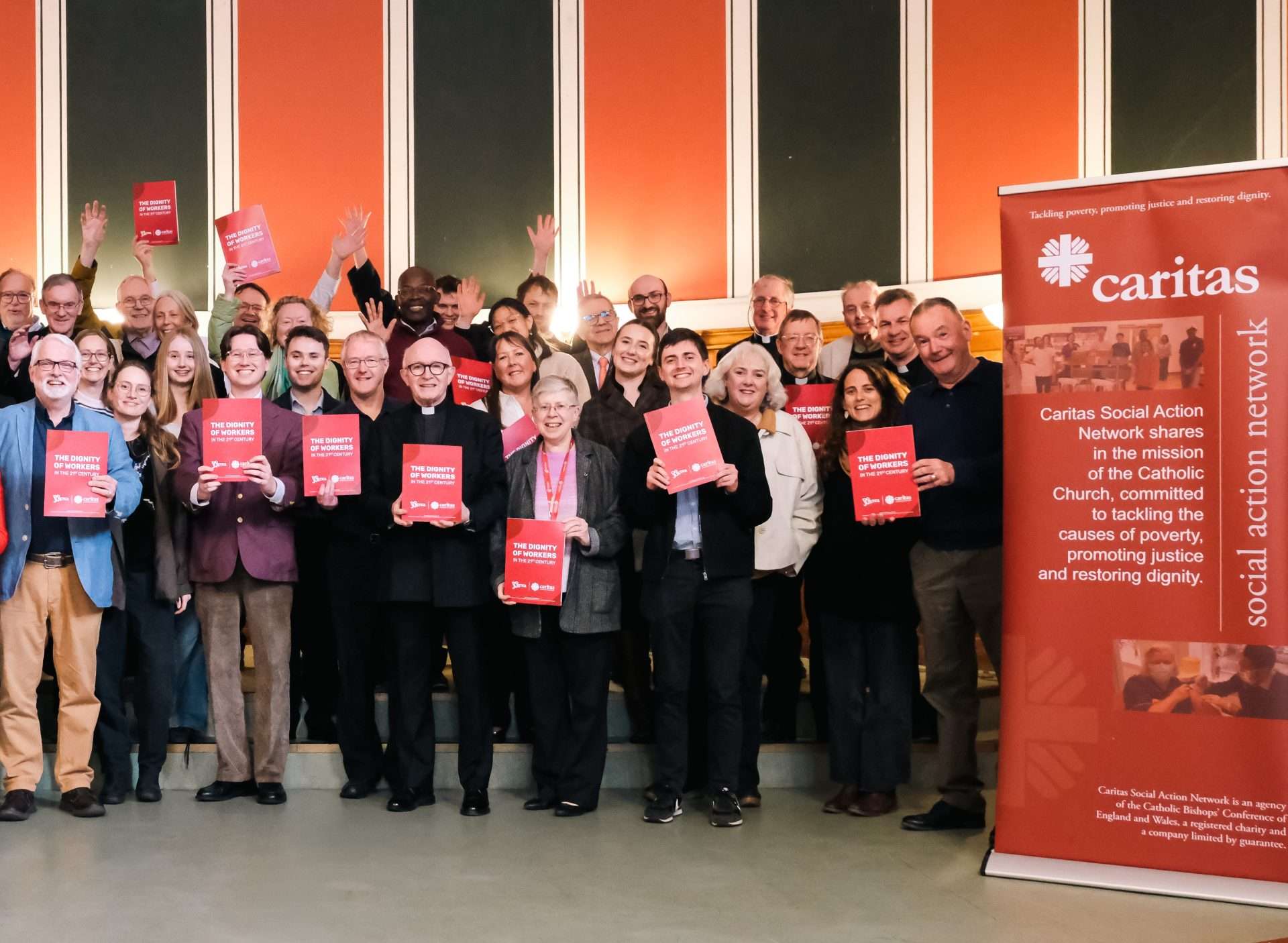
UK workers are increasingly “working harder, for longer, for less” due to four decades of neoliberal economics and widening inequality, a symposium convened by Caritas Social Action Network (Csan) was told.
This conference on the dignity of labour in the twenty-first century marked the 135th anniversary of Rerum Novarum, Pope Leo XIII’s encyclical on workers’ rights and the Industrial Revolution, on 15 May.
The event coincided with Pope Leo XIV signing his first encyclical, Magnifica Humanitas, which is expected to be published on 25 May and to address the implications of artificial intelligence for human dignity.
The conference, attended by Archbishop of Westminster Richard Moth as well as Archbishop John Sherrington Bishop John Arnold and Bishop Paul McAleenan, heard that the twenty-first century is witnessing a “crisis” of workers’ rights caused not just the rapid advance of AI, but also by “the deterioration in trade relations and the rise in inequality, which undermines the common good”.
“We are living through a time of radical change for work and the workplace, from what work we will do to how that work will be valued,” said Raymond Friel, chief executive officer of Csan. “It is an urgent moment to renew these discussions for the future of work, and the dignity of the worker.”
Dr Maria Exall, leading trade unionist and honorary fellow at the Centre for Catholic Social Thought and Practice at Durham University, warned that more than four million people in the UK work without proper employment rights.
“Workers without contracts with guaranteed hours must live with uncertainty, not knowing when their next shift will be or when or if they will be able to earn enough from week to week to pay their bills,” she said.
Exall said the UK also has the longest working hours and the highest level of unpaid overtime in Europe, due to the “predominance of free market dogmas” over the past four decades.
“Work intensification and a narrow instrumentalisation of productivity has created bullying cultures in too many workplaces,” she said. “This culture does not fit with teleological understandings of the nature of work in the Catholic Social Teaching tradition.”
She added that modern performance management has reached “a whole new level of effectiveness” because of the sophistication of digital tools of monitoring and surveillance and said this has exacerbated bullying cultures, including through the harassment and discriminatory treatment of those with mental and physical disabilities.
“We are at a crossroads,” Exall concluded. “The assumption that employees are mere units of production expected to meet accelerating targets, has become the norm.
“Rather than recognising the importance of taking pride in a job well done, and the satisfaction of the delivery of a good service, work becomes soulless and soul destroying.
“Either we change direction and integrate matters of social and environmental sustainability into our models of economic growth, or forces will take us down the authoritarian populist route of continuing labour exploitation, social division, and environmental destruction.”
Clifford Longley, Tablet leader writer and author of Just Money: How Catholic Social Teaching Can Redeem Capitalism, explained: “Neoliberalism is plainly not a scientifically sound economic theory”, because it wrongly assumes that “economics has no need of morality, that ‘the business of business is business’, and that what matters is the short-term maximisation of shareholder value”.
Longley presented the case study of migrant care workers, warning that many are living below the poverty line and working on zero-hours contracts with no compensation for travel time or sick leave.
He referenced research showing many migrant care workers do not receive the pay or working conditions they were promised, while others experience “severe forms of exploitation and modern slavery”.
Separately, new research from the Living Wage Foundation found that 78 per cent of low-paid workers said better pay would improve their health, while around three quarters said flexibility and predictable hours would benefit their wellbeing.
Graham Griffiths, the director of the Living Wage Foundation, said, “This makes the case even stronger for a real living wage across the health and social care sector in England.
“If we recognise that low pay damages health, it cannot be right that so many people working in care itself are still earning below the real Living Wage.
“Social care workers do vital, skilled and demanding work supporting the health and wellbeing of others every day. The sector should be leading the way on fair pay and healthy work, not lagging behind.”
Stay updated — add us as a preferred news source on Google:


Help us keep The Tablet’s voice independent, clear and far-reaching.
Founded in 1840, The Tablet is the leading independent English-language Catholic weekly, celebrated for great writing, astute analysis, brilliant arts and books reviews and trustworthy reporting from correspondents in Britain, Ireland, Rome and across the world.
Independent, high-quality journalism is at the heart of what we do. The Tablet does not have deep pockets and we are not funded by rich donors. If you appreciate our work please consider supporting The Tablet’s Development Fund. It only takes a moment and you can cancel at any time.
- Support with £5 per month
- Support with £10 per month
- Support with other amount.

MOST READ ARTICLES
-
1
Pope returns to Vatican after hospital discharge
-
2
Diverse schools that are 100 per cent Catholic
-
3
Under endless skies
-
4
Battling confession fatigue
-
5
Nigerian bishop scorns suggestion of running in presidential election
-
6
Schismatic Spanish nuns strip contents of convent before eviction
FROM THE EDITOR'S DESK


