Preserve the ‘human’ amid challenge of AI, plead archbishops


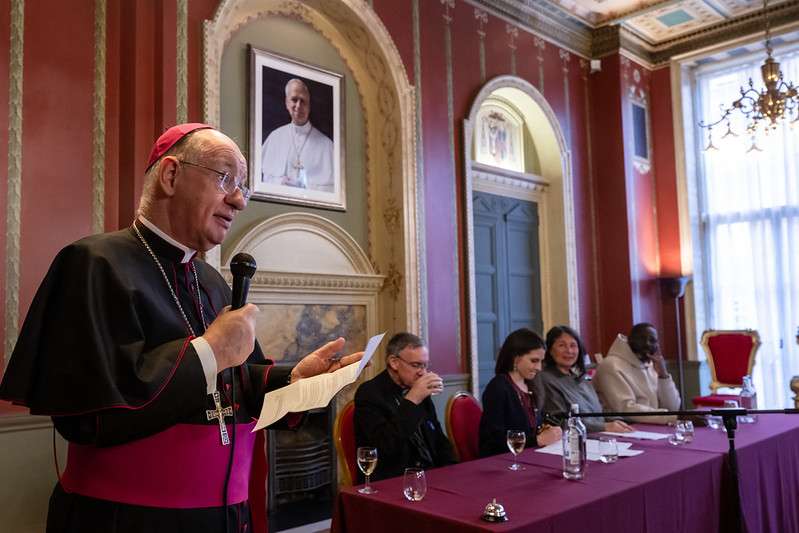
Archbishop of Westminster Richard Moth addresses communications at Archbishop’s House Westminster on Friday 15 May
© Mazur/cbcew.org.uk
The leader of the Catholic Church in Ireland has appealed to the faithful to ‘preserve human faces and voices’ amid the challenges posed by AI in communications and the media.
Reflecting on Pope Leo XIV’s message for Sunday’s 60th World Day of Social Communications, Archbishop of Armagh Eamon Martin said the Pontiff is “speaking into a world where technology can now copy a voice, create a face, imitate emotion, and produce words that sound human”.
He spoke out as Pope Leo on Friday signed his new encyclical, Magnifica Humanitas, the date chosen to mark the 135th anniversary of Pope Leo XIII’s 1891 encyclical Rerum Novarum on capital and labour, which addressed the social issues that resulted from the industrial revolution.
In his message for World Communications Day today, Pope Leo said, “Each of us possesses an irreplaceable and inimitable vocation, that originates from our own lived experience and becomes manifest through interaction with others. If we fail in this task of preservation, digital technology threatens to alter radically some of the fundamental pillars of human civilisation that at times are taken for granted. By simulating human voices and faces, wisdom and knowledge, consciousness and responsibility, empathy and friendship, the systems known as artificial intelligence not only interfere with information ecosystems, but also encroach upon the deepest level of communication, that of human relationships.
“The challenge, therefore, is not technological, but anthropological. Safeguarding faces and voices ultimately means safeguarding ourselves. Embracing the opportunities offered by digital technology and artificial intelligence with courage, determination and discernment does not mean turning a blind eye to critical issues, complexities and risks.”
The Pope in his message, said Archbishop Martin, is asking people to return to a simple but demanding truth: before a person is a profile, a statistic, a screen name, a consumer, a complainant, or a ‘case,’ they are someone created in the image and likeness of God. “Their face and voice matter.”
The Archbishop of Armagh noted that the Pope is reminding people that, at a time when technology can imitate the human face, clone the human voice, simulate affection, produce convincing falsehoods, and shape what people see, think and feel, “we must ask ourselves whether our communication is truly recognising, protecting and serving the human person”.
A person, Archbishop Martin underlined, is someone whose dignity must be honoured.
This understanding, he added, is “deeply Christian” because “in Jesus Christ, God has shown us His face, The Word became flesh. God did not communicate with us from a distance but came among us with a human voice, a human face and a human heart.”
Archbishop Martin suggested that in people’s use of technology, in their conversations, in parish life, in schools, in families, online and offline, “the question is not only, ‘Are we communicating efficiently?’ The question is, ‘Are we recognising the person before us?’”
Other questions that needed to be addressed he suggested were: “Are we listening to real voices? Are we protecting real faces? Are we speaking truthfully? Are we allowing technology to serve communion, or are we letting it replace encounter?”
The heart of Pope Leo’s message, the archbishop said, can be expressed simply: Christian communication recognises the person before us.
The Primate of All Ireland stressed that “a human person is not content. A human person is not data. A human person is not an image to be manipulated. A human person is not a voice to be silenced or copied.”
Rather, he stressed, a human person is “a child of God, with a face to be honoured and a voice to be heard”.
He suggested that Christian communication should never be cold, manipulative, faceless or mere strategy. “It must seek to carry something of the way Jesus communicated: truthfully, personally, mercifully, courageously.”
While Pope Leo had recognised that artificial intelligence and digital technologies can be useful, assisting communication, learning, creativity and access to knowledge, the Pope had warned that the question is not simply, ‘What can technology do?’.
“From a faith perspective the question goes much deeper,” Archbishop Martin said and he set out some of the questions people need to ask such as: “Does this help us become more human? Does this serve truth? Does this protect the vulnerable? Does this honour the dignity of the person? Does this deepen communion, or does it isolate us further?”
The Church, the archbishop, who is chair of the Communications Council of the Irish Catholic Bishops’ Conference, said, must always seek to preserve the faces of those who are easily hidden, edited out, mocked, exploited or forgotten.
These include the face of the poor; the face of the refugee; the face of the abused; the face of the lonely young person; the face of the elderly person in a room with no visitors; the face of Christ in the suffering human person.
“In a digital world of manipulated images and artificial faces Pope Leo invites us to look truthfully and tenderly at the real face before us.”
He highlighted that one of Pope Leo’s strongest warnings is that “we must not give up the human capacity to think, judge and discern. AI can produce polished answers. Algorithms can feed us what holds our attention. Social media can reward anger, speed and reaction, but none of these can replace conscience, wisdom and the slow work of truth.”
This is important for families, schools, parishes and public life, Archbishop Martin said and stressed that a Christian cannot simply ask, ‘What is everyone saying? What is trending? What does the machine tell me?’
Instead, a Christian must ask: ‘Is it true? Is it just? Is it loving? Does it honour the person made in God’s image? Does it lead me towards Christ or away from him?’
He appealed to people to listen before reacting. Check what is true before sharing. Protect the vulnerable and ask themselves if they hide behind screens when a real conversation is needed.
Inviting everyone to reflect on Pope Leo’s message for the Church’s annual World Day of Social Communications, he urged families to help children and young people use technology without losing real conversation.
He also suggested that schools should teach discernment, media literacy and respect for truth while parishes should ensure communication is personal, hospitable and not merely administrative; “use digital tools to lead people towards Christ”, he appealed.
To those in public life, he asked them to resist disinformation, manipulation and the dehumanisation of opponents.
Noting that St Carlo Acutis saw technology as a path to encounter, Archbishop Martin warned that technology becomes dangerous when it becomes a substitute for real presence, real friendship and real communion.
“Technology is at its best when it helps us to see Christ more clearly, and to love one another more deeply,” he said.
Archbishop of Westminster Richard Moth spoke of the responsibilities and opportunities of those working in communications to give a voice to those who cannot otherwise be heard or seen, and to rediscover the sacred nature of this task.
Bishop John Arnold, Bishop of Salford and lead bishop for communications for the Bishops’ Conference of England and Wales, also spoke about the opportunities and pitfalls of AI, agreeing with Pope Leo that the value of artificial intelligence must never outweigh the importance of human personality and our capacity for decision-making.
“We must value artificial intelligence, AI, in as far as it can be of benefit and it is a wonderful invention. But with all inventions we’ve got to be quite sure that it doesn’t intrude on personality, conscience or on people’s freedom to be who we are – made in the image of God.
“Many people are unaware of AI’s power to ‘persuade’, and if we allow AI to guide our decisions, we risk losing our sense of our own personality and humanity. The mechanical voice lacks the authenticity of the human mind, making its own decisions for the circumstances in which a person finds himself or herself.”
Speaking on the bishops’ Catholic News podcast, Bishop Arnold added, “Pope Leo is saying we must remind ourselves that artificial intelligence can be used to our benefit, but it mustn’t get to a place of priority in our lives that doesn’t add value. We must use it well, but not be governed or in any way dictated to by it.”
Also on Friday, Csan held a symposium marking the anniversary of Rerum Novarum, bringing together practitioners, theologians and policy professionals for reflection on how Catholic Social Teaching can shape responses to today’s labour challenges. Delegates looked at ontemporary challenges to the dignity of work, examining current threats and structural pressures affecting workers today.
Stay updated — add us as a preferred news source on Google:


Help us keep The Tablet’s voice independent, clear and far-reaching.
Founded in 1840, The Tablet is the leading independent English-language Catholic weekly, celebrated for great writing, astute analysis, brilliant arts and books reviews and trustworthy reporting from correspondents in Britain, Ireland, Rome and across the world.
Independent, high-quality journalism is at the heart of what we do. The Tablet does not have deep pockets and we are not funded by rich donors. If you appreciate our work please consider supporting The Tablet’s Development Fund. It only takes a moment and you can cancel at any time.
- Support with £5 per month
- Support with £10 per month
- Support with other amount.

MOST READ ARTICLES
-
1
Pope returns to Vatican after hospital discharge
-
2
Diverse schools that are 100 per cent Catholic
-
3
Under endless skies
-
4
Battling confession fatigue
-
5
Nigerian bishop scorns suggestion of running in presidential election
-
6
Schismatic Spanish nuns strip contents of convent before eviction
FROM THE EDITOR'S DESK