St Columban – celebrating the ‘White Dove’ of Europe


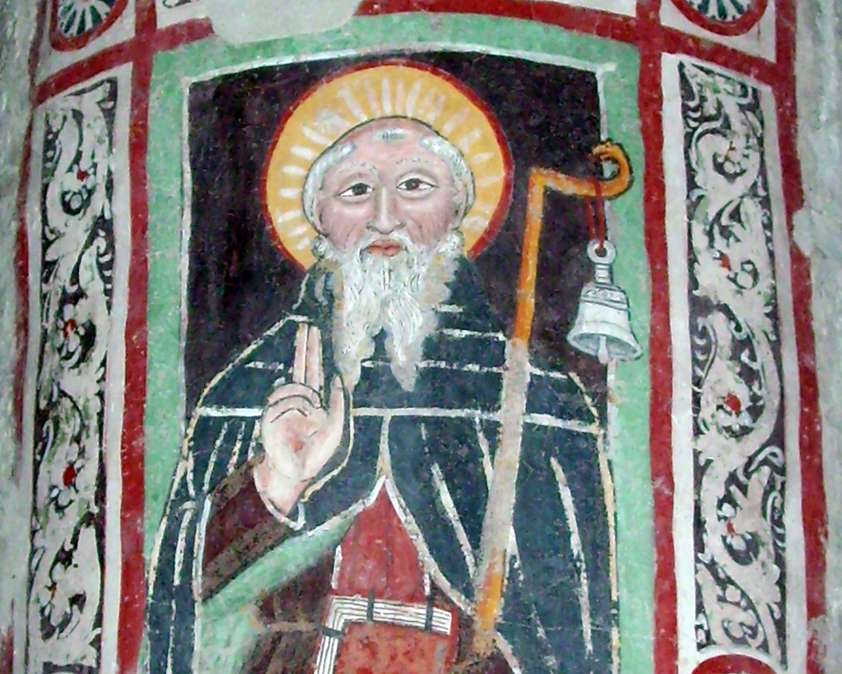
A fresco of St Columban in Brugnato Cathedral, in northern Italy.
Davide Papalini / Wikimedia Commons
Whether we are Franks, Irish or Britons or whatever race, we are members of one body.
St Columban to French bishops
Let us eat with the poor, drink with the poor, share with the poor.
St Columban, Sermon 7
Be helpful when you are at the bottom of the ladder and be the lowest when you are in authority…. A life unlike your own can be your teacher.
St Columban, Letter to the monks of Luxeuil
A few weeks ago, Ireland celebrated the new public holiday of St Brigid, Patron of the Diocese of Kildare and Leighlin and co-Patron of Ireland. Today Ireland celebrates St Patrick’s Day, a feast so popular it has become known globally.
Less known globally are the “Two Colms” (literally “Doves”) – Colm Cille and Colm Bán – both of whom had to leave their native land, the first in an act of political banishment, the second as a voluntary “exile for Christ” who became an unlikely champion of European unity as well as a thundering “prophet of truth” to the kingdoms through which he and his monks travelled until their last foundation at Bobbio, Northern Italy in 612AD.
Strong tradition has it that Columban (“White Dove”) was born in 540 at the foot of Mount Leinster, Co Carlow, and turned his steps northwards to the illustrious monasteries of Fintan at Cluain Ard, of Sinell on Cleenish Island (present day Lough Erne, Co Fermanagh), and finally to Comgall’s Abbey of Bangor, 15km east of Belfast, now better known as a sailing port and neighbouring city to golfer Rory McIlroy’s village of Hollywood, Co Down.
As if that wasn’t sufficient travelling for a monk of medieval times, in midlife Columban felt a new call to the “white martyrdom” of forsaking one’s land, family and nation to allow God to quite literally blow him (in a small boat) to which ever shore He wished, never to return home.
So it was that Columban, with 12 companions, began their sojourn through the European continent, founding abbeys in eastern France (Luxueil, Annegray and Fontaines), being expelled from (by the rage and jealousy of its rulers) and “miraculously returned” to Frankish territory by a storm in the sea, journeys through present day Austria and Switzerland, a dramatic parting of company with Gall – one of their number – who was disinclined to proceed any further (and who then founded the famous library, city and canton of St Gallen), and finally settling in Bobbio where Columban died in 615.
These continental communities have preserved the memory and cult of Columban over the succeeding centuries, and the Irish Church, too, has honoured him in various ways: his choice as patron of the “Maynooth Mission to China” (Columban Fathers) in 1916; his recognition by a number of Irish presidents (particularly Mary McAleese and Michael D. Higgins) as a true “architect of European unity” (echoing French Foreign Minister Schumann’s epithet in 1951 for the Irishman as “the patron of all who wish to build a more united Europe”).
In September 2024, the mapping and walking of the 568km Columban Way in Ireland was successfully completed. This year Bishop Denis Nulty and the people of the Diocese of Kildare and Leighlin are extending an invitation to people in Ireland, Britain and Europe to join a celebration of St Columban’s life and legacy in Carlow from on 11-13 July.
The programme will be a mixture of civil and church ceremonies of welcome (given there will be a goodly number of European mayors and bishops), a walking of the first steps of Columban’s “exile” from Mount Leinster to Myshall village, moments of ecumenical prayer with the local Church of Ireland community, two symposia on Columban’s historical importance as well as on biodiversity and climate change, a concert, local dancing and craftwork, culminating with a Jubilee Mass at Carlow Cathedral on Sunday 13 July.
We hope that relationships renewed and initiated during this weekend will grow and be precisely that leaven of unity which Columban so strenuously preached and lived. Kildare and Leighlin, as the diocese better known as the birthplace of St Bridget, it is fitting that honour be shown the other great “son of our soil”, Columban, Dove of Peace, Monk and Missionary.
Let us die to ourselves and live for Christ … let us be His, not our own … May He deign to grant us this who is with the Father and the Holy Spirit, one God, for ever and ever. Amen.
St Columban, Sermon 10
Fr Patrick Colgan is a Columban missionary.
Login
Please login to comment
0 Comments
Oldest

Help us keep The Tablet’s voice independent, clear and far-reaching.
Founded in 1840, The Tablet is the leading independent English-language Catholic weekly, celebrated for great writing, astute analysis, brilliant arts and books reviews and trustworthy reporting from correspondents in Britain, Ireland, Rome and across the world.
Independent, high-quality journalism is at the heart of what we do. The Tablet does not have deep pockets and we are not funded by rich donors. If you appreciate our work please consider supporting The Tablet’s Development Fund. It only takes a moment and you can cancel at any time.
- Support with £5 per month
- Support with £10 per month
- Support with other amount.

MOST READ ARTICLES
-
1
Nun girl summer: ‘You are so good at that’
-
2
Whisper it loud – the ‘still small voice’ of God is what we really want to hear
-
3
Pope Leo XIV: A good family is the best way to prevent drug addiction
-
4
Why Catholics are rediscovering ancient traditions such as the Brown Scapular
-
5
Bishops offer ‘message of hope’ to Venezuela with prayers for prisoners
-
6
New bid for Orthodox reconciliation in Ukraine as winter strikes continue
FROM THE EDITOR'S DESK