Learning the Victimae paschali for Easter


Catholic Bishops' Conference of England and Wales
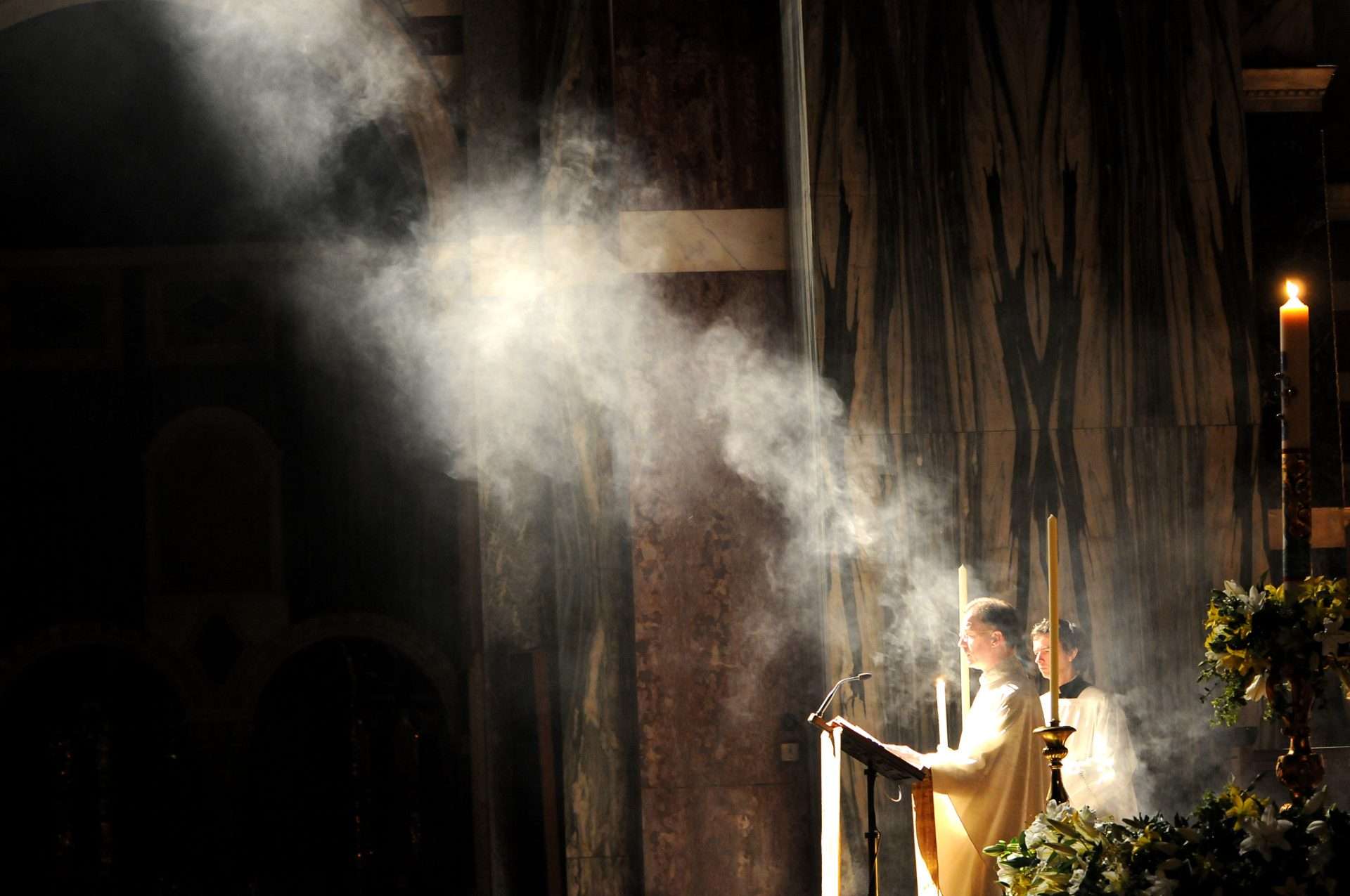
In only a couple of weeks now we will have reached Easter. As well as getting back the Gloria and the Alleluias (still sadly shorn of their exclamation mark), there is a particular extra bit of liturgy for Easter Sunday Mass.
It comes after the Second Reading and before the Alleluia-before-the-Gospel. It is of course the Victimae paschali. This is one of the “Sequences” that occur at various points in the Church’s year. Others include the Veni, Sancte Spiritus at Pentecost, and the Lauda, Sion, Salvatorem at Corpus Christi, which is where Panis angelicus comes from.
They can vary considerably in length; they can be late mediaeval or earlier; the Victimae paschali is tentatively dated to the turn of the first millennium. There is a blurred line between sequences and mediaeval hymns; Pange lingua is officially classed as a hymn, and that’s where we get the Tantum ergo which is so often a part of Benediction. Adeste fideles, the beloved hymn O come, all ye faithful, is a late one which shows them morphing into carols and other devotional music.
There used to be more of them, but we are now down to about four that make it into the Missal; and then you have to make choices, because there are various ways to deal with them. For some there are hymn versions available, so you can just sing them in English. The Veni, Sancte Spiritus has at least two very close translations which work beautifully, and are loved as hymns in their own right.
These are Latin traces of a much earlier Church. I would argue that there’s nothing magical or holy about Latin per se, but I would also say that these prayers, poems and songs are easy Latin, both in vocabulary and grammar, and entirely within the scope of any Sunday congregation. The Victimae paschali is in the Missal for Easter Sunday morning, with the line “The Sequence is said or sung at all Masses”, and you can use it at any time especially during the Easter Octave.
It’s given in English in the Missal, but that is not a good translation, lacking many of the virtues of the original. Like the Salve Regina, it is brief enough to use as an unaccompanied Entrance or Recessional hymn on weekdays, so once the congregation has learnt it, one can see how it might be useful.
Learning to sing the Salve Regina with the whole congregation was a similar project two years ago, and now we sing it at every Mary feast to keep it green, which works well. It’s a living link to the past; it is an achievement to have mastered it together; and it makes a lovely song to sing in honour of the Queen of Heaven.
So I decided to offer our congregation the chance to learn the Victimae paschali, as their Lent project this year. Of course we could do it with the choir alone, but it’s much better if everyone joins in; our choir is there to lead, not to take over the singing. The complete title of this piece of liturgical music is Victimae paschali laudes, meaning “the praises for the Easter Victim”, but mostly people abbreviate it to the first two words.
We could of course sing one of the hymn translations instead, which is what we did last year, or just listen to it being read in translation, but that seems a shame, given how elegantly this Sequence is constructed (and none of the translations that we have is as accurate as the Holy Spirit ones). As a piece of music it’s not very long, and the Church has been singing it at Easter for more than a thousand years.
As I said, it’s relatively easy Latin, because it was written so late, and it genuinely is one of the pieces of music that you might come across in a Catholic church anywhere in the world. If you did, you would want to be able to join in. I am sure that the current Pope, who launched his papacy with everyone in St Peter’s square singing the Salve Regina together, would approve.
We have a very mixed congregation, which is a plus for something like this, because some people will know it already; and we have a wide range of ages, which also helps. I knew I wasn’t teaching it to a group where no one knew it. But it was a new piece of music to many, it’s in Latin, and I had literally less than five minutes each Lent Sunday before Mass, so I broke it down into sections.
It’s built in sections anyway, so we could start with the minimum of preparation. The first line is a call to praise, and stands alone (like the last line, when we get to it). I pronounced it for them and translated it as literally as possible, so they knew what they were singing.
The second and third lines of music are the same, so we were able to get to the end of the third line in our first five minutes, and I was able to point out the little Latin flourishes – you can’t quite call them puns, but lines like “the Lamb has redeemed the sheep” are meant to be memorable because they are witty.
The following week we had the exciting dialogue section, where the singer asks Mary Magdalene what she saw on Easter morning, and she describes the empty tomb and the clothes neatly piled separately, exactly as in the Gospel account. The music is a bit more complicated, but again it repeats.
The words are in rhyming couplets (I said it was late Latin!), which helps to keep everyone on track. The week after we tried putting those two sections together. Next week we will learn the last line, which repeats an earlier part of the tune, and then concentrate on building all the bits together into a musical whole. The very last bit, almost a coda, will have to wait until Easter Sunday.
I wish I could have a bit more time, or do the practising at a point when more people have arrived, but you can’t have everything. I am sorry for the members of the congregation who are missing the fun because they haven’t arrived early enough, but I’m hoping that there will be a critical mass of those who know it which will float everyone else in to the beach. Mastering something new together is a brilliant way to grow community cohesion, even in five minute bursts.
It is a fascinating piece of music, spikier and funkier than the other sequences, especially in the dialogue section with Mary Magdalene. This is also important because half the dialogue is in a woman’s voice, which is really rare in the liturgy. I don’t want to put an accompaniment to the music, because it would destroy the movement and flex that is the life of plainchant, but I am occasionally tempted, when I’m singing it through to myself in the kitchen, by the thought of putting a beat behind it.
Because the lines are short, and rhyme in couplets, it’s not a huge leap to imagine certainly the dialogue section almost as an ancestor of jazz or rap. The words have one set of shapes and the music has another, interweaving with them. As it becomes more hopeful and excited, heading for the last line, the melody rises higher in contrast to the middle section, which makes it feel as though it is even higher than it actually is, and contributes to the excitement; but it’s also going back to an earlier part of the tune.
The music, the rhythm and the rhymes tie the whole piece together as tightly as Julian of Norwich’s hazelnut, and make it far easier to memorise than you might expect.
That last line also takes us back to the group we started with, the Christians who were invited to praise the Easter Victim, but now the group is “we”, and we have become a part of the story we have been telling in the third person. The piece ends with a plea for mercy, an Amen and an Alleluia, which means we can’t practise that bit until the end of Lent, so I sneakily sang the last two words with my congregation on the last Sunday before Ash Wednesday and asked them not to forget them before Easter.
I always worry about them forgetting the Gloria during Lent, and they always remember much better than I expect, so I’m hoping that will be the case here as well. I hope that by the time we get to Easter Sunday, the congregation will be excited to sing it all the way through, as it has been sung for centuries, but never by all of us before.
It is one of the oldest of songs; but we will be singing a new song, as the Psalms call on us to do so often, and for the best of reasons: our Easter joy.
Kate Keefe composes musical settings for the Mass and writes about the psalms. You can follow her on Facebook, Twitter, LinkedIn and Instagram.
Login
Please login to comment
0 Comments
Oldest

Help us keep The Tablet’s voice independent, clear and far-reaching.
Founded in 1840, The Tablet is the leading independent English-language Catholic weekly, celebrated for great writing, astute analysis, brilliant arts and books reviews and trustworthy reporting from correspondents in Britain, Ireland, Rome and across the world.
Independent, high-quality journalism is at the heart of what we do. The Tablet does not have deep pockets and we are not funded by rich donors. If you appreciate our work please consider supporting The Tablet’s Development Fund. It only takes a moment and you can cancel at any time.
- Support with £5 per month
- Support with £10 per month
- Support with other amount.

MOST READ ARTICLES
-
1
Healing and reconciliation must be a ‘priority’
-
2
Still hope for future even if old model of Church is dying, says Irish priest
-
3
Obituary: David Palmer, Composer of ‘Holy Boy’
-
4
Poll finds falling Catholic support for Trump ahead of US mid-terms
-
5
Horror without words
-
6
Cardinal Marx – on the money
FROM THE EDITOR'S DESK