Who can we trust on the Iran war?


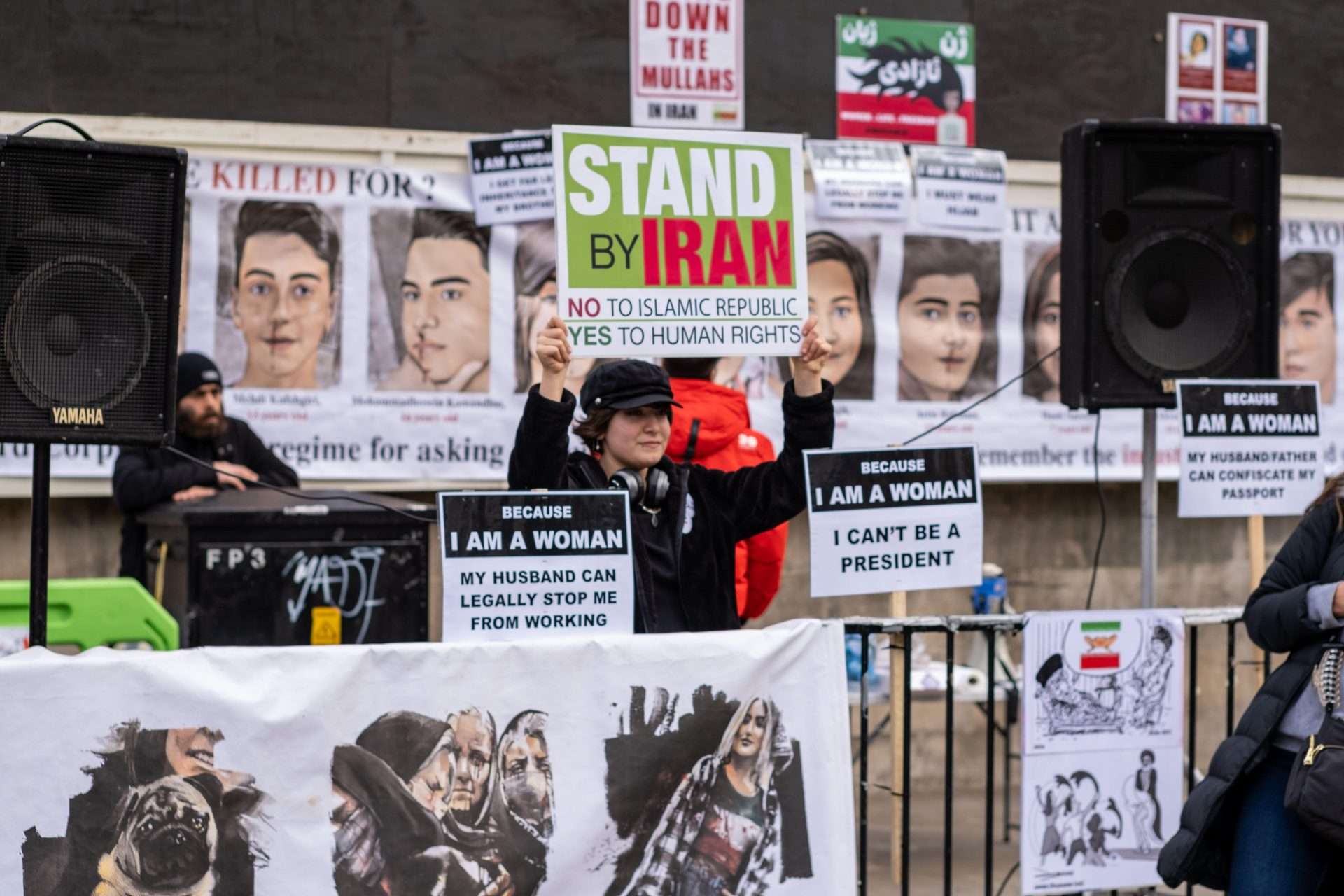
Woman holds up protest placard 'Stand by Iran' against the Iran Regime, during London protests, March 2023.
Orlando Britain/Alamy
A handful of Iranians were present at the small anti-war protest in my corner of little England this weekend, but not to condemn the war.
Instead, these Iranians, most of whom I first met during the “Women, Life, Freedom” demonstrations of 2022, were there to protest against the protest.
For, as was demonstrated in London over the weekend – when Iranians marched not with the anti-war protesters but in their own anti-regime rally – the truth is that many Iranians support the strikes; not because they are pro-war, but because they see no other way of ridding themselves, and the world, of the Islamic Republic.
I spent a few moments speaking with some of the anti-war demonstrators in Exeter on Sunday, and asked them whether the presence of Iranians – not supporting them, but demanding them not to speak for them – challenged their perspective.
In response, I was asked whether I supported the bombing of children – a nod to the widely reported strike on a school in Minab, which according to Iranian state media claimed over 150 lives, mostly of schoolchildren. My answer, of course, was that I did not support the bombing of children, but nor did I believe that the US or Israel would deliberately do such a thing.
A few moments later, as my Iranian friends continued to hold out their thumbs, pointing downwards, at the protesters, one of them shouted back in a thick Irish accent: “You’re f***ing traitors to your country!”
The Iranians took it quite well, though one of their British partners became upset, and it was at this moment that I bade my farewell both to my Iranian friends and their detractors.
As I left the scene, I asked myself how we had arrived at this moment in history, when activists on the streets of the UK – no doubt with good intentions – have ended up siding not with the people whose country is being bombed, but their oppressive leaders.
And as considered this, I thought back to the mainstream reporting of the conflict since it began on 28 February, much of which has focused on the human cost of the war.
Aside from the school bombing, there have also been interviews with Iranians who’ve fled the bombs and state-media aficionados, both of whose testimonies have given credence to the suggestion that this is a war that has been inflicted upon Iran by the United States and Israel, against the Iranian people’s wishes.
In stark contrast to this, working as I do for an Iranian human rights organisation I’ve had the privilege of connecting with many Iranians over the past week, and have heard very different takes.
“Iranians see this as a big help,” one Iranian, a Christian refugee in Turkey, told me last week, saying she’d been doing her best to educate her Afghan and Turkish friends about the true feelings of many Iranians at this time.
Many of her Turkish friends, she said, were surprised but expressed their joy at what she shared, but her Afghan friends were less convinced.
“I think they must be getting their news directly from the Iranian state TV,” my friend said.
Several Iranian colleagues of mine, meanwhile, told me they joined people on the streets of North London on the night Khamenei was killed, and danced in celebration at the death of the dictator.
Expressions of joy following someone’s death may go against our natural inclinations, but it is essential to note that Iranians are still in mourning following the worst massacre of citizens in the country’s recent history.
“We needed this moment,” one colleague told me, as he shared how congregants at a large Iranian church in London had danced together in celebration the following morning.
It is of course right to feel horror at the reported bombing of a school and concern at the widening of a conflict and the innocent lives that will have been taken and continue to be taken as a result of it, but I am also concerned that many consumers of mainstream media in the West today may have little to no understand of the hope many Iranians are feeling.
My refugee friend was in Tehran during the last Israeli strikes, in June 2025, and recalled how “horrible” it had been to watch bombs fall from outside her window, feeling sick because of all the smoke, and being unable to acquire basic necessities.
But now, having spoken to family members back home, when they’ve managed to connect amidst another Internet shut down, my friend told me she has heard only expressions of celebration and hope, as Iranians both inside and outside the country dare to dream that the tyranny they’ve endured for so long may finally be drawing to a close.
Our prime minister tells us we shouldn’t support “regime change from the skies”, but against a foe like the Islamic Republic of Iran, what other methods of effecting change exist?
No-one wants to be at war, and Tehranis today will no doubt also be as scared as my refugee friend was last June, but I believe it to be a great tragedy that much of our media only seems to focus on the devastating effects of war, rather than also providing coverage of the hope that exists among Iranians.
We each live within our own echo chambers, of course, and social media algorithms, including X’s, don’t help in that regard.
One imagines that the anti-war demonstrators in London and Exeter, or those who joined the recent vigils to mourn Ayatollah Khomeini’s death, receive a different set of information from their algorithms and also believe their own view of reality to be the correct one: that Israel and the US are the bad guys, and Iranians – and even the regime – are the victims.
But as we each seek to make sense of what is unfolding, surely it is the voices of the Iranians themselves we should be listening to.
Steve Dew-Jones is news director of Article 18.
Login
Please login to comment
0 Comments
Oldest

Help us keep The Tablet’s voice independent, clear and far-reaching.
Founded in 1840, The Tablet is the leading independent English-language Catholic weekly, celebrated for great writing, astute analysis, brilliant arts and books reviews and trustworthy reporting from correspondents in Britain, Ireland, Rome and across the world.
Independent, high-quality journalism is at the heart of what we do. The Tablet does not have deep pockets and we are not funded by rich donors. If you appreciate our work please consider supporting The Tablet’s Development Fund. It only takes a moment and you can cancel at any time.
- Support with £5 per month
- Support with £10 per month
- Support with other amount.

MOST READ ARTICLES
-
1
Healing and reconciliation must be a ‘priority’
-
2
Still hope for future even if old model of Church is dying, says Irish priest
-
3
Obituary: David Palmer, Composer of ‘Holy Boy’
-
4
Poll finds falling Catholic support for Trump ahead of US mid-terms
-
5
Horror without words
-
6
Cardinal Marx – on the money
FROM THE EDITOR'S DESK