News Briefing: Church in the World


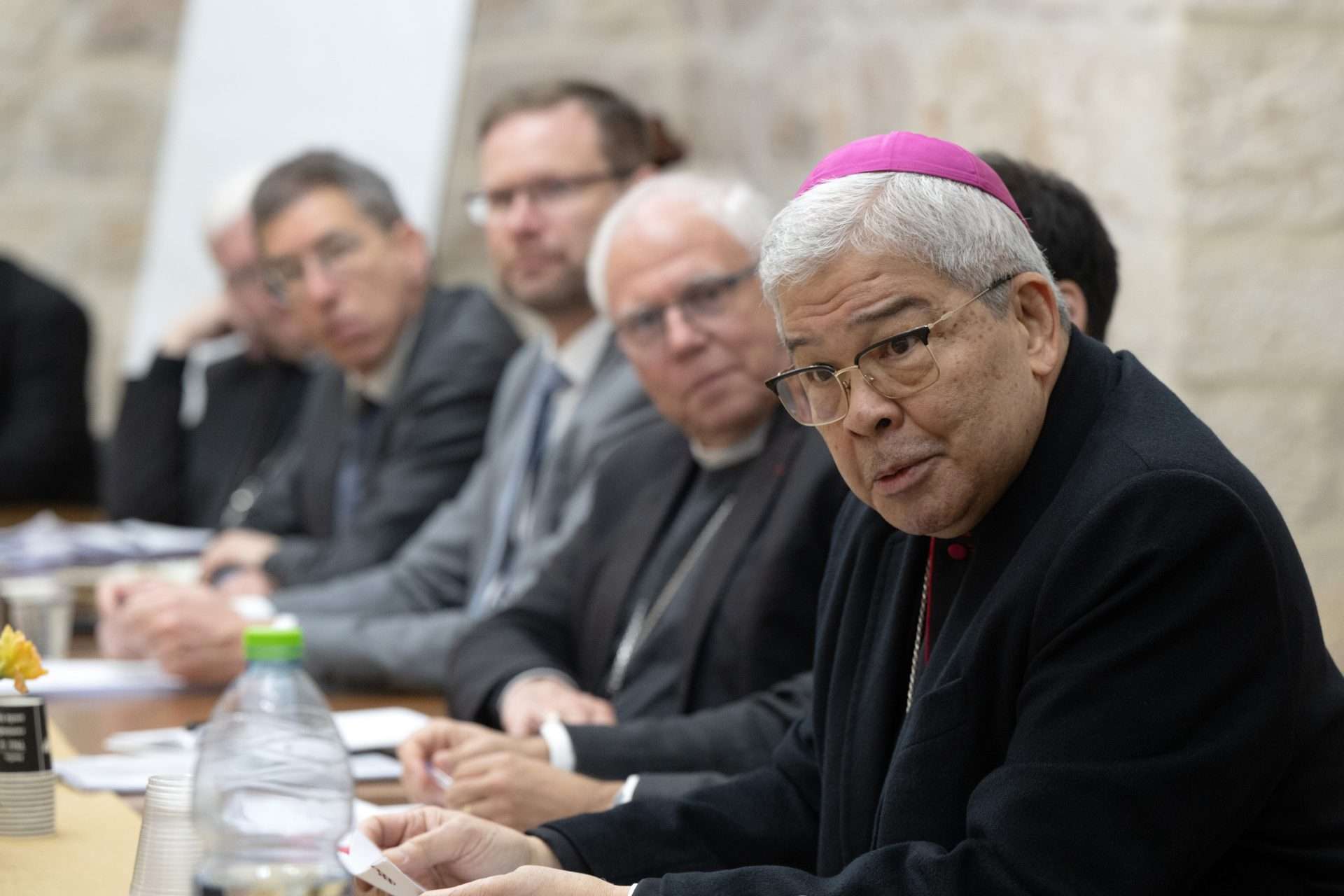
The apostolic delegate to Jerusalem and Palestine and apostolic nuncio to Israel Archbishop Adolfo Tito Yllana retired after four and a half years in post.
The Catholic Church in England and Wales / Mazur
Peru’s Ambassador to the Holy See Jorge Ponce Román invited Pope Leo to visit the country during a ceremony in the Vatican gardens. The Pope attended the unveiling of a mosaic of Our Lady and a statue dedicated to St Rose of Lima in the gardens on 31 January, where Ponce voiced hopes that he would visit Peru “very soon”.
The artworks were commissioned by the Peruvian Bishops’ Conference, which was conducting its ad limina visit to the Vatican. During their audience with Pope Leo, he recalled his time as Bishop of Chiclayo in northern Peru from 2015 to 2023 and said the country held “a special place in my heart”.
The Archbishop of Port-of-Spain Charles Jason Gordon called for a ban on social media for children in Trinidad and Tobago, while also warning of serious consequences for children exposed to artificial intelligence in education.
Archbishop Gordon, president of the Antilles Episcopal Conference, wrote this week in his diocesan weekly The Catholic News that “we are living through one of the most decisive educational moments in human history”. He warned that children’s brains “do not develop properly” if they become “dependent on an external cognitive prosthesis”.
He said there was a danger of “raising a generation that sounds articulate, produces polished work, and answers questions fluently, but lacks depth, resilience, originality and moral judgement”. Prime Minister Kamla Persad-Bissessar said her government was willing to consider a ban.
Haiti remains too dangerous to deport people there, warned the chairmen of two committees at the US Conference of Catholic Bishops (USCCB), calling on the Trump administration to reconsider its decision to remove Temporary Protected Status (TPS) from Haitian immigrants living in the United States.
“There is simply no realistic opportunity for the safe and orderly return of people to Haiti at this time,” said a statement from Bishop Brendan Cahill of Victoria, Texas, chairman of the Committee on Migration, and Bishop A. Elias Zaidan of the Maronite Eparchy of Our Lady of Lebanon of Los Angeles, who chairs the Committee on International Justice and Peace.
Their statement followed the decision by the Secretary of Homeland Security Kristi Noem’s to terminate TPS for Haiti from 3 February. More than 300,000 Haitians in the US are covered by the designation. The USCCB noted that the Department of State’s travel advisory for Haiti is Level 4 because of “life-threatening risks” that include kidnapping, terrorist activity and civil unrest.
Pope Leo XIV expressed “great concern” over tensions between the United States and Cuba. Speaking after the Angelus on Sunday, the Pope echoed an appeal from the island’s bishops on 31 January for “dialogue” to prevent hostilities: “I join the message of the Cuban bishops, inviting all those responsible to promote sincere and effective dialogue, in order to avoid violence and any action that could increase the suffering of the beloved Cuban people”, he said.
The bishops’ statement addressed the growing economic and humanitarian issues on the Caribbean island. “Cuba needs changes, and they are increasingly urgent, but it does not need any more anguish or pain,” they said. “No more blood and no more mourning in Cuban families. We have had too much of that in our recent history!”
The bishops said they long for a “renewed, prosperous and happy Cuba”, but added that it cannot come at the cost of increased suffering. They noted the imposition of US tariffs on countries that export oil, saying that “the risk of social chaos is real”. The statement concluded: “The unchanging position of the Pope and of the Holy See, consistent with international law is that governments should be able to resolve their disagreements and conflicts through dialogue and diplomacy, not coercion or war.”
Three USCCB committee chairmen praised the US State Department’s move to publish three new rules that significantly expand the “Mexico City Policy”.
The State Department referred to those three rules collectively as the Promoting Human Flourishing in Foreign Assistance Policy. Historically, the policy has restricted federal money from non-governmental organisations that provide or refer abortion services abroad.
“We support robust funding for authentic lifesaving and life-affirming foreign assistance and applaud new policies that prevent taxpayer dollars from going to organisations that engage in ideological colonisation and promote abortion or gender ideology overseas,” the bishops said in a statement on 30 January.
“We also call for the implementation of any related policies to be carried out in a manner that recognises the inherent dignity of every human person and does not harm those who are racially or ethnically marginalised,” they continued.
Pope Leo accepted the resignation of Bishop Paskalis Bruno Syukur OFM of Bogor at the age of 53, after 12 years in post. In October 2024, Pope Francis named the Indonesian prelate a cardinal but he asked to be allowed to decline the appointment.
His resignation more than 20 years before the mandatory episcopal retirement age followed a Vatican-commissioned investigation of allegations of authoritarianism and mismanagement in the diocese.
Announcing his resignation on 19 January, Syukur said he resigned “not with a sense of loss but with freedom of heart”. He defended his conduct as bishop in a separate statement, and said he had been asked not to accept the appointment as cardinal after claims that he mishandled sex abuse allegations.
Church authorities in Sri Lanka demanded legal action after police assaulted a priest. Fr Milan Priyadarshana of the Archdiocese of Colombo was admitted to hospital on 24 January following an assault by police officers who stopped him on his motorcycle while he was travelling back from celebrating a Mass, according to reports. Six officers later appeared in court and were remanded, while Church officials said they would file a petition on Fr Priyadarshana’s behalf seeking accountability.
The Inter-Regional Meeting of Bishops of Southern Africa (IMBISA) appealed for relief aid for thousands of people affected by recent floods that devastated parts of the region, while welcoming Pope Leo’s support for the region “with gratitude”.
According to reports, more than 100 people have been killed by the floods, with thousands left homeless. The IMBISA bishops expressed their “solidarity with the people of Mozambique, South Africa and Zimbabwe, who are presently experiencing the disastrous effects of floods following torrential rains and the tragic loss of life, displacement of people, and damage to homes”.
Record rainfall in Mozambique, Malawi, South Africa and Zimbabwe has destroyed homes and bridges and claimed livestock, with government departments still assessing the cost of the devastation.
“We recognise with gratitude the unity and prayers expressed by our Holy Father, Pope Leo XIV for the countries affected, urging the universal Church to be in solidarity with those experiencing this difficult time,” IMBISA said. “We appeal to humanitarian organisations, governments and all people of good will to offer a helping hand to those affected by this tragic event.”
The Zimbabwe Catholic Bishops’ Conference (ZCBC) and the Catholic University of Zimbabwe (CUZ) argeed a joint initiative to address social health through the formal training of therapists and counsellors. Church officials said their Memorandum of Understanding signed on 29 January is part of a broader response to the country’s social, emotional and spiritual challenges.
“Safeguarding is something the conference takes very seriously, and teachers are key in creating safe environments where children can grow into who they are meant to be,” said Fr Tryvis Moyo, secretary general of the ZCBC. The agreement will support training for Zimbabwean educators.
“Teachers are not only expected to impart knowledge, but also to serve as mentors, counsellors and guardians of learners’ holistic wellbeing. This programme equips them with skills to nurture intellectual, emotional, moral and spiritual development,” said Prof Ben Nyambo, the CUZ vice-chancellor.
Bishops in Zambia called for a level playing field for candidates in elections slated for later this year and called on churches and clergy to be non-partisan. They denounced the use of state resources to promote the ruling party.
The message was issued last week amid heightened tensions as political parties escalate their campaigns, with the bishops warning that the campaigns must be guided by “civility” and “focus on issues not insults” if the election is to be credible.
“Politicians should state how they will address the cost of living, how they will improve the energy sector and grow the economy sustainably and what steps they will take to combat poverty,” they said.
“We have consistently affirmed that the Church is not and must never be a mouthpiece for any political party or candidate. Our duty is to form consciences, promote the common good and speak truth to power.”
Pope Leo offered prayers for victims of a mine collapse in the Democratic Republic of Congo. “I assure my prayers for the many victims of the landslide in a mine in North Kivu, in the Democratic Republic of the Congo,” he said after the Angelus on Sunday.
Hundreds of people died during mudslides in eastern DR Congo, a region still blighted by fighting over access to minerals. According to local reports, more than 200 people died after the mine in North Kivu gave in and buried men, women and children as a result of a mudslide triggered by heavy rains on 30 January.
“May the Lord sustain those who suffer so much,” the Pope said. The mine produced coltan, a metallic ore used in the production of smartphones, computers and aircraft engines. While considered one of the continent’s richest countries because of its mineral wealth, DR Congo remains mired in a protracted civil war that has worsened widespread poverty.
The Justice and Peace Commission of the Diocese of Kumbo reported that at least 3,000 Cameroonians have been victims of a criminal network that trafficked them to camps in Nigeria.
The report compiled in collaboration with Nigerian partners said that the victims – mostly young people from Cameroon’s conflict-ridden North-West and South-West regions – were promised lucrative employment but were housed in squalid camps where they suffered exploitation.
Their captors used the victims as leverage to extort ransoms from their impoverished families before ultimately selling them into modern-day slavery.
The Supreme Council for Shari’ah in Nigeria (SCSN) demanded the removal of the chairman of the Independent National Electoral Commission (INEC) Prof Joash Amupitan, saying his role poses a “serious threat to the credibility of Nigeria’s democratic process”.
In 2022 Prof Amupitan, a pastor, authored a legal brief which alleged the existence of a Christian genocide in Nigeria. The SCSN said Muslims across the country would not recognise or legitimise any election conducted under the leadership of such an INEC chairman.
Speaking at the council’s pre-Ramadan lecture and general assembly in Abuja on 27 February, its president Sheikh Bashir Umar said the demand was based on Amupitan’s “questionable antecedents, particularly his opinion about Christian genocide in the country”, which he said the federal government has repeatedly dismissed.
Pope Leo appointed Archbishop Giorgio Lingua as apostolic delegate to Jerusalem and Palestine and apostolic nuncio to Israel on 22 January. A former nuncio to Cuba and Croatia, Lingua succeeded Archbishop Adolfo Tito Yllana who retired the same day aged 77 after four-and-a-half years in post.
Church agencies in the Holy Land warned that continued restrictions on access to Gaza threatened the lives of thousands of Palestinians in need of medical treatment, after Israeli authorities reopened the Rafah crossing into Egypt on 2 February subject to strict limits.
The bishops of the Ukrainian Greek Catholic Church in western Europe launched a fundraising effort for victims of Russian strikes that have destroyed much of Ukraine’s energy infrastructure.
In an appeal issued after a meeting in London last week, the bishops said that “when the enemy weaponises the cold of winter, we must not allow cold indifference to take root in our hearts”.
A special collection on 8 February to fund support for Ukrainians suffering from cold and hunger will “aim to warm them with the love of God and our solidarity as fellow humans”, the appeal said.
Churches in the German state of Sachsen-Anhalt issued a warning about the draft manifesto of the far-right Alternative für Deutschland (AfD) in forthcoming state elections.
The party proposes to abolish the church tax as well as the benefits paid to the churches for the expropriation of their property by the Prussian state during secularisation in the nineteenth century. It would also abolish the German practice of church asylum for people in danger of deportation.
The AfD claims that large churches in particular no longer represent Christian values but a “rainbow ideology”. In recent polls, the AfD reached 40 per cent in the East German state.
“The AfD’s demands pose a serious threat to the existence of the local Catholic Church in Saxony-Anhalt. AfD, that stands for fear, enmity and discrimination [Angst, Feindschaft und Diskrimierung],” the head of the Catholic office of Saxony-Anhalt, Mathias Bethke, told the outlet katholisch.de. Bishops fear drastic cuts in areas such as social care, culture and integration.
Church representatives in Germany have repeatedly stated that AfD membership is not compatible with the Christian faith.
Last week, the Vatican confirmed the exclusion of the Saarland MP Christian Schaufert from his local parish council after he complained to Rome about the Bishop of Trier Stefan Ackermann’s decision to bar him from the position.
Legislation for assisted suicide and euthanasia in Italy risks “weakening the public commitment to the most frail and vulnerable”, the Archbishop of Bologna Cardinal Matteo Zuppi said.
Speaking on 26 January during a meeting of the permanent council of the Italian bishops’ conference, of which he is president, Zuppi said a bill due before the Senate this month could convince vulnerable people “that they have become a burden to their families and to society as a whole”.
He continued: “The answer to suffering is not to offer death, but to guarantee forms of social support, continuous health care and home health care, so that the patient does not feel alone and families can be supported and accompanied.”
The daughter of a victim of the rail crash in Adamuz said only a religious funeral was fitting for those killed, amid public anger at the Spanish government’s response to the disaster.
“Thank you to our diocese for this funeral, which is the only funeral possible for this farewell, since the only presidency we want by our side is God’s [he] who has become present in the bread and the wine under the gaze of his mother,” said Liliana Sáenz during a Requiem Mass celebrated by the Bishop of Huelva Santiago Gómez Sierra on 29 January.
Sáenz, whose mother Natividad de la Torre was one of 45 passengers killed in the crash on 18 January, added: “Huelva is a Marian land, Andalusia is a people who believe and embracing its Cross is where we find the greatest consolation.”
King Felipe VI, Queen Letizia and the first vice president María Jesús Montero were part of the 4,000-strong congregation gathered in the sports hall of the city of Huelva. Afterwards the king and queen embraced survivors and their relatives, who had refused to attend a “secular” state funeral for victims planned by the Spanish government for 31 January.
A schismatic community of former Poor Clares launched an online campaign to find a new home after a court rejected their appeal against eviction from their monastery in northern Spain. The “Queremosunconvento.com” (“Wewantaconvent.com”) webpage went live days after the provincial court of Burgos rejected the appeal against a legal order to evict them from the monastery of the Poor Clares of Belorado, near Burgos. The community is due for eviction from Belorado on 10 February.
Stay updated — add us as a preferred news source on Google:


Help us keep The Tablet’s voice independent, clear and far-reaching.
Founded in 1840, The Tablet is the leading independent English-language Catholic weekly, celebrated for great writing, astute analysis, brilliant arts and books reviews and trustworthy reporting from correspondents in Britain, Ireland, Rome and across the world.
Independent, high-quality journalism is at the heart of what we do. The Tablet does not have deep pockets and we are not funded by rich donors. If you appreciate our work please consider supporting The Tablet’s Development Fund. It only takes a moment and you can cancel at any time.
- Support with £5 per month
- Support with £10 per month
- Support with other amount.

MOST READ ARTICLES
-
1
Archbishop of Cardiff-Menevia meets with other worldwide Catholic Church leaders to discuss liturgy
-
2
Let there be light
-
3
World Humanitarian Day: aid workers face a ‘crisis of protection’
-
4
Ruling allows French private hospitals limited exemption from assisted suicide
-
5
A tract for our times
-
6
The wisdom of the saints
FROM THE EDITOR'S DESK