We are made to delight in the goodness of all God’s creation


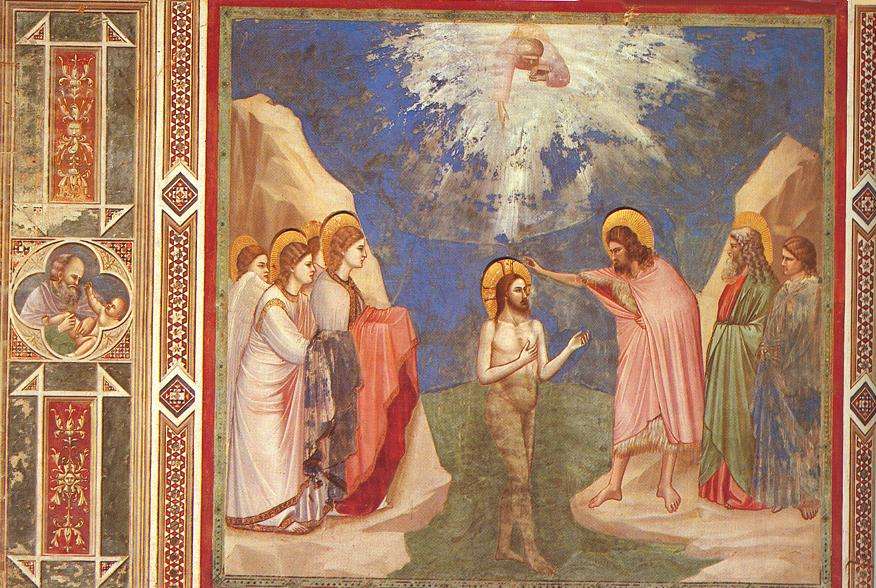
The Baptism of Christ by Giotto (1303)
THE BAPTISM OF THE LORD | MATT 3:13-17 | 11 JANUARY 2026
Today’s feast, the Baptism of the Lord, is both an end and a beginning. Liturgically, it marks the end of Christmastide; textually, it marks the beginning of Jesus’ public ministry. But its theological significance is what we need to think about, because the baptism of Christ in the Jordan encapsulates the whole Gospel. However, it took time for this to be realised.
For obvious reasons, early Christians found the baptism of Jesus troubling. Why did the sinless Son of God, they not unreasonably asked, need to be baptised, if John’s baptism was “for the forgiveness of sins”? But they very soon came to understand that what had at first appeared contradictory summed up the whole purpose and meaning of the Incarnation itself. He himself was without sin, but his baptism was an act of humility and solidarity that presaged and prefigured his self-sacrifice on the Cross, for the forgiveness of our sins.
As much is conveyed in multiple allusions within the narrative. The fact that Jesus is baptised in the river Jordan, for instance, the final barrier to be crossed before Israel entered the Promised Land, implies that he himself is the Promised Land, so that to be “in Christ” is to have already arrived.
The hovering dove was an echo of the Spirit who hovered over the waters at creation, implying that “in Christ”, an entirely new creation is being inaugurated. It would also have recalled the story of Noah and the Ark, when the appearance of a dove announced deliverance from the cataclysmic flood that had caused such loss of life. Now, “in Christ”, we have been delivered from a far greater cataclysm and loss, the loss of eternal life. And, finally, since doves figured prominently in temple sacrifice that celebrated the liberation of Israel from slavery to Pharaoh, so through Christ’s sacrifice, we have been freed from a far worse slavery, namely, slavery to those deadening acts we call our “sins”.
Jesus’ baptism foreshadows the fact, then, that the sinless Son of God, by becoming vulnerable to suffering at our hands – by becoming the victim of our sins, that is – will liberate us from the suffering that we, by our own hands, bring on ourselves. What greater proof of unselfish love could there be?
The climax of his baptism comes when, as Jesus emerges from the Jordan, the voice of the Father is heard to say, “You are my Son, the Beloved, with whom I am well pleased”; or, more aptly, “in whom I delight”. The most common translations imply divine approval, but translated as “in whom I delight”, the Father’s voice implies not just approval but the delight of a doting rather than a stern father. On this reading, it’s God’s delight more than his approval that unequivocally identifies Jesus as his Son. What could be more natural between a father and son or in any bond of love? Unconditional delight in the very existence of another human being belongs to the very essence of love. Delight draws us out of ourselves and is key to our flourishing as human beings.
What’s more, we are made to delight in the goodness of all God’s creation and, a fortiori, in the infinite goodness of our Creator. Importantly, that delight engages our whole selves, both mind and body. So, Aquinas, for instance, says that God has given us our bodily senses, all of them, so that we might delight in his creation. Delight could even be said to be the ultimate purpose of the Incarnation, by which God not only shows us his delight in us but, by sharing his life, has made it possible for us to share in the mutual delight that is the life of the Blessed Trinity.
Nietzsche (1844-1900) once famously said that Christians don’t look redeemed, by I presume he meant that he saw little evidence of delight. Admittedly, this was bit rich coming from one so gloomy himself, but he had a point. The far from gloomy St Catherine of Siena (1347-80) thought that the delight we rightly take in God is imaged best in the delight we take in wine. She says in a letter to a morose young Dominican friar who was prone to take himself too seriously, that if we were really to delight in God as much as he delights in us, we would permanently appear as if we’d drunk too much, forgetful of our worries and freed from our preoccupation with ourselves. She explicitly advises Frà Bartolomeo (I quote): “You should appear like someone who drinks a lot…” Similes can, of course, be over-stretched; but they can also be missed altogether. In this case, far better the former, than the latter.

Help us keep The Tablet’s voice independent, clear and far-reaching.
Founded in 1840, The Tablet is the leading independent English-language Catholic weekly, celebrated for great writing, astute analysis, brilliant arts and books reviews and trustworthy reporting from correspondents in Britain, Ireland, Rome and across the world.
Independent, high-quality journalism is at the heart of what we do. The Tablet does not have deep pockets and we are not funded by rich donors. If you appreciate our work please consider supporting The Tablet’s Development Fund. It only takes a moment and you can cancel at any time.
- Support with £5 per month
- Support with £10 per month
- Support with other amount.

MOST READ ARTICLES
-
1
Pope Leo diagnosed with lung cancer after operation
-
2
Breaking up … for now
-
3
The future lies with the laity
-
4
A tiny gem
-
5
Archbishop bars Catholics from firing squad for US military execution
-
6
Thousands arrested as Delhi locked down for protest over voter roll scandal
FROM THE EDITOR'S DESK