Those who know their need of God are the salt of the earth and the light of the world


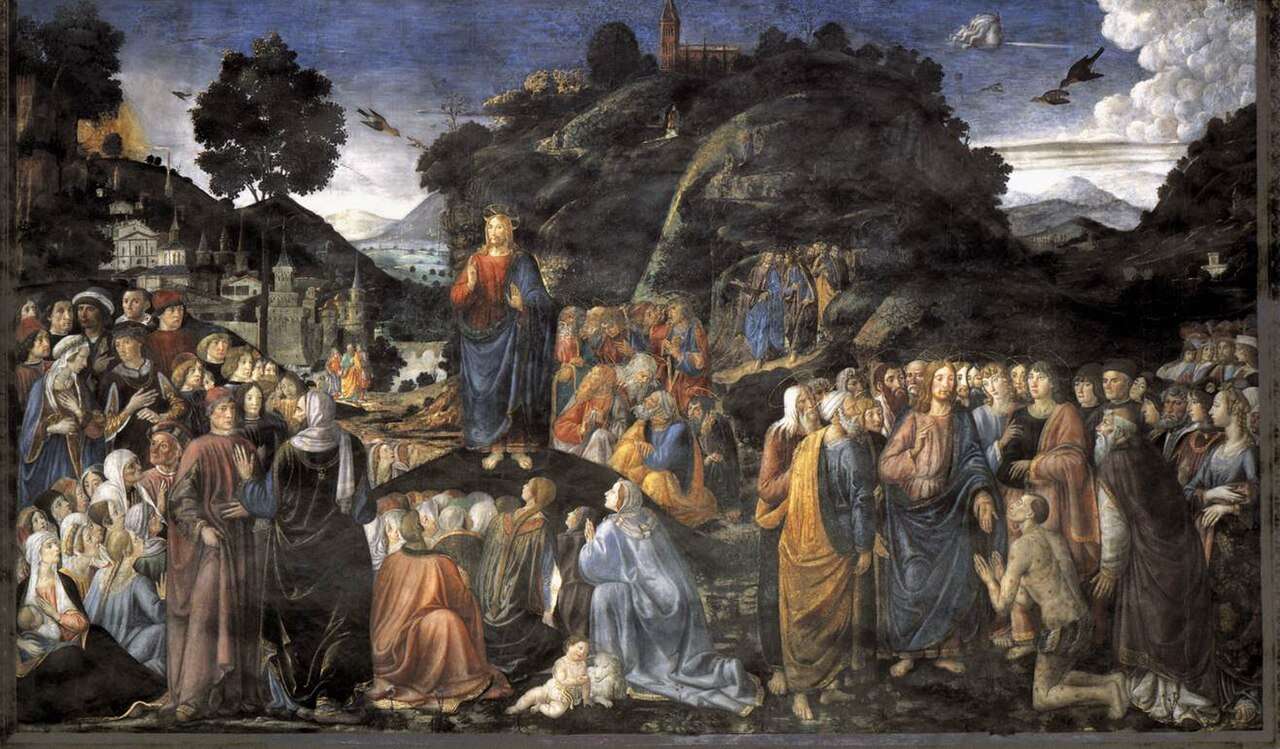
The Sermon on the Mount by Cosimo Rosselli
A5 | 8 FEBRUARY 2026 | MATTHEW 5:13-16
The Sermon on the Mount uses over fifty memorable images, many of which have passed into such common usage that their origins in Matthew’s gospel would come as a surprise to many. “Salt of the earth” and “the light of the world” are among the best-known. The natural symbolism of light needs no elucidation: it is an essential condition of life as we know it. In our hyper health-conscious age, salt, on the other hand, is more ambivalent, even if equally essential. In Jesus’s world, it was an unalloyed good, an indispensable food preservative as much as a taste enhancer. It has, of course, other uses, some of which Martin Luther had in mind when he suggested that the image was an encouragement to rub salt into the wounds of one’s opponents. In the same sermon, he exhorts preachers to practise what he called the “ministry of salting”: rubbing salt into the wounds even of your hearers, to convince the congregation of “their misery and incapacity”.
Matthew’s gospel, the most Jewish of the four, even if also the most critical of the “mother faith”, reflects the tensions associated with Christianity’s emergence from its Jewish roots. By this time, Christians were already being anathematised by Jews as heretics and blasphemers.
Matthew’s apologetic in defence of Christianity aims to show its continuity with Judaism: the Church is the New Israel. To this end, he constructs at the heart of his text five blocks of teaching, paralleling the Pentateuch, the first five books of the Hebrew Bible, constituting the Law of Moses, the Torah. So, just as Moses went up the mountain to receive the Law from God, so here in the Sermon on the Mount – St Augustine was the first to call it that – Jesus goes up a mountain to teach his followers the New Law.
But the Sermon on the Mount offers not just a New Law, but a decidedly strange Law, a strangeness to be savoured rather than diluted. For one thing, contrary to everything a pious Jew of the time would have been taught, the Sermon teaches that that holiness (the Jewish concept of “righteousness” is deliberately used) consists primarily not in outward actions but in a pure heart, a heart rightly disposed. If the heart is the source of our actions, we need to get the heart right, if right actions are to follow, we are told. The Old law, or at least the contemporary understanding of it in the time of Jesus, had laid almost exclusive emphasis on external observance; but by emphasising “righteousness” in the heart rather than on the sleeve, Jesus restores the original purpose of the law.
The New Law, in other words, can’t be interpreted legalistically. For one thing, it’s just not that kind of Law; for another, it’s delivered in such a way as to make it impossible to codify and thus control. That’s why so much of what Jesus has to say teeters on the brink of paradox and even contradiction. He makes it clear that he comes not to congratulate religious high-flyers or spiritual “experts”, but to call “crooks and crocks”, as Ronald Knox once described most of the people in the gospels whose company Jesus kept.
But as well as overturning religious expectations, the New Law reverses worldly expectations, too, especially those focused on security and success, whether financial, domestic or defensive. All such conventional ideals are overturned in the Sermon on the Mount: don’t save; don’t resist violence; the poor and the persecuted are happier and more blessed than the rich and the powerful. It is the poor, the gentle, the mourning, the merciful, the simple, the persecuted, and those who yearn to be better, who are the genuine salt of the earth and the light of the world, not necessarily the squeaky clean.
It is, in other words, those who know their need of God, who yearn for his love, and yearn to love him in return, who are the salt of the earth and the light of the world. God’s presence is most clearly known in the poor in spirit, not the proud of heart.
So, in this New Law, Jesus is turning the world not so much inside out as inside in, turning us from slavish, self-serving conformism to a law imposed from outside of ourselves, to the work of the Spirit within. Aquinas expresses it thus: “The Old Law was a written law to be obeyed, whether out of fear or for reward”. By contrast, the New Law “consists chiefly in the grace of the Holy Spirit, which is shown forth by faith working through love”. It “derives its pre-eminence from the spiritual grace implanted in our hearts, called the Law of Love.” George Herbert (1593-1633) agrees:
but, above all, the heart
must bear the longest part.

Help us keep The Tablet’s voice independent, clear and far-reaching.
Founded in 1840, The Tablet is the leading independent English-language Catholic weekly, celebrated for great writing, astute analysis, brilliant arts and books reviews and trustworthy reporting from correspondents in Britain, Ireland, Rome and across the world.
Independent, high-quality journalism is at the heart of what we do. The Tablet does not have deep pockets and we are not funded by rich donors. If you appreciate our work please consider supporting The Tablet’s Development Fund. It only takes a moment and you can cancel at any time.
- Support with £5 per month
- Support with £10 per month
- Support with other amount.

MOST READ ARTICLES
-
1
Pope Leo diagnosed with lung cancer after operation
-
2
Breaking up … for now
-
3
The Tablet Lecture 2026: Keeping the dream of peace alive
-
4
A tiny gem
-
5
Vatican confirms Pope’s Latin America travel plans despite operation
-
6
Archbishop bars Catholics from firing squad for US military execution
FROM THE EDITOR'S DESK