If we live the Beatitudes, we will be entirely fearless, absurdly happy and never out of trouble


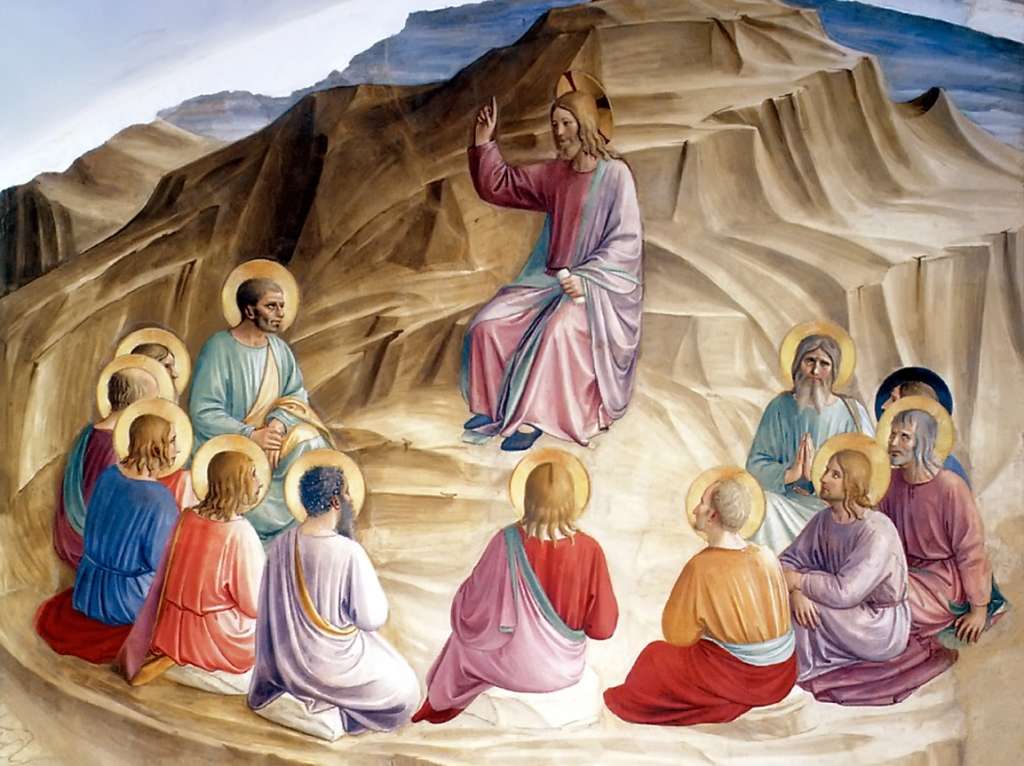
The Sermon on the Mount by Fra Angelico
A4 | 1 FEBRUARY 2026 | MATTHEW 5:1-12
The Sermon on the Mount, the setting for the Beatitudes in today’s gospel, was said by St Augustine (354-430) to be the charter of the Christian life. St Thomas Aquinas (1225-74) believed that it contained everything we need to know about Christian morality. Aquinas’s great Franciscan contemporary, St Bonaventure (1221-74), thought it was the text that definitively distinguished the New Law, written on our hearts, from the Old Law, written on tablets of stone. But when John Colet (1467-1519), the humanist scholar friend of St Thomas More (1478-1535) and Dean of St Paul’s, first read it in the original Greek, he was so struck by its power that he said: “Either this be not the Gospel, or we be not Christians.” Much later, Mahatma Ghandi (1869-1948), who declared the Sermon on the Mount his favourite text, would reproach Christians for neglecting it.
Nevertheless, there has been wide disagreement about how to interpret the Sermon on the Mount. It has sometimes been seen by past Protestant theologians as an impossible ideal, unrealisable in real life. Martin Luther (1483-1546), for instance, thought it served as a permanent reminder of the impossibility of living virtuously, apart from the grace of God. Some past Catholic theologians have understood it to be applicable only to an élite few, principally vowed religious, committed to poverty, chastity and obedience, the so-called ‘evangelical counsels’, as opposed to ‘the evangelical precepts’, which everybody is bound to follow. Tolstoy (1828-1910), on the other hand, saw in the Sermon on the Mount a programme for social revolution, while the polymath, Albert Schweitzer (1875-1965), thought it offered a morality for an heroic age.
Despite its centrality in the gospel, however, the Sermon on the Mount has in the past been relegated to the margins of what is conventionally called ‘morality’. As Catholic moral theology over time came to be manualised and equated with canon law, morality was separated from spirituality and, as a consequence, came to have less to do with holiness and more to do with obedience. The outcome of that long process was a duty-driven, legalistic outlook that many, both Catholics and other Christians, have mistaken for Christian morality.
St Thomas Aquinas, for one, would have disagreed that morality primarily concerns rules, duty, and obedience. For him morality’s primary concern is not the discharging of duty and fulfilling of obligations, but human flourishing and the lasting and true happiness such flourishing constitutes. Morality is primarily concerned, in other words, with what we are, and only secondarily, with what we do, in that the latter follows from the former. Happily, Catholic moral thinking is returning in the form of a virtue based ethic, to a much older, saner view, evident at an earlier time in the Church’s life, when the Sermon on the Mount was the central text for all moral discussion.
The medievals understood the Sermon on the Mount to concern interior acts – the will, intention, desire and love; and whereas the Old Law, the Mosaic Law, spoke of external actions only, the New Law, the Law of the Gospel, articulated in the Sermon on the Mount, speaks of the inner sources of our actions, focussing first and foremost on virtues and character, rather than rules and precepts.
Virtues and rules are not, of course, mutually exclusive, but nor are they the same thing. Virtues are attributes of the person, the well-springs of action, some acquired through practice, others, the theological virtues, gifts of grace. But as they come more and more to characterise us, becoming, as it were, “second nature”, so the need for precepts decreases. We act generously willingly and freely because we have become generous by nature, not because we are duty bound to be generous or through slavish obedience.
So it is that Aquinas speaks of the New Law as the Law of Freedom. We moderns, of course, think of law and freedom as opposites, but that misconception belongs to a duty driven morality, having as much to do with our skewed notion of freedom as much as of law. Aquinas sees law as a tutor, guiding us to moral maturity and thus true freedom, freedom both to be and to do, precisely through growing in virtue. “You were all called to freedom, brethren”, says St Paul to the Galatians, “and through love to be servants of one another.” (5:13) On this reading, sin is primarily the negation of virtue, a failure of character, a lapse in love, not disobedience to an externally imposed law.
Unlike the more modern, law-led, duty-driven understanding of morality, the New Testament offers a wisdom for holiness and human flourishing that is larger than any legal model could encompass. That’s why the Beatitudes, often spoken of as the self-portrait of Jesus himself, have the form: “Happy (blessed) are the poor in spirit.”
It has been said that if we dare to live the life of the Beatitudes, making them our own self-portrait, we will be, as Jesus himself was, entirely fearless, absurdly happy and, in this life at least, never out of trouble.

Help us keep The Tablet’s voice independent, clear and far-reaching.
Founded in 1840, The Tablet is the leading independent English-language Catholic weekly, celebrated for great writing, astute analysis, brilliant arts and books reviews and trustworthy reporting from correspondents in Britain, Ireland, Rome and across the world.
Independent, high-quality journalism is at the heart of what we do. The Tablet does not have deep pockets and we are not funded by rich donors. If you appreciate our work please consider supporting The Tablet’s Development Fund. It only takes a moment and you can cancel at any time.
- Support with £5 per month
- Support with £10 per month
- Support with other amount.

MOST READ ARTICLES
-
1
Pope Leo diagnosed with lung cancer after operation
-
2
Breaking up … for now
-
3
The Tablet Lecture 2026: Keeping the dream of peace alive
-
4
A tiny gem
-
5
Vatican confirms Pope’s Latin America travel plans despite operation
-
6
Archbishop bars Catholics from firing squad for US military execution
FROM THE EDITOR'S DESK