Our Good Shepherd


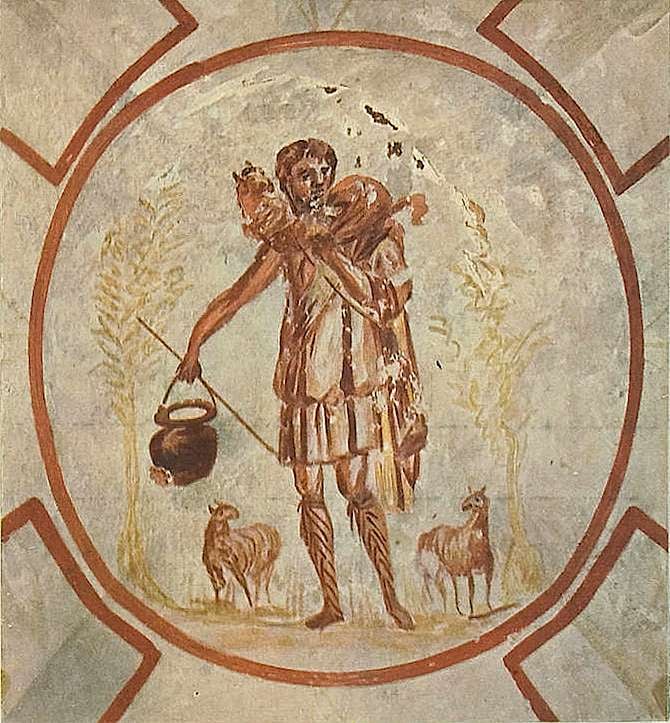
The Good Shepherd, Priscilla Catacomb, Rome c.250-300 CE
Wikimedia Commons
EASTER 4C | 11 MAY 2025 | JOHN 10:27-30
Extracts from this chapter of St John’s gospel, in which Jesus describes himself as the Good Shepherd, have been read at Mass on this Sunday in Eastertide from the time of Pope St Leo the Great in the fifth century to the pontificate of Pope Leo XIV in the present century. Even earlier, what’s thought to be the first example of Christian art, a still discernible mural dating from the middle of the second century in the Catacomb of Callistus, the oldest of the tunnel-like burial grounds under the Via Appia Antica, the ancient road linking Rome to the heel of Italy, depicts Jesus as a young shepherd, carrying on his shoulders a sheep. Little wonder, then, that the image of Christ as the Good Shepherd is so indelibly imprinted on the Christian imagination.
But some of those who first heard Jesus speak of himself as the good shepherd would have been perplexed: he was, after all, identifying himself with what had become by his day a despised underclass. To others, it would have been clear that in calling himself the good shepherd, Jesus was launching a broadside against the religious authorities of Judaism, who had often been referred to as the shepherds of God’s people. We’re told just after this passage that, unsurprisingly, his words caused division on both fronts.
Shepherds in the world Jesus knew were as rugged and weather-beaten as their sheep, more like men of the road than gentleman farmers. Living permanently outdoors with their sheep, they were regarded as only half-human. Along with sailors, camel drivers, and butchers, they were despised and feared in equal measure as disreputable, dishonest, and untrustworthy. They were notorious for pilfering from others’ land as they went and such was their reputation for selling sheep in their care for private profit, people were warned not to buy anything from them – wool, milk, or lambs – as they would be more than likely buying stolen property. One Midrash says that “there is no more disreputable occupation than that of a shepherd” and the Jewish philosopher, Philo (25BC-45AD) says that looking after sheep and goats was “a mean andinglorious” occupation. The low standing of shepherds was such that their witness was inadmissible in a court of law and they themselves were barred from entering legal contracts.
But disreputable and untrustworthy as they were thought to be by other people, shepherds were trusted implicitly by the sheep in their care: indeed, the close rapport between a shepherd and his flock was as close then as is the rapport now between a shepherd and his or her sheep dog. Each was known individually by name, and sheep distinguished their shepherd’s voice from all others. When, for instance, they were called in the morning from the common overnight pens, they knew who was calling and trustingly followed.
So, when Jesus called himself a good shepherd (the word used is not ‘good’ [agathos] but ‘beautiful’ [kalos], thus bearing a broader connotation than competence or efficiency) it would have seemed almost an oxymoron. But it was precisely by speaking of himself in this way that Jesus contrasted the relationship between him and his sheep with the total lack of rapport between the false shepherds of Israel, the Scribes and the Pharisees, and the sheep entrusted to their care.
What definitively distinguished him, however, as the good shepherd, as opposed to a false shepherd, was his willingness to sacrifice his life for the sake of his sheep. He repeats no less than ten times in this chapter: “A good shepherd lays down his life for the sheep.” The difference was that his sheep were his own: “I know my own, and my own know me.”
But this too is a far from obvious allusion. Since all shepherds at the time would have been hirelings and none an owner, they would not have been known for their heroism. And, anyway, it’s questionable whether in real life a shepherd should lay down his life for his sheep if they came under attack from wild animals: what would happen to the remainder of the flock, if he did? At the very least they would be scattered.
But this is precisely how Jesus draws a paradox from this puzzling allusion: his death leads, not to the scattering of the flock, but to its being gathered together. Having freely laid down his life for his flock, he is raised up again, and we, his flock are raised up with him.
Jesus’ self-description as the Good Shepherd vividly illustrates, then, the entire purpose of his life, death, and resurrection. He came into the world as one of us so that we might have life with him when he was raised from death, a death he accepted as a consequence of becoming human. But by his death and resurrection, he restored us to the original relationship for which we were made. God became one of us, in other words, to restore us to friendship with him and one another.
Of course, as Aristotle says, “No one can make someone their friend”, not even God: forced friendship is a contradiction in terms. Rather, having proven to us how precious our friendship is to him – “greater love has no man than to lay down his life for his friend” – and having enabled us by grace to share his risen life, he invites us freely to be his friends, for all eternity.

Help us keep The Tablet’s voice independent, clear and far-reaching.
Founded in 1840, The Tablet is the leading independent English-language Catholic weekly, celebrated for great writing, astute analysis, brilliant arts and books reviews and trustworthy reporting from correspondents in Britain, Ireland, Rome and across the world.
Independent, high-quality journalism is at the heart of what we do. The Tablet does not have deep pockets and we are not funded by rich donors. If you appreciate our work please consider supporting The Tablet’s Development Fund. It only takes a moment and you can cancel at any time.
- Support with £5 per month
- Support with £10 per month
- Support with other amount.



