A new commandment of love


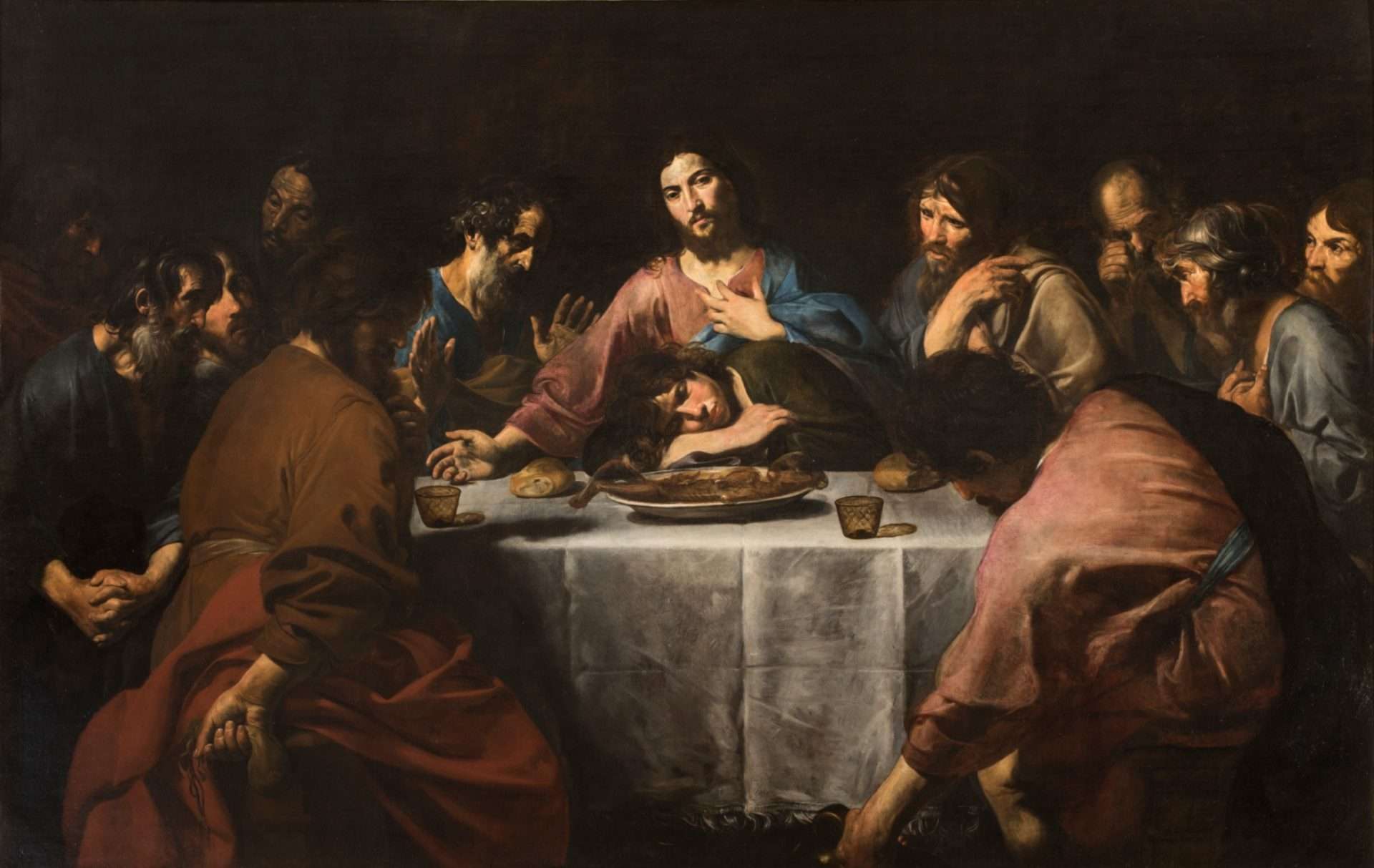
Valentin de Boulogne's "The Last Supper", c.1625
Wikimedia Commons
EASTER 5C | 18 MAY 2025 | JOHN 13:31-35
This short passage from John’s gospel, in which Jesus speaks of his ‘new commandment’ – “Love one another as I have loved you” – is sandwiched, significantly, between Judas’s perfidy and Peter’s cowardice. John marks the moment that Judas leaves to set in motion the events that will lead directly to Jesus’ death with these portentous words, “It was night.” He is conveying both the darkness of Judas’s deed and the darkness of a world that fails to recognise Goodness Itself in its midst. Peter’s cowardly denial, on the other hand, starkly confronts each of us with our helplessness in the face of our own weaknesses and failings. Only the new commandment to love as we ourselves are loved by God can overcome both the darkness of the world and our own inner darkness.
To love as Christ loves us is not, however, just to imitate his love, but to love with his love, as in the prayer, “Lord, so act in me that all I do is done also by Thee.” It is his love, in other words, active in us, that overcomes the darkness. To love as Christ loves us is not primarily an act originating within ourselves, but a grace, which we receive and share; and to share his love is possible only if, by his gift, we share his life. Again, only by sharing his life and loving as we ourselves are loved, do we find our true selves, the selves God created. How could it be otherwise? We were created out of love and for love. Our beginning and end, our origin and goal, in other words, is God, Love Itself.
Further, Jesus is unequivocal, here and elsewhere, that loving as he loves is the only authentic measure of our identity with him. The unnerving Sheep and Goats judgement scene at the end of Matthew’s gospel graphically makes the same point: compassionate love for all is the single criterion according to which we will be judged. Has my life been shaped and guided by compassionate, selfless love, or not?
Love, of course, can only be given and received freely, not bought, begged, bartered, merited or earned, and certainly not forced on or out of us. Equally, to love as Christ loves us is, by definition, to love without bounds. The more we genuinely love one person, the more, that is, that their good becomes our own good, the easier it is to act for the good of all, even those who would wish us harm. We love all in God and God in all, or we don’t love at all. I cannot love God and, at the same time, harbour hatred for anyone. If I hate just one person, I cannot be said to love God. That is the true basis of the Ordo Amoris recently referred to (inaccurately) by a politician and (correctly) by a soon-to-be-pope cardinal.
The great St Augustine could say, without ambivalence or ambiguity, “Love, and then do what you will”. That might sound like relativism, a seeming endorsement of so-called Situation Ethics beloved of the ‘60s. But relativism was the last thing Augustine meant. The ‘new’ commandment – “Love one another as I have loved you” – is not just another commandment or law, except by way of analogy; nor does it nullify or replace law. Rather, it is the principle by which all laws and commandments are to be judged. As such, it fulfils every just law and every good commandment because it brings to perfection in us the image and likeness of God, who is Love Itself, in which we have been made. To love with Christ’s love is already to live with his risen life, and to experience, even now, the life that has no end.

Help us keep The Tablet’s voice independent, clear and far-reaching.
Founded in 1840, The Tablet is the leading independent English-language Catholic weekly, celebrated for great writing, astute analysis, brilliant arts and books reviews and trustworthy reporting from correspondents in Britain, Ireland, Rome and across the world.
Independent, high-quality journalism is at the heart of what we do. The Tablet does not have deep pockets and we are not funded by rich donors. If you appreciate our work please consider supporting The Tablet’s Development Fund. It only takes a moment and you can cancel at any time.
- Support with £5 per month
- Support with £10 per month
- Support with other amount.

MOST READ ARTICLES
-
1
Pope returns to Vatican after hospital discharge
-
2
Diverse schools that are 100 per cent Catholic
-
3
Under endless skies
-
4
Battling confession fatigue
-
5
Nigerian bishop scorns suggestion of running in presidential election
-
6
Schismatic Spanish nuns strip contents of convent before eviction
FROM THE EDITOR'S DESK


