Show world the ‘radicality of Christian peace’, Pope is urged on Lent retreat


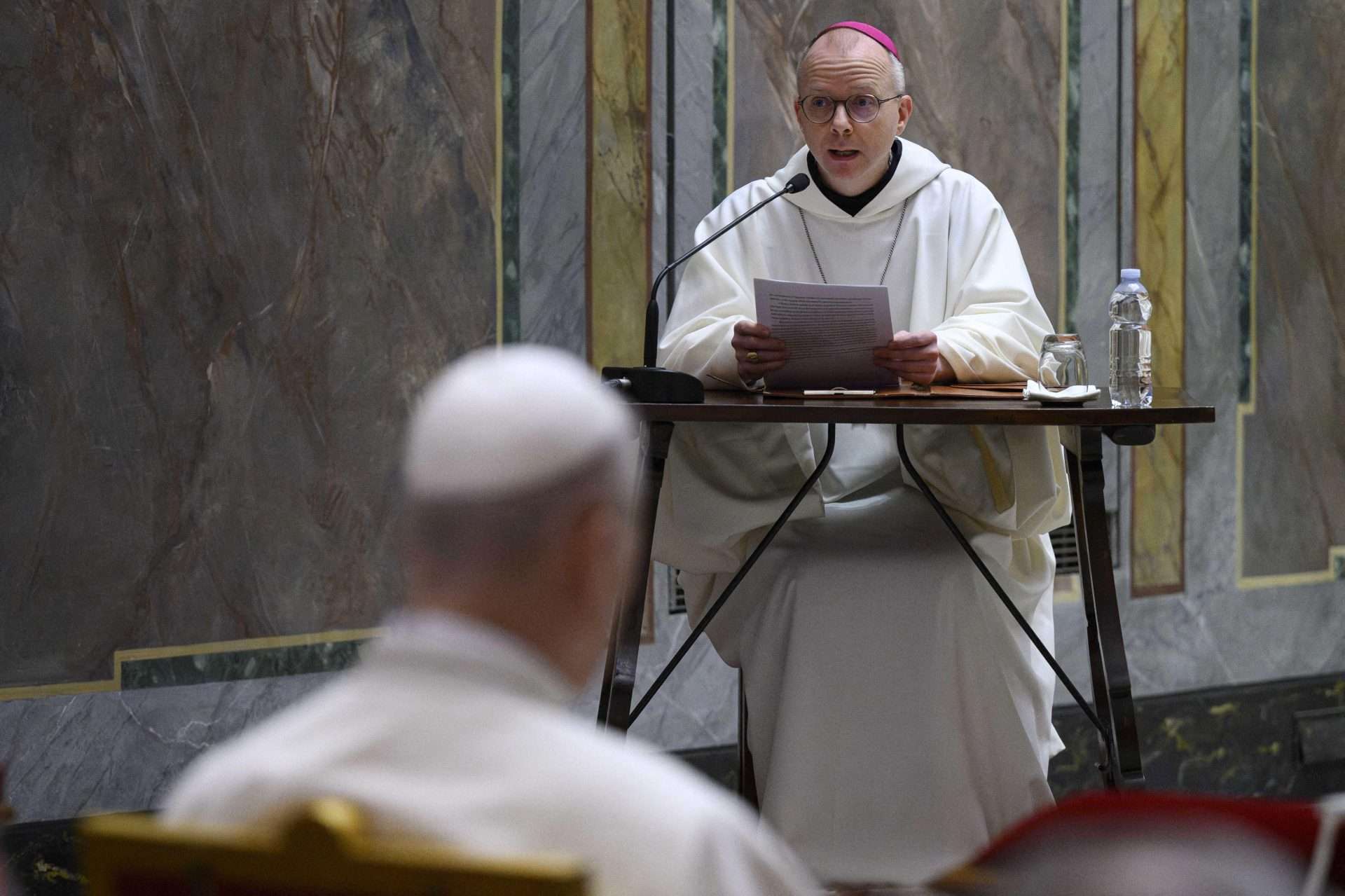
Pope Leo XIV listens to Trappist Bishop Erik Varden during the Spiritual Exercises for Lent.
Abaca Press/Alamy Live News
‘Was not the universal call to holiness, the call, that is, to embody truth, the strongest note struck by the Second Vatican Council? It resounded splendidly like a gong throughout its deliberations.’
Trappist monk Erik Varden, the Bishop of Trondheim in Norway, has preached the Spiritual Exercises for Lent to Pope Leo XIV and senior Vatican officials, including cardinals and prefects of dicasteries, in the Pauline Chapel for the Vatican Lent retreat from 22 to 27 February.
“The extent of the peace we embody – that signal peace ‘which the world cannot give’ – indicates Jesus’s abiding presence in us,” said Bishop Varden in his first reflection. “We must insist on this now, when the Gospel is sometimes deployed as a weapon in culture wars.
“Instrumentalisations of Christian language and signs should be challenged, not just by wan outrage, but by teaching the terms of authentic spiritual warfare. For Christian peace is not a promise of ease; it is a condition for transformed society.
“It is timely to articulate the radicality of Christian ‘peace’ while we remind ourselves and others of the truth in St John Climacus’s words: ‘There is no greater obstacle to the presence of the Spirit in us than anger.’”
Bishop Varden returned to the theme of the nonviolent Christian witness of love in his fourth reflection: “Christian freedom is not about seizing the world with force; it is about loving the world with a crucified love magnanimous enough to make us freely wish, one with Christ, to give our lives for it, that it may be set free.
“A variety of political causes in Europe now harness the jargon of freedom. Tensions result. What one segment of society perceives as ‘liberating’ is found oppressive by others. Opposing fronts are raised, with the banner of ‘freedom’ held high on all sides. Bitter conflicts arise from incompatible agendas of purported liberation.
“Caution is called for when freedom, held hostage by force, is manipulated as a means to legitimate the doings of impersonal subjects like ‘the Party’, ‘the Economy’, or even ‘History’. In a Christian way of thinking, no oppressive policy can be redeemed by invocations of ideological ‘freedom’. The only meaningful freedom is personal; and one person’s freedom cannot cancel another’s.
“To subscribe to a Christian idea of freedom is to consent to pain. When Christ tells us: ‘Resist not evil’, He does not ask us to countenance injustice. He lets us see that justice’s cause is sometimes best served by suffering for it, refusing to meet force with force. Our emblem of freedom remains the Son of God who ‘emptied Himself’.”
In his fifth reflection, Bishop Varden emphasised the importance of the Church embodying truth and holiness. He suggested that the Christian claim to truth only “becomes compelling when its splendour is made personally evident with sacrificial love in sanctity”, and said this “universal call to holiness” was the “strongest note struck by the Second Vatican Council”.
He added that the splendour of this “call” shines through when it is “cleansed of temptations to temporise”: “It is tempting to think we must keep up with the world’s fashions. It is, I’d say, a dubious procedure. The Church, a slow-moving body, will always run the risk of looking and sounding last-season.
“But if she speaks her own language well, that of the Scriptures and liturgy, of her past and present fathers, mothers, poets, and saints, she will be original and fresh, ready to express ancient truths in new ways, standing a chance, as she has done before, of orienting culture.
“This work has an important intellectual dimension. It also has an existential dimension. As Cardinal Schuster said on his deathbed: ‘It seems that people no longer let themselves be convinced by our preaching, but in the presence of holiness, they still believe, they still kneel and pray.’”
Throughout the exercises, Bishop Varden reflected on St Bernard of Clairvaux, founder of the Cistercians, as an idealist and a realist: in his final meditation on 27 February, he noted that St Bernard offered “no institutional remedies” to the problems of the Church, but instead advised Pope Eugene III to “surround himself with good people”.
“The better the Church’s central offices are run, the greater the benefit will be for the Church worldwide,” he said, recalling St Bernard’s description of people who “habitually devote themselves to prayer, and in every undertaking place more confidence in it than in their own industry or labour. Their arrival is peaceful, their departure unassuming.”
“In so far as the Church operates in these terms will she reflect the organisation of the angels’ hierarchies. Whoever considers her then will see her principal mission: that of giving God glory.”
St John Henry Newman, said Bishop Varden in his eighth reflection, also “envisaged the priest’s ministry as angelic”: “The priest is at home in this world, unafraid to go into dark woods in search of the lost. At the same time he keeps his mind’s eyes raised towards the Father’s face, letting its radiance illumine all present reality.
“Newman, now a Doctor of the Church, invites us to rediscover the teacher, too, as angelic enlightener. It is a prophetic challenge, given how much so-called ‘education’ is now farmed out to digital, artificial media, while young people yearn to meet teachers who are worthy of trust, who can impart not only skills but wisdom. An angelic encounter is always personal. It cannot be replaced by a download or a chatbot.”
Warning of the harms caused by the Church’s failures to live its call to truth and holiness, Bishop Varden said, “Not for nothing does the figure of the ambitious clergyman haunt literature and cinema as a comic, but not very funny, trope – from the fawning parsons in Jane Austen to the tart courtier priest in Patrice Leconte’s notable film Ridicule.”
On the subject of abuse, he said, “Nothing has done the Church more tragic harm, and compromised our witness more, than corruption arisen within our own house. The worst crisis of the Church has been brought on, not by secular opposition, but by ecclesiastical corruption. The wounds inflicted will take time to heal. They call out for justice and for tears.
“It is tempting, face to face with corruption, especially when we confront abuse, to look for a diseased root. We expect to find early warning signs that were ignored: some failure in screening, an original pattern of deviancy. Sometimes these trails exist and we are right to blame ourselves for not having spotted them in time. We do not, however, find them always.
“We can recognise the great and joyful good often manifest in the beginnings of communities now linked with scandal. We cannot presuppose that there was structural hypocrisy from the start, that founders set out as white-washed sepulchres.
“Sometimes we do find signs of inspiration, even traces of holiness. How can we simultaneously account for these and for warped developments? A secular mindset will simplify: when it meets calamity, it designates monsters and victims. Happily the Church possesses, when she remembers to use them, more delicate and more effective tools.”
In his ninth reflection, Bishop Varden said that the more St Bernard recognised the “cry in human hearts, in bitter tears, in worldly conflicts, in madcap campaigns against decency and truth, and in the whisper of the trees of the forest, the more he was conscious of God’s gracious response”.
He concluded, “He heard it in the holy name of Jesus, which became unspeakably dear to him. In Jesus God reveals his saving purpose, pouring it forth upon mankind as fragrant, healing, cleansing oil.”
Stay updated — add us as a preferred news source on Google:


Help us keep The Tablet’s voice independent, clear and far-reaching.
Founded in 1840, The Tablet is the leading independent English-language Catholic weekly, celebrated for great writing, astute analysis, brilliant arts and books reviews and trustworthy reporting from correspondents in Britain, Ireland, Rome and across the world.
Independent, high-quality journalism is at the heart of what we do. The Tablet does not have deep pockets and we are not funded by rich donors. If you appreciate our work please consider supporting The Tablet’s Development Fund. It only takes a moment and you can cancel at any time.
- Support with £5 per month
- Support with £10 per month
- Support with other amount.

MOST READ ARTICLES
-
1
Pope returns to Vatican after hospital discharge
-
2
Diverse schools that are 100 per cent Catholic
-
3
Under endless skies
-
4
Battling confession fatigue
-
5
Nigerian bishop scorns suggestion of running in presidential election
-
6
Schismatic Spanish nuns strip contents of convent before eviction
FROM THE EDITOR'S DESK