Rome refuses German bishops’ request for lay preaching at Mass


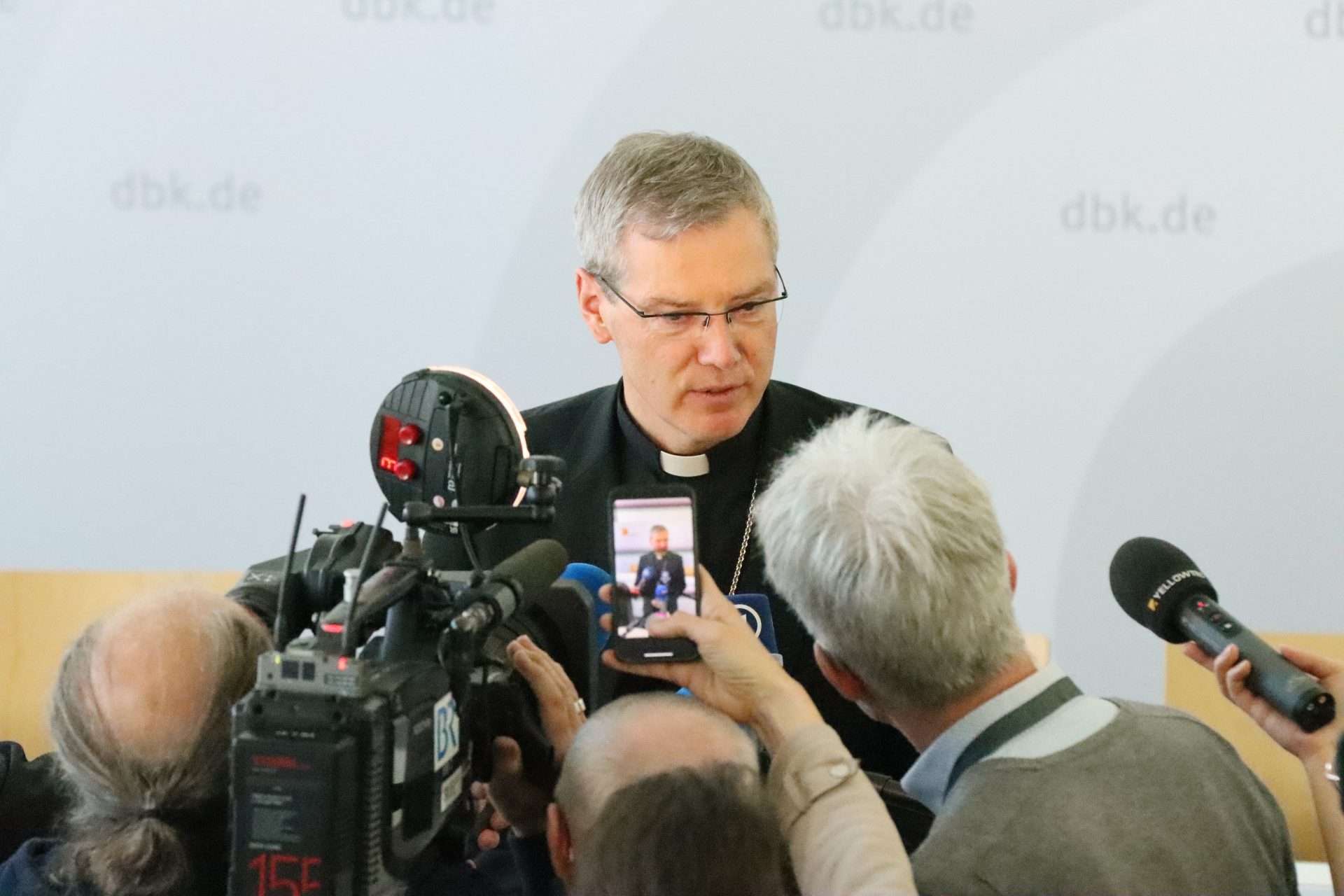
Bishop Heiner Wilmer’s election as president of the DBK in February was understood to be connected to his experience of dealing with curial officials in Rome.
German Bishops’ Conference / Marko Orlovic
‘Since reserving the homily for the ordained minister is part of the sacramental and liturgical structure of the celebration of the Eucharist itself, no dispensation by indult may be granted from the norm established in canon 767 § 1,’ said Cardinal Arthur Roche.
The Holy See rejected a request from the German bishops to allow laypeople to preach at Mass.
In a letter dated 17 June published by the German Bishops’ Conference (DBK) on Tuesday, the prefect of the Dicastery for Divine Worship and the Discipline of the Sacraments Cardinal Arthur Roche denied an indult to permit lay preaching.
He said it is not a question of theological competence but of ordination and office.
Based on a decision at the fifth plenary of the assembly of the German Synodal Way in May 2023, the president of the DBK Bishop Heiner Wilmer of Münster had requested an indult which would permit laypeople with appropriate theological training to give a homily at Mass.
The plenary had asked the bishops of to work up a particular norm and to seek permission from the Holy See, to increase the role of women in the liturgy and to grow the significance and quality of preaching.
Cardinal Roche argued that according to canon law the homily is an integral part of the liturgy and thus reserved for a priest or deacon, as it is “a specific exercise of the munus docendi which is entrusted to the ordained minister”.
In his request for the indult in March, Wilmer had pointed to grave pastoral considerations as a reason for his request. Roche writes that there are other “forms of proclamation” entrusted to lay people, yet “during the eucharistic celebration lay believers are not permitted to preach in the place envisaged for the homily”.
“Since reserving the homily for the ordained minister is part of the sacramental and liturgical structure of the celebration of the Eucharist itself, no dispensation by indult may be granted from the norm established in canon 767 § 1, even in the presence of serious pastoral considerations,” said Roche.
Reactions among the DBK were largely negative, while the president of the Central Committee of Lay Catholics Irme Stetter-Karp said that she “had not been involved in the application” but many bishops had supported the decision of the 2023 assembly.
“We … expect the German bishops to reaffirm their position on the substance of the matter to Rome, to strengthen their arguments, and under no circumstances to interpret Cardinal Roche’s letter as a discouragement,” she said.
The popular lay movement “We Are Church” called the rejection “a decision of principle that is entirely out of touch with reality”, pointing to the increasing age and worsening shortage of priests.
Ruth Fehlker, spiritual leader of the Union of Catholic Women, said that the “decision shows once again how big the gap is between the pastoral realities of many local churches and the prescripts from Rome”.
In an interview with the portal Kirche + Leben, pastoral theologian Christian Bauer from the University of Münster said: “It was not a good day for overcoming the hard-bodied and deep-seated clericalism of a church that has been practised for centuries and is only very timidly synodalising.”
Wilmer’s election as president of the DBK in February was understood to be connected to his experience of dealing with curial officials in Rome as general superior of the Congregation of the Priests of the Sacred Heart. The indult was his first request based on the deliberations of the Synodal Way.
The rejection follows the Holy See’s negative response to provisions made in several German dioceses for blessings for couples in “irregular” situations to whom sacramental marriage is not available.
While Wilmer is an avowed supporter of the Synodal Way, he has repeatedly emphasised that Germany will not pursue a form of synodality distinct from the Universal Church. Rome has yet to respond to the proposed constitution for a Synodal Conference of Bishops and Lay Leaders, which is due to have its first meeting in November 2026 despite past concerns about its canonical status.
Continuing his catechesis on the documents of the Second Vatican Council at the general audience on Wednesday, Pope Leo echoed Roche’s argument in his discussion of Sacrosanctum Concilium, the document on the liturgy.
“Dear brothers and sisters, when we participate in the Eucharist, we are invited to listen to the Word of God and to be nourished at the Lord’s table, where He offers Himself to the Father,” he said.
“These two parts of the Mass, the Liturgy of the Word and the Liturgy of the Eucharist, ‘are so closely connected with each other that they form but one single act of worship’ (SC, 56).”
Should women be allowed to preach the homily at Mass? Increasing numbers think so
Church leadership in crisis amid the twilight of the patriarchs
Stay updated — add us as a preferred news source on Google:


Help us keep The Tablet’s voice independent, clear and far-reaching.
Founded in 1840, The Tablet is the leading independent English-language Catholic weekly, celebrated for great writing, astute analysis, brilliant arts and books reviews and trustworthy reporting from correspondents in Britain, Ireland, Rome and across the world.
Independent, high-quality journalism is at the heart of what we do. The Tablet does not have deep pockets and we are not funded by rich donors. If you appreciate our work please consider supporting The Tablet’s Development Fund. It only takes a moment and you can cancel at any time.
- Support with £5 per month
- Support with £10 per month
- Support with other amount.

MOST READ ARTICLES
-
1
Pope Leo diagnosed with lung cancer after operation
-
2
Breaking up … for now
-
3
The Tablet Lecture 2026: Keeping the dream of peace alive
-
4
Vatican confirms Pope’s Latin America travel plans despite operation
-
5
A tiny gem
-
6
Archbishop bars Catholics from firing squad for US military execution
FROM THE EDITOR'S DESK