Release secured for 100 children kidnapped from Catholic school in Nigeria


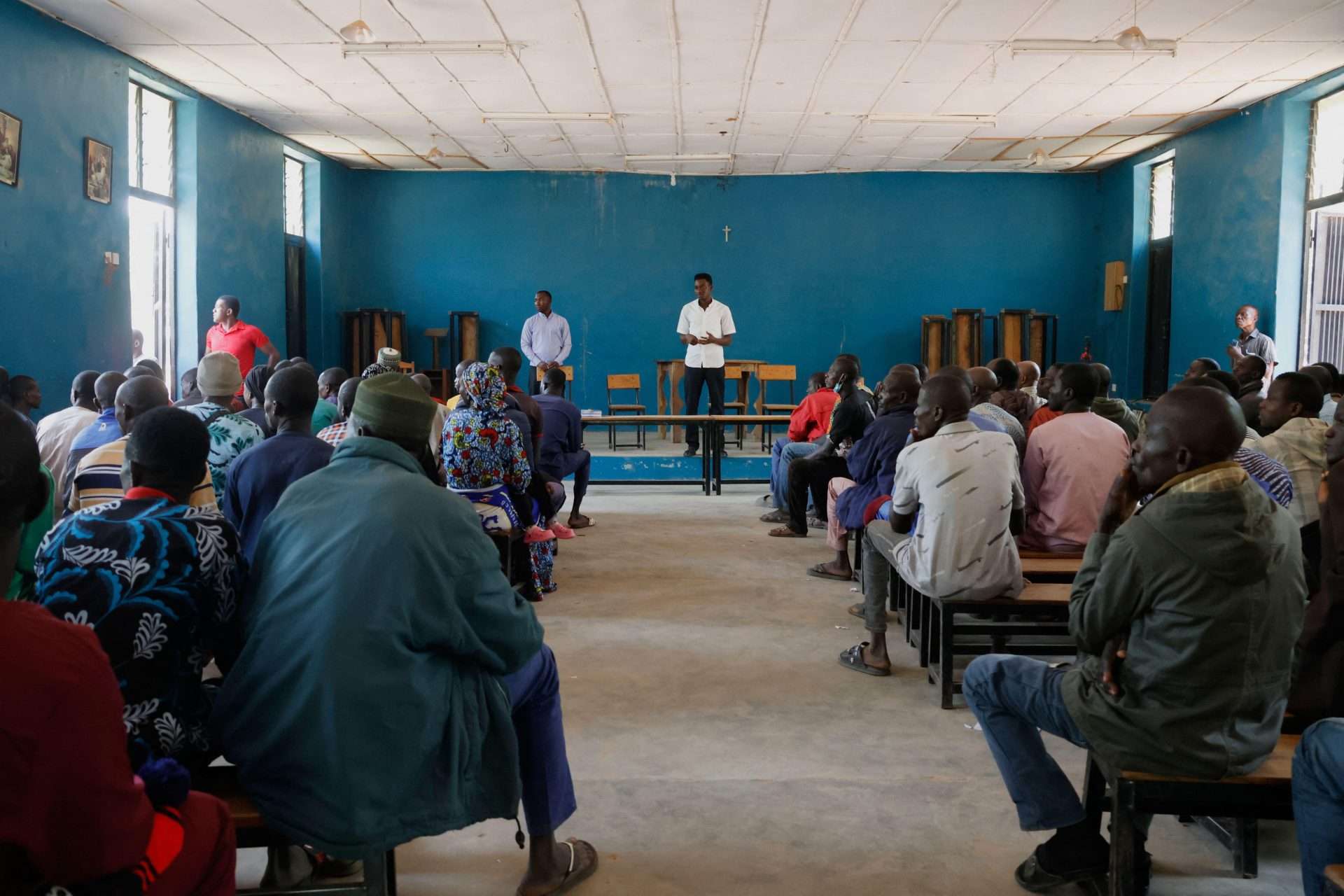
Parents of kidnapped schoolchildren at St Mary’s Catholic School in Papiri following the mass abduction in November
Associated Press / Alamy
Christians across Nigeria marked Sunday as a day for prayer for an end to genocide, amid debate among Church and state leaders over the nature of the violence afflicting the country.
Nigerian authorities secured the release of 100 schoolchildren abducted last month from a Catholic school in the northwest of the country.
Bishop Bulus Dauwa Yohanna of Kontagora, whose diocese includes St Mary’s Catholic School in Papiri, and the police commissioner for Niger State Adamu Abdullahi Alleman confirmed the release on Monday. The fate of 165 other pupils and staff remained unclear.
In November, gunmen kidnapped 315 pupils and staff from the co-educational boarding school in north-central Niger State, during a wave of mass abductions that recalled the infamous 2014 Boko Haram abduction of schoolgirls in Chibok. About 50 of the St Mary’s children escaped shortly afterward, leaving 265 in captivity.
A United Nations source told AFP on Sunday that 100 children were to be handed over to local government officials in Niger State the next day, without clarifying whether the release was secured through negotiation or military action, nor reporting the condition of pupils and staff thought still to be in their kidnappers’ hands. A presidential spokesperson confirmed the release.
“We have been praying and waiting for their return, if it is true then it is a cheering news,” said Daniel Atori, spokesperson for Bishop Yohanna. “However, we are not officially aware and have not been duly notified by the federal government.”
Christians across Nigeria had marked Sunday as a day for prayer for an end to genocide, an initiative of the Christian Association of Nigeria (CAN). The Revd Victor Abayomi, chairman of CAN in the Kuje Area Council of the Federal Capital Territory and pastor of the First Baptist Church in Kuje, called on the congregation to cry to God for His intervention during an intercession service.
“Our land is sick and crying over the innocent blood being shed against our brothers and sisters on daily basis. Enough of this,” he said. “But the Church must repent of its own sins. We have issues with God and God has issues with us. Are we being punished for our sins?
“The book of 2 Chronicles 7:14 quoted God as saying: ‘If my people which are called by my name, shall humble themselves, and pray, and seek my face, and turn from their wicked ways; then will I hear from heaven, and will forgive their sin and will heal their land.’ So, let us all be genuine in our cry to God, so that He can hear and heal Nigeria.”
The Kukah Centre (TKC), a public policy institute, issued a response last week to what it called the “mischaracterisation” of remarks by its founder, Bishop Matthew Hassan Kukah of Sokoto, about the alleged genocide.
In a statement on 2 December, TKC’s executive director Fr Atta Barkindo criticised reporting of Kukah’s remarks at an event in Kaduna on 28 November, in which he reaffirmed his public view that allegations of a genocide or systematic persecution of Christians in Nigeria are not supported by credible data. He reportedly argued that the claim “1,200 churches are burned every year in Nigeria” lacks verification.
“In which Nigeria?” he asked, pointing out that no one had checked with the Catholic Church to confirm such numbers.
The bishop emphasised that “genocide” is defined not by the number of deaths or attacks alone but by intent, a deliberate plan to eliminate a group. “You can kill 10 million people, and it still won’t amount to genocide,” he said. “What matters is intent.”
He also challenged the use of terms such as “martyrdom”, pointing out that some violence might be criminal or opportunistic rather than motivated by religious hatred.
Religious organisations and Christian advocacy groups rebuked Kukah after his remarks circulated last week, Fr Barkindo said TKC had “followed with humility and keen attention recent reports about remarks attributed to our founder” and found they reflected neither Kukah’s statement at the time nor the context of his work against persecution over half a century.
In northeast Nigeria, Borno State’s Governor Babagana Zulum denied claims that the authorities were complicit in a genocide, reporting that the state government had rebuilt no fewer than 45 churches destroyed by terrorists.
He was speaking at a high-level consultative meeting with the leadership of CAN and Jama’atu Nasril Islam at Government House, Maiduguri. The meeting focused on strengthening collaboration between the state government and religious bodies to combat insecurity.
“It is absolutely crucial that we collectively dispel all false narratives that seek to portray our security crisis in religious colouration,” Zulum said. “Religious conflict is alien to us. [The] Boko Haram conflict is not a religious crisis. It is an assault on our civilisation, humanity, and all that we hold dear, irrespective of creed. The perpetrators of violence have killed, maimed and displaced Muslims and Christians alike. They have destroyed mosques and churches with equal impunity.”
He continued: “I wish to inform you that, as part of our massive reconstruction programme across the affected local government areas, Borno State Government has reconstructed 45 Christian worship centres that were destroyed during the Boko Haram insurgency. Our reconstruction policy is not based on religion or ethnicity. We rebuild based on need and on our commitment to restoring the social fabric of every community.”
Last week the northern chapter of CAN congratulated the former Chief of Defence Staff, retired General Christopher Musa, on his appointment as federal Minister of Defence, describing it as a strong indication of Tinubu’s resolve to address insecurity across the country which could strengthen public confidence in security institutions. President Tinubu announced Musa’s appointment following the resignation of his predecessor Abubakar Badaru on health grounds.
Archbishop meets president as Nigeria responds to Trump threats
Christianity under siege in Nigeria
Stay updated — add us as a preferred news source on Google:


Help us keep The Tablet’s voice independent, clear and far-reaching.
Founded in 1840, The Tablet is the leading independent English-language Catholic weekly, celebrated for great writing, astute analysis, brilliant arts and books reviews and trustworthy reporting from correspondents in Britain, Ireland, Rome and across the world.
Independent, high-quality journalism is at the heart of what we do. The Tablet does not have deep pockets and we are not funded by rich donors. If you appreciate our work please consider supporting The Tablet’s Development Fund. It only takes a moment and you can cancel at any time.
- Support with £5 per month
- Support with £10 per month
- Support with other amount.

MOST READ ARTICLES
-
1
Pope returns to Vatican after hospital discharge
-
2
Diverse schools that are 100 per cent Catholic
-
3
Under endless skies
-
4
Battling confession fatigue
-
5
Nigerian bishop scorns suggestion of running in presidential election
-
6
Schismatic Spanish nuns strip contents of convent before eviction
FROM THE EDITOR'S DESK