Pope Leo XIV says migrants always welcome in Jubilee homily


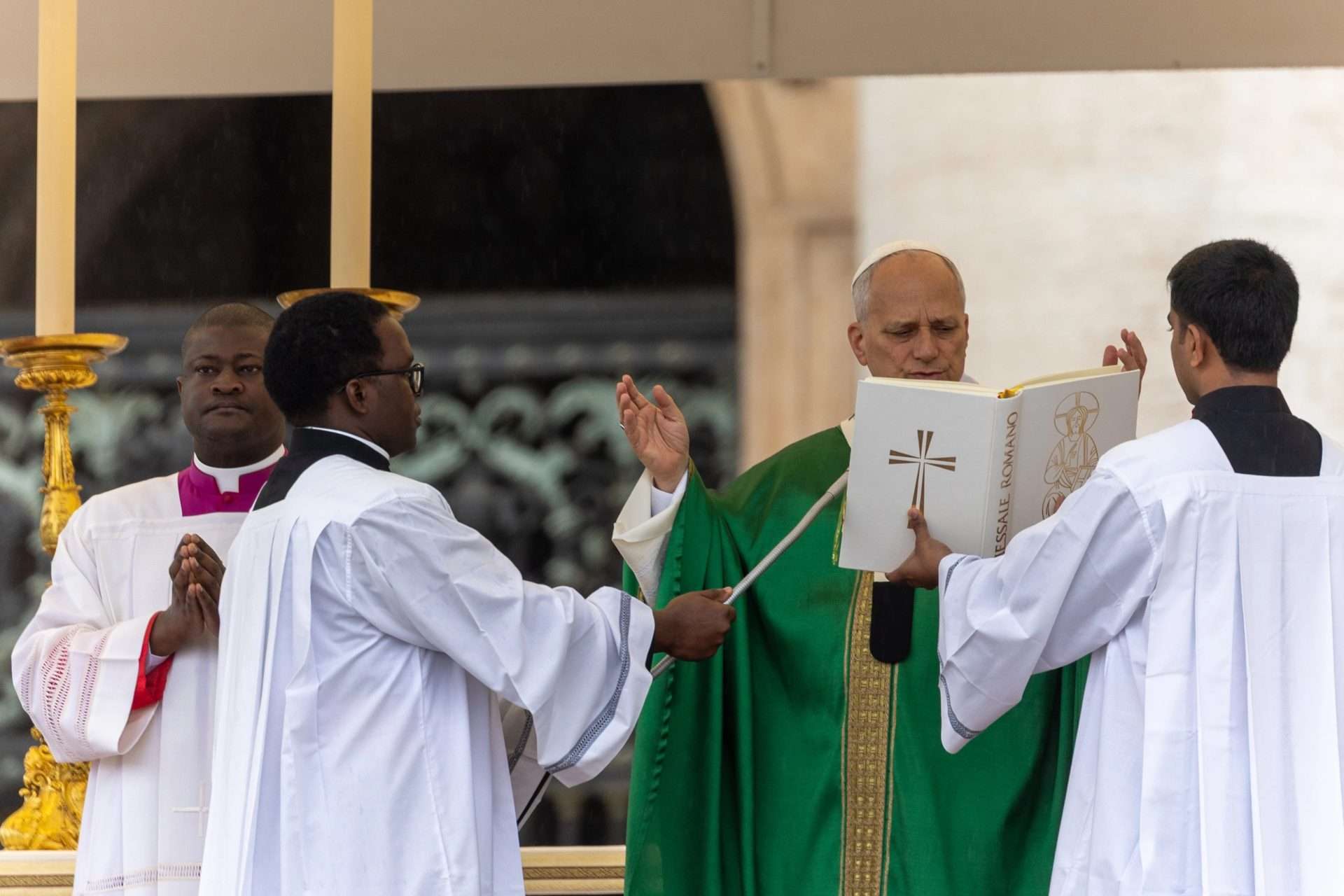
Pope Leo XIV celebrates Mass in St. Peter’s Square at the Vatican on Oct. 5, 2025.
Credit: Daniel Ibañez/CNA
Pope Leo XIV called for solidarity with “our migrant brothers and sisters” as he addressed tens of thousands of pilgrims who had gathered in Rome for the Jubilees of Migrants and Missions in his homily in St Peter’s Square on Sunday.
He said, “Those boats which hope to catch sight of a safe port, and those eyes filled with anguish and hope seeking to reach the shore, cannot and must not find the coldness of indifference or the stigma of discrimination.”
The Holy See designated several Jubilee Days throughout the Jubilee Year of 2025 to celebrate diverse groups of people and ministries within the Church. The Jubilee’s activities encourage Catholics to receive God’s mercy and participate in acts of mercy in our daily lives and communities. The Jubilee of the Missionary World and the Jubilee of Migrants took place concurrently on 4 and 5 October to coincide with the World Day of Migrants and Refugees, which the Church has observed since 1914.
The mass was followed by a Festival of Peoples, an afternoon of music and storytelling celebrating the Church’s commitment to hospitality, multiculturalism, and unity in diversity, organised by the Dicastery for Promoting Integral Human Development, the Dicastery for Evangelisation and numerous Catholic organisations that serve migrants, refugees, and mission territories.
Pope Leo reflected on the relationship between mission and migration in his homily. “Mission is not so much about ‘departing’, but instead ‘remaining’ in order to proclaim Christ through hospitality and welcome, compassion and solidarity. We are to remain without fleeing to the comforts of our individualism; to remain so as to look upon those who arrive from lands that are distant and violent; to remain and open our arms and hearts to them, welcoming them as brothers and sisters, and being for them a presence of consolation and hope.”
Bishop McAleenan, the lead bishop for migrants and refugees in the Catholic Bishops’ Conference of England and Wales, said that the World Day of Migrants and Refugees was an opportunity “for acknowledging the presence of migrants and refugees in our communities, celebrating their contribution and becoming more aware of the difficulties they encounter”.
He lamented the rise of “sentiments opposed to immigration and migrants” in the UK, and said, “Love of country is honourable and so is love of neighbour. In speeches, demonstrations and rallies, which have taken place in recent months and weeks, those two virtues – love of country and love of neighbour – have not come together. ‘Who is my neighbour?’ Jesus was asked. In answer, Jesus gave the Parable of the Good Samaritan – my neighbour is anyone in need.”
He alluded to the recent wave of protests fostering anti-immigration rhetoric and nationalistic violence, and thanked “all who support migrants and refugees and advocate their cause and dignity; who, in these difficult times, continue to insist on the need to welcome the stranger, even in the face of opposition.”
In his Message for the World Day of Migrants and Refugees, the Pope also warned against “the widespread tendency to look after the interests of limited communities” and encouraged “the sharing of responsibility, multilateral cooperation, the pursuit of the common good and global solidarity for the benefit of our entire human family”.
“The prospect of a renewed arms race and the development of new armaments, including nuclear weapons, the lack of consideration for the harmful effects of the ongoing climate crisis, and the impact of profound economic inequalities make the challenges of the present and the future increasingly demanding. Faced with frightening scenarios and the possibility of global devastation, it is important that there be a growing desire in people’s hearts for a future of peace and of respect for the dignity of all.”
Pope Leo’s analysis reflects the UN Refugee Agency’s data on the causes of forced migration. The number of forcibly displaced people has nearly doubled globally in the past decade to 123 million in 2024, driven especially by conflict, persecution, and human rights violations. Those fleeing natural disasters have reached 32 million and are predicted to continue increasing due to climate change.
Pope Leo also expressed gratitude to migrants for their willingness to “initiate interreligious dialogue based on everyday life and the search for common values” and to bring their “spiritual enthusiasm and vitality” to “revitalise ecclesial communities that have become rigid and weighed down”. He addressed migrants directly at the end of his homily: “know that you are always welcome! The seas and deserts that you have crossed, Scripture calls ‘places of salvation’, in which God makes himself present to save his people.”
Stay updated — add us as a preferred news source on Google:


Help us keep The Tablet’s voice independent, clear and far-reaching.
Founded in 1840, The Tablet is the leading independent English-language Catholic weekly, celebrated for great writing, astute analysis, brilliant arts and books reviews and trustworthy reporting from correspondents in Britain, Ireland, Rome and across the world.
Independent, high-quality journalism is at the heart of what we do. The Tablet does not have deep pockets and we are not funded by rich donors. If you appreciate our work please consider supporting The Tablet’s Development Fund. It only takes a moment and you can cancel at any time.
- Support with £5 per month
- Support with £10 per month
- Support with other amount.

MOST READ ARTICLES
-
1
Pope returns to Vatican after hospital discharge
-
2
Diverse schools that are 100 per cent Catholic
-
3
Under endless skies
-
4
Battling confession fatigue
-
5
Nigerian bishop scorns suggestion of running in presidential election
-
6
Schismatic Spanish nuns strip contents of convent before eviction
FROM THE EDITOR'S DESK