‘Let all be saved!’ says Leo at Jubilee of Prisoners


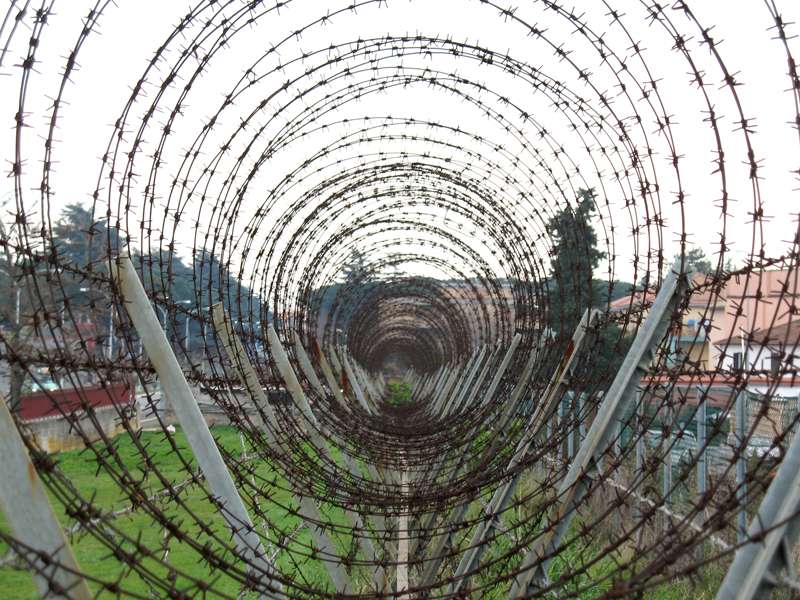
A fence at Rebibbia prison, where Pope Francis opened a Holy Door on 26 December 2024
Giuso Caprarelli
Pope Francis wanted Jubilee celebrations to include ‘forms of amnesty or pardon meant to help individuals regain confidence in themselves and in society’, Leo said.
Pope Leo XIV presided over the final major celebration of the Holy Year on Sunday, calling for renewed commitment to justice, rehabilitation and hope as he celebrated a Jubilee Mass dedicated to prisoners in St Peter’s.
About 6,000 pilgrims took part in the Jubilee of Prisoners, including prisoners and their families, prison chaplains, correctional officers, police and prison administrators. Participants came from countries across Europe, the Americas, Africa, Asia, and Oceania, including Italy, Spain, Portugal, the United Kingdom, Poland, Germany, Indonesia, Mexico, Brazil, Colombia, the United States, the Philippines, Taiwan and Australia.
In his homily, the Pope said that as the Jubilee concludes, significant challenges remained within prison systems worldwide.
“While the close of the Jubilee Year draws near, we must recognise that, despite the efforts of many, even in the penitentiary system there is much that still needs to be done,” he said. Words of the prophet Isaiah – “the ransomed of the Lord shall return, and come to Zion with singing” – recall that “it is God who ransoms, who redeems and liberates”, Leo said.
The Pope acknowledged that prison is “a difficult place and even the best proposals can encounter many obstacles”. For that reason, he said, people must not “tire, be discouraged or give up”, but continue “with tenacity, courage, and a spirit of collaboration”.
Leo emphasised that justice should not be reduced to punishment alone. “There are many who do not yet understand that for every fall one must be able to get back up, that no human being is defined only by his or her actions and that justice is always a process of reparation and reconciliation,” he said.
Reflecting on the meaning of the Jubilee, the Pope said that even in difficult conditions, the preservation of compassion, respect, and mercy could bear unexpected fruit.
“When even in difficult situations we are able to maintain and preserve the beauty of feelings, sensitivity, attention to the needs of others, respect, the capacity for mercy and forgiveness, beautiful flowers spring forth from the ‘hard ground’ of sin and suffering,” Leo said, adding that “gestures, projects, and encounters, unique in their humanity, mature even within prison walls”.
He also recalled Pope Francis’ hopes for the Jubilee. Leo said his predecessor had wanted Jubilee celebrations to include “forms of amnesty or pardon meant to help individuals regain confidence in themselves and in society” and to offer “real opportunities of reintegration” to all.
“I hope that many countries are following his desire,” the Pope said, noting that in its biblical origins the Jubilee was “a year of grace in which everyone was offered the possibility of restarting in many different ways”.
Addressing both prisoners and those who work in the penal system, Leo said the task entrusted to them was demanding. He pointed to challenges such as overcrowding, insufficient educational and rehabilitation programs, and limited job opportunities, as well as personal burdens including past wounds, disappointment and the difficulty of forgiveness.
“The Lord, however, beyond all this, continues to repeat to us that only one thing is important: that no one be lost and that all be saved,” he said. “Let no one be lost! Let all be saved! This is what our God wants, this is his Kingdom, and this is the goal of his actions in the world.”
Delegations attending the Jubilee included inmates and staff from several Italian prisons, including Rebibbia, Casal del Marmo, Brescia, Teramo, Pescara, Rieti, Varese and Forlì, as well as international groups coordinated by prison chaplaincies in Portugal, Spain, Malta, and Chile. A group of 500 pilgrims was accompanied by the General Inspectorate of Chaplains of Italian prisons.
The hosts used for the Mass were produced by prisoners through the “Sense of Bread” project run by the Fondazione Casa dello Spirito e delle Arti. Since 2016, the initiative has involved more than 300 inmates each year in making communion hosts for more than 15,000 dioceses, religious communities, and parishes in Italy and abroad.
Pope Francis makes surprise Holy Thursday visit to Rome prison
Books for Lent: the prayers of a prisoner
Stay updated — add us as a preferred news source on Google:


Help us keep The Tablet’s voice independent, clear and far-reaching.
Founded in 1840, The Tablet is the leading independent English-language Catholic weekly, celebrated for great writing, astute analysis, brilliant arts and books reviews and trustworthy reporting from correspondents in Britain, Ireland, Rome and across the world.
Independent, high-quality journalism is at the heart of what we do. The Tablet does not have deep pockets and we are not funded by rich donors. If you appreciate our work please consider supporting The Tablet’s Development Fund. It only takes a moment and you can cancel at any time.
- Support with £5 per month
- Support with £10 per month
- Support with other amount.

MOST READ ARTICLES
-
1
Pope returns to Vatican after hospital discharge
-
2
Diverse schools that are 100 per cent Catholic
-
3
Under endless skies
-
4
Battling confession fatigue
-
5
Nigerian bishop scorns suggestion of running in presidential election
-
6
Schismatic Spanish nuns strip contents of convent before eviction
FROM THE EDITOR'S DESK


