Leo finds ‘joy and hope’ in ‘beautiful yet wounded’ Angola


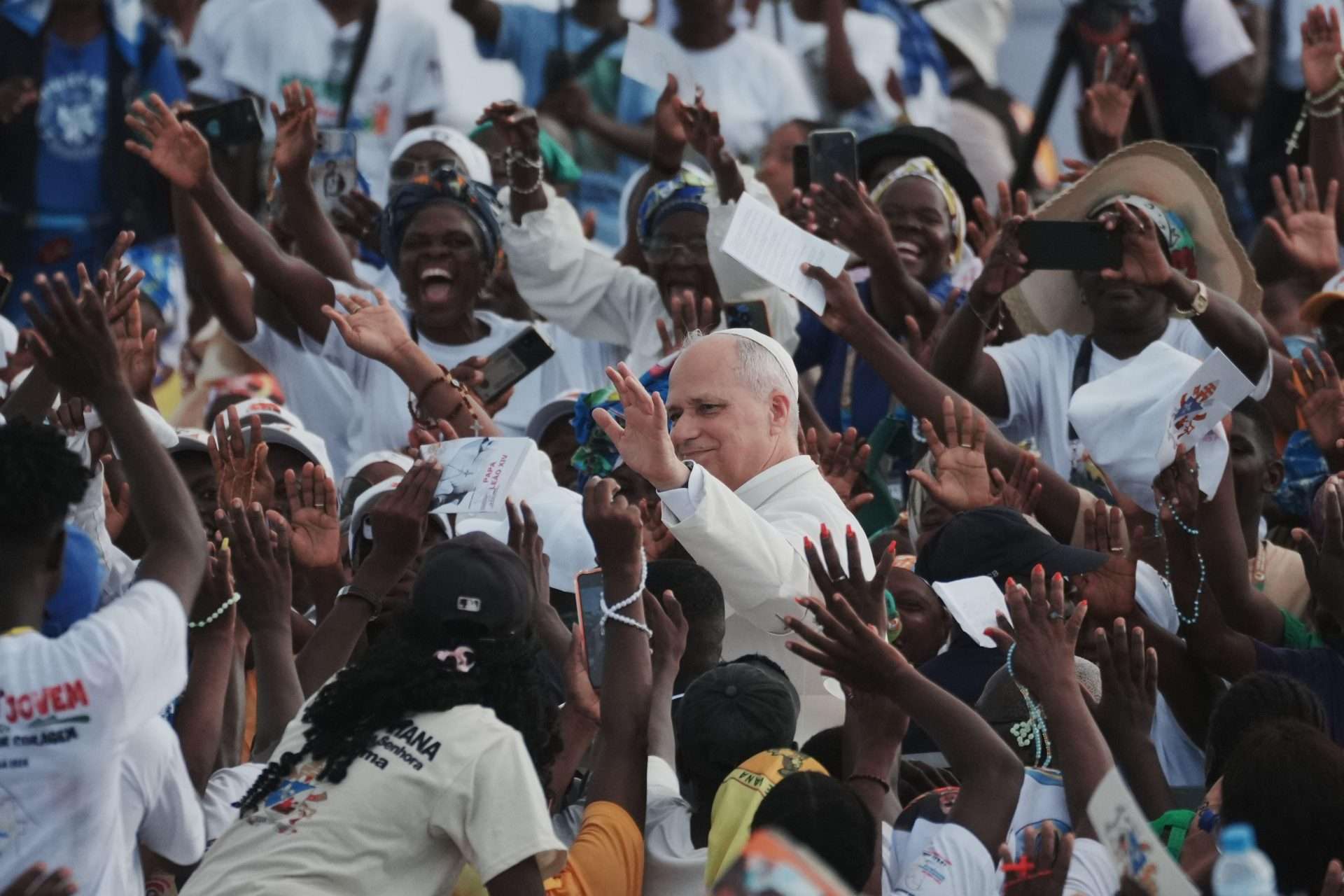
‘Angolans possess treasures that cannot be bought or taken away.’
Andrew Medichini / Associated Press / Alamy
‘For the entire world, Africa is a reservoir of joy and hope, which are virtues that I would not hesitate to call political, because her young people and her poor continue to dream and to hope.’
The Pope praised the “freshness” of Angolan Christianity after praying the Rosary at a major Marian shrine.
Around 30,000 people joined Pope Leo at the Mamã Muxima Shrine in the west of the country on Sunday to pray the Rosary, which he described as an “intense and fervent moment with the living and young Church of Angola”.
“We are in a sanctuary where, for centuries, many men and women have prayed in times of joy and also in moments of sorrow and great suffering in the history of this country,” he said.
The shrine on the Kwanza River was built by Portuguese colonists in the late sixteenth century, when Muxima was a centre for the slave trade. It became a centre of popular devotion after reports of an apparition in 1833 and now draws millions of pilgrims each year.
Speaking in Portuguese to young people and members of the Legion of Mary gathered there, Pope Leo urged them to recognise “a sign” in the construction of a new shrine on the site.
“For the Mother of Heaven entrusts a great project to you as well: to build a better, welcoming world, where there is no more war, injustice, poverty or dishonesty, and where the principles of the Gospel increasingly inspire and shape hearts, structures and programmes, for the good of all.”
Earlier that day, the Pope celebrated an outdoor Mass in Kilamba, a suburb of the capital Luanda, attended by an estimated 100,000 people.
In his homily, Pope Leo said the gospel story of the disciples meeting Jesus on the road to Emmaus (Luke 24:13-35) was “a reflection of the history of Angola, of this beautiful yet wounded country, which hungers and thirsts for hope, peace and fraternity”.
After Portugal withdrew from its colony in 1975, rival groups fought for control of Angola resulting in a civil war between a Cuban-backed government in Luanda, which controlled the expanding oil industry, and rebels supported by the apartheid-era government of South Africa and the proceeds from diamond mines in the west of the country. Since a peace agreement in 2002, the government has struggled to restore Angola’s infrastructure.
“The history of your country, the ongoing difficult consequences you endure, the social and economic problems and the various forms of poverty call for the presence of a Church that knows how to walk alongside you and how to heed the cry of its children,” Leo said.
“Angola needs bishops, priests, missionaries, men and women religious, and lay people who carry in their hearts the desire to ‘break’ their own lives and give them to others, to commit themselves to mutual love and forgiveness, to build spaces of fraternity and peace, and to perform acts of compassion and solidarity towards those most in need.”
Speaking to officials after his arrival from Cameroon on Saturday, Leo said the Church in Angola “desires to be leaven in the dough and to foster the growth of a just model of coexistence, free from the various forms of slavery imposed by the elite who are laden with much wealth but false joys”.
Angolans, he said, “possess treasures that cannot be bought or taken away”.
“For the entire world, Africa is a reservoir of joy and hope, which are virtues that I would not hesitate to call ‘political’, because her young people and her poor continue to dream and to hope,” Leo continued.
He emphasised the importance of “the millions of men and women of good will who constitute the primary wealth of this country” and condemned the “logic of extractivism” threatening life and the harmony of creation.
“Your people have suffered time and again when this harmony was violated by the arrogance of a few. They bear the scars not only of material exploitation, but also of the presumption of imposing an idea upon others,” he said.
“Africa urgently needs to overcome situations and dynamics of conflict and enmity that tear apart the social and political fabric of many countries, fostering poverty and exclusion. Only in encounter does life flourish. Dialogue is the first step.”
Leo said that “the joy and hope that characterise your society” are not just “personal, private sentiments [but] a profound and empowering force – one that resists every form of resignation and every temptation to close in on oneself”.
“Together, you can make Angola a project of hope,” he said. “Only together can we multiply the talents of this wonderful people, even in the urban peripheries and the remotest rural areas, where life is vibrant and the future of the people is being prepared.”
‘Peace’ at the heart of preparations for papal visit to Africa
Africa: cry, the beloved continent
Stay updated — add us as a preferred news source on Google:


Help us keep The Tablet’s voice independent, clear and far-reaching.
Founded in 1840, The Tablet is the leading independent English-language Catholic weekly, celebrated for great writing, astute analysis, brilliant arts and books reviews and trustworthy reporting from correspondents in Britain, Ireland, Rome and across the world.
Independent, high-quality journalism is at the heart of what we do. The Tablet does not have deep pockets and we are not funded by rich donors. If you appreciate our work please consider supporting The Tablet’s Development Fund. It only takes a moment and you can cancel at any time.
- Support with £5 per month
- Support with £10 per month
- Support with other amount.

MOST READ ARTICLES
-
1
Pope returns to Vatican after hospital discharge
-
2
Diverse schools that are 100 per cent Catholic
-
3
Under endless skies
-
4
Battling confession fatigue
-
5
Nigerian bishop scorns suggestion of running in presidential election
-
6
Schismatic Spanish nuns strip contents of convent before eviction
FROM THE EDITOR'S DESK