‘Ireland’s commitment to peace needs a new articulation’ says Archbishop Farrell at Dublin Peace Mass


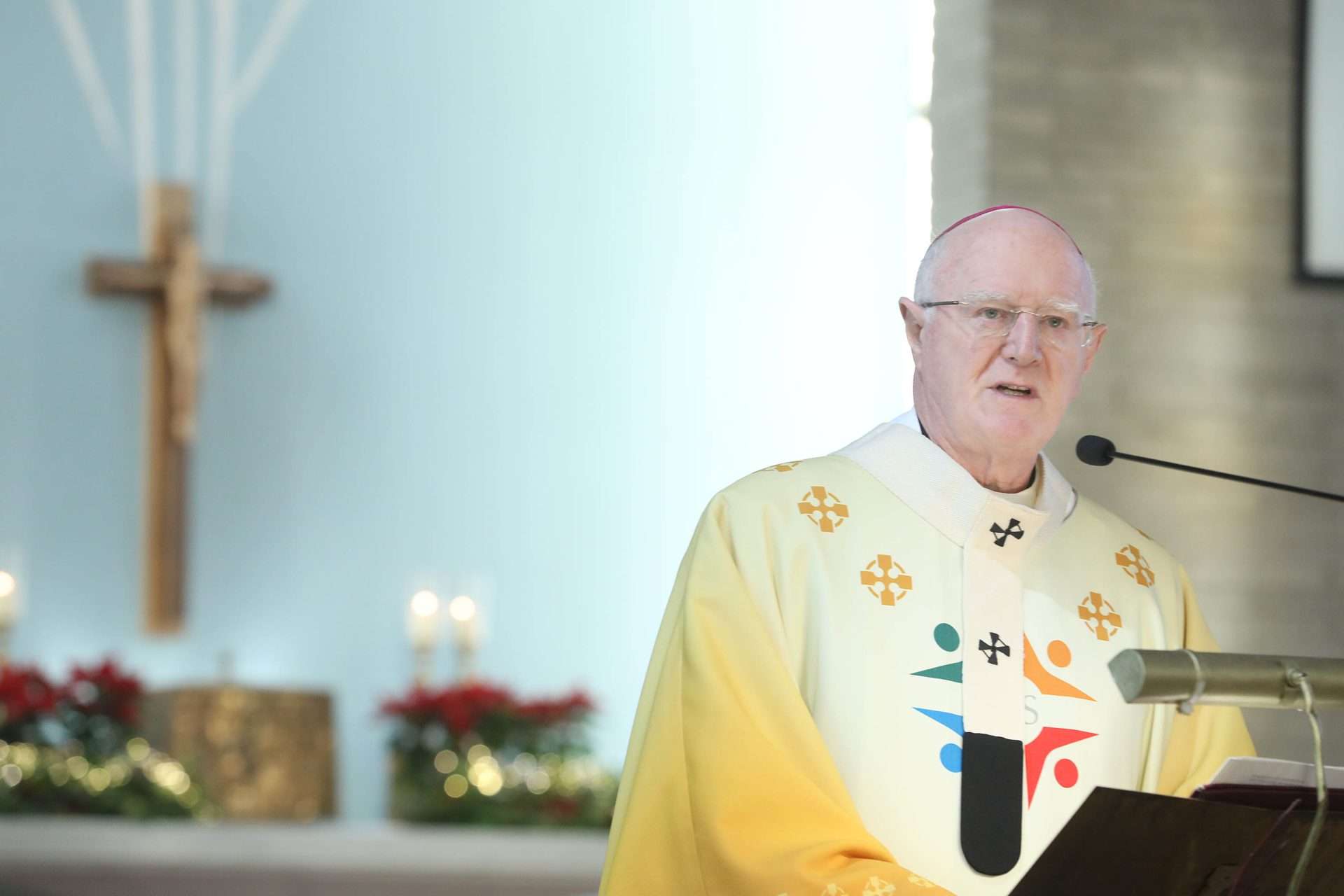
'On this World Day of Peace, we do well to remember that a faith that is truly Catholic calls us to encounter the world,' said Archbishop Dermot Farrell at the Dublin Peace Mass.
Photograph by John McElroy
‘We need to resist dragging the language of faith into political battles or justifying violence in the name of our beliefs. In this time of deep change in our world, we need to discover a new idiom, and maybe in certain ways a new language.’
“Enduring peace is born of compassion and respect; it is born of patience, of attention to the other, of the conviction that the one who presents themselves as different, as other, is actually like oneself, is a true sister or brother of mine,” said Archbishop of Dublin Dermot Farrell in the homily of Mass for the World Day of Peace on 1 January.
Archbishop Farrell celebrated the Mass at Newtownpark Avenue Church in Dublin with Apostolic Nuncio Archbishop Luis Mariano Montemayor and Archbishop Emeritus Diarmuid Martin as concelebrants.
Archbishop Farrell said that this patient process of building trust and the recognition of fraternity across differences “is what our faith means when we say that peace is born of hope”, referring to Pope Leo XIV’s message for the World Day of Peace, where he said that peace can arise from “every spiritual, cultural and political initiative that keeps hope alive”.
Archbishop Farrell said, “Enduring peace is born not of some conviction that we can force a lasting and just peace, a peace that offers dignity to all, that gives to all, ‘a place to lay their head’. The biblical meaning of ‘peace’ is not some passive removal of violence, but the active giving of life and wellbeing.”
He referred to the “blessing ‘May the Lord uncover his face to you and bring you peace’ from the reading from the Book of Numbers, a blessing which “lies at the heart the relationship between our God and his people.”
He paid tribute to the role of the commitment of ordinary people to “compassion and respect for the other” in building peace in Northern Ireland: “There is no enduring peace without the commitment of ordinary people.”
He said, “Recent days have seen the release of the State papers from 30 years ago. As well as the many insights one can gain into political events of the time, and into the public figures that shaped them, there is also a clear witness of the many years of building trust and confidence that led to ‘the commitment to pursue political aims through peaceful means’, that we call the Good Friday Agreement.
“Given the inevitable complications and setbacks, such a long process can only be born of hope. Those who worked for peace on this island, were not only the important figures, whose names we all know, but they were also the people on the streets and farms of this land. They were—and are—the people who did not forget, who remembered.
“It was not for nothing that people of faith across the various communities in Northern Ireland made such a contribution to the ‘peace process.’ Faith transforms; living faith gives us another horizon. Living faith does not lead us away from the world but brings us to the heart of world.
“On this Eighth Day of Christmas, we do well to remember that the birth of Christ, brings God into the world as it is. Jesus, God’s embrace of creation, comes into the world at it is. On this World Day of Peace, we also do well to remember that a faith that is truly Catholic calls us to encounter the world.
“In the words of Pope Leo, we are to ‘foster a civic culture that promotes self-awareness in civil societies, forms of responsible association, experiences of nonviolent participation and practices of restorative justice on both a small and large scale.’”
Archbishop Farrell said that, while “good leadership is vital” we also need “to take to heart that good leaders bring people with them.” He compared the process of building peace across all levels of society to “our response to the climate crisis”, where alongside governments’ “critical” role, “the contribution of every single person is important.”
He emphasised that Ireland’s voice for peace on the world stage needs a new vision in this volatile international context: “Ireland has a proud record in international work for peace. Now, in our days, there is a need and opportunity for the Irish State to articulate how this tradition and the values which underpin it will be continued in a rapidly changing international situation.
“It is not enough to invest in defence capacity or to point to how the circumstances of our traditional military neutrality have changed; Ireland’s commitment to promoting a sustainable peace needs a new articulation.
“We cannot emphasise enough the importance of fostering ‘a culture of memory that preserves the hard-won awareness of the twentieth century and the millions of victims,’ and the need to counter ‘communication campaigns that spread a perception of threats and promote only an armed notion of defence and security.
“We are not in an either-or situation. It is not them or us. When we invest in peace everybody wins. In our land too we need to resist dragging the language of faith into political battles or justifying violence in the name of our beliefs.
“In this time of deep change in our world, we need to discover a new idiom, and maybe in certain ways a new language. It takes time to learn a new language, just as learning a new language needs another person. Nobody learns a new language on their own! Real language is born of the other.
“In Christ God learns our language, from within, without any shortcuts. But that is not all, in Christ, we are learning God’s language for ourselves. No longer do we have a word from beyond ourselves, but in Christ, we receive anew our very own word spoken to us by our brother, by the one who is ‘God with us,’, by the one who remains faithful to us in all life’s seasons, in all our ups and downs.”
The Mass in Dublin was attended by the Deputy Cllr John Stephens, representing the Lord Mayor, ministers of state Jerry Buttimer and Jennifer Murnane O’Connor, members of the diplomatic corps, deputy commissioners of An Garda Síochána, the Order of Malta, the Order of the Holy Sepulchre and the Knights of Columbanus.
Archbishop of Armagh and Primate of All Ireland Eamon Martin also celebrated a Mass for the World Day of Peace on 1 January.
He quoted Pope Leo, who said that “It has become increasingly common to drag the language of faith into political battles, to bless nationalism, and to justify violence and armed struggle in the name of religion. Believers must actively refute, above all by the witness of their lives, these forms of blasphemy that profane the holy name of God.”
Archbishop Martin said, “Like Pope Leo, I am hopeful that even amid what the late Pope Francis called ‘a Third World War fought piecemeal’, peacemakers can continue to resist the spread of darkness, standing as sentinels in the night.
“My wish on this World Day of Peace is that Christians everywhere, who regularly exchange the Sign of the Peace of Christ, will be active ambassadors for peace in the Church and in the world, beginning in their own homes, families, workplaces and neighbourhoods. In this way the Sign of Peace will avoid becoming an empty or meaningless gesture, but will rather be an impulse and driver towards reconciliation and peace building.”
Stay updated — add us as a preferred news source on Google:


Help us keep The Tablet’s voice independent, clear and far-reaching.
Founded in 1840, The Tablet is the leading independent English-language Catholic weekly, celebrated for great writing, astute analysis, brilliant arts and books reviews and trustworthy reporting from correspondents in Britain, Ireland, Rome and across the world.
Independent, high-quality journalism is at the heart of what we do. The Tablet does not have deep pockets and we are not funded by rich donors. If you appreciate our work please consider supporting The Tablet’s Development Fund. It only takes a moment and you can cancel at any time.
- Support with £5 per month
- Support with £10 per month
- Support with other amount.

MOST READ ARTICLES
-
1
Pope returns to Vatican after hospital discharge
-
2
Diverse schools that are 100 per cent Catholic
-
3
Under endless skies
-
4
Battling confession fatigue
-
5
Nigerian bishop scorns suggestion of running in presidential election
-
6
Schismatic Spanish nuns strip contents of convent before eviction
FROM THE EDITOR'S DESK