Hindu nationalists will turn on Christians, Indian bishops warned


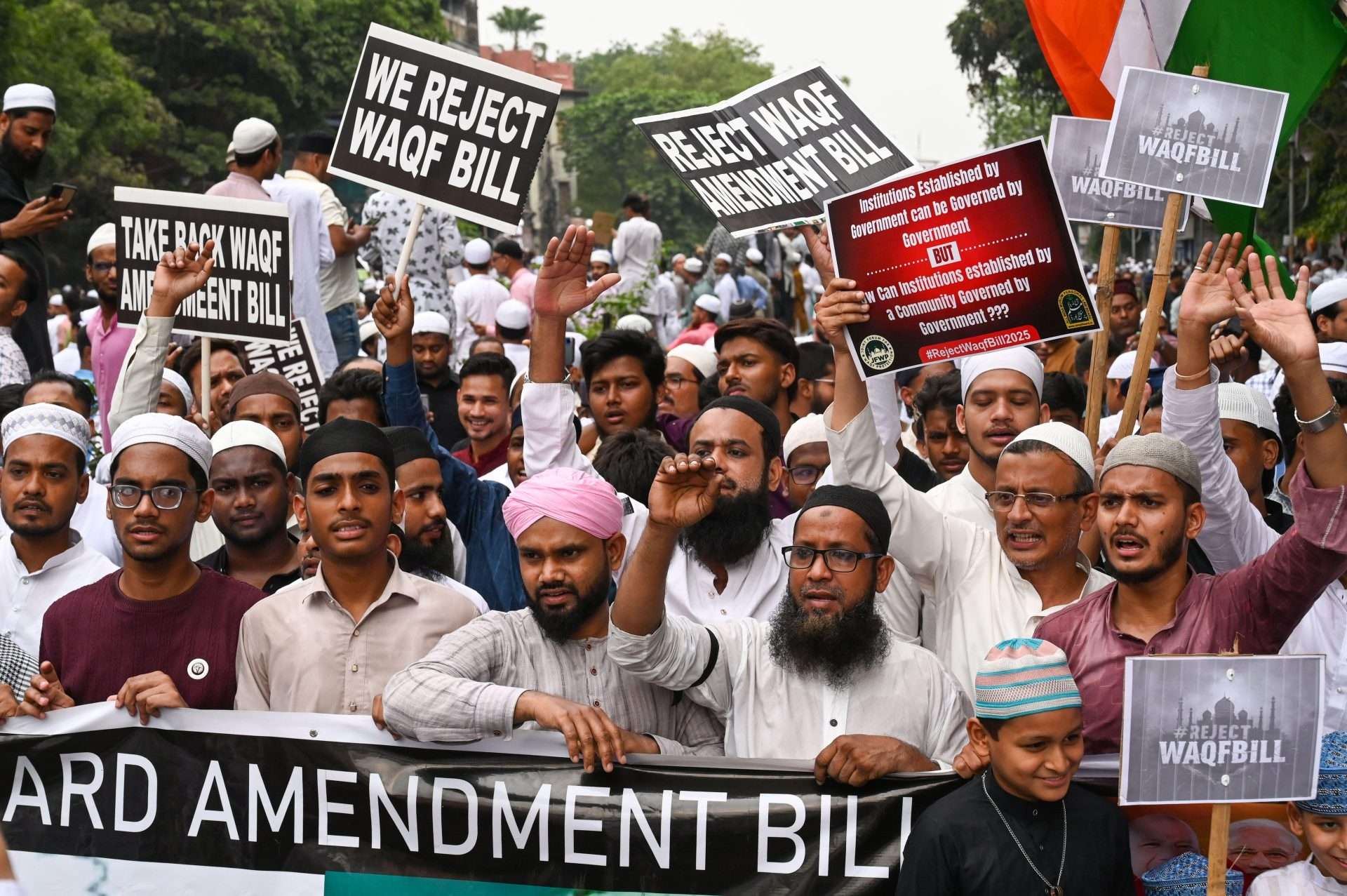
Protests against the Waqf (Amendment) Bill in Kolkata on 4 April.
Samir Jana / Hindustan Times / Sipa USA / Alamy
‘Many groups, even those that should not be, are celebrating the new law. But is it truly a win or just the experimental beginning of a nightmare?’
The Indian government cited the support of religious organisations including Catholic bishops to bring through legislation to change the regulation of Islamic charitable gifts, against protests from Muslim groups.
Church leaders had backed the Waqf (Amendment) Bill 2024 which was passed last week, despite opposition parties’ claim it was unconstitutional and marathon debates in both Houses of Parliament.
President Droupadi Murmu gave her assent to the bill on 5 April, after the Upper House, the Rajya Sabha, had passed the bill by 128 to 95 on 4 April and the Lower House, the Lok Sabha, had passed the bill by 288 to 232 two days earlier.
The bill, brought forward by the Hindu nationalist Bharatiya Janata Party (BJP), changes how properties donated by Muslims to religious causes are governed, adding to previous amendments to the 1954 Waqf Act from 1995 and 2013. A Waqf is a charitable or religious donation made by Muslims for the benefit of the community. Such properties cannot be sold or used for any other purpose by their subsequent owners, subject to the ruling of Waqf boards.
During the Rajya Sabha debate, the federal Minister for Minority Affairs Kiren Rijiju justified the removal of Section 40 of the Act, which gave Waqf boards power to declare property as Waqf, by citing support from organisations like the Catholic Bishops’ Conference of India (CBCI). He argued that abuse of the act’s provisions was affecting ordinary people, such as more than 600 families in Munambam village in the southern state of Kerala.
The CBCI president Archbishop Andrews Thazhath of Thrissur had previously written to the federal government complaining that a church, convent and dispensary in the seafront between Munambam and Cherai villages in Kerala’s Ernakulam district, faced eviction by the local Waqf board. Most residents of the area, within the Diocese of Kottapuram, are Latin Catholic fisher folk.
In a statement on 31 March, the CBCI urged all political parties and legislators to adopt an “unbiased and constructive approach” towards the amendment of the Waqf Act. The Kerala Catholic Bishops’ Council asked MPs from the state not to oppose the amendment.
The council’s spokesman Fr Thomas Tharayil said “the unbridled powers in the Waqf should be amended … The dispute over 400 acres of land in Munambam can be resolved in favour of the residents once the bill is passed.”
While the government said the law aimed to bring efficiency and transparency in the administration of Waqf properties, the opposition said that it was an attack on the rights of minorities and accused the government of seeking to repossess Waqf properties.
In a post on social media, Prime Minister Narendra Modi said the passage of the Waqf (Amendment) Bill and the Mussalman Wakf (Repeal) Bill was a “watershed moment in our collective quest for socio-economic justice, transparency and inclusive growth” which would “particularly help those who have long remained on the margins”.
Kerala Christians protest Islamic law claims to property
India denies US findings of religious freedom violations
Despite appeals from the Catholic Church, the opposition Congress Party parliamentarians from Kerala maintained that they would take their party’s national position rather than a Kerala-specific stand on the bill.
Other critics also said the Church should consider the bill in the national interest, rather than in terms of local grievances. The veteran rights campaigner John Dayal said the bishops “may have overreacted on Muslim Waqf issue”.
“It is not a question of being sympathetic or allying with Muslims,” he told The Tablet, “the Catholic bishops in particular must understand that the Hindu nationalist BJP is quite capable of acting against anybody. They cannot be trusted. Christians tomorrow will have very few friends.”
He said the CBCI’s statement of support for the bill, close to Eid festival, was a “breach of traditional fraternity across the country”.
“It may go on to permanently sour Christian relations with the Islamists as the amendments could impact the community’s religious properties in perhaps as many as half a million villages,” he said.
The prominent lawyers and opposition MPs Abhishek Singhvi and Kapil Sibal said the legislation was “more a conspiracy than an attempt to bring reforms”, claiming it violated the Articles 25 and 26 of the Constitution providing for freedom of religion and freedom to manage religious affairs.
Catholic MP Hibi Eden said the BJP was trying to “create conflict” between the Muslim and Christian communities.
The Indian Union Muslim League and other Islamic organisations also condemned the bill, calling it a “deceptive attempt” to seize Waqf properties, which span millions of acres and hold significant economic and cultural value estimated at trillions of rupees. It said it would challenge the act in the Supreme Court.
Writing in the Capuchin-published weekly Indian Currents, Fr Gaurav Nair said: “Many groups, even those that should not be, are celebrating it. But is it truly a win or just the experimental beginning of a nightmare?”
He said the act set a dangerous precedent and offered a prototype for targeting other communities.
The Waqf board is the third largest landholder in the country after the government and defence services. There are at least 872,351 Waqf properties across India, spanning more than 940,000 acres, according to government data.
Opponents of the bill said it grants the government undue power to regulate the management of these endowments and determine whether a property qualifies as “Waqf”.
The bill also proposes the induction of two non-Muslim members on the Waqf boards. Critics have opposed this provision, arguing that most religious institutions run by non-Muslims do not permit followers of other faiths in their administration.
The bill allows for judicial intervention in disputes, whereas the decisions by Waqf tribunals were hitherto considered final.
The Organiser, published by the Rashtriya Swayamsevak Sangh (RSS), a paramilitary Hindu nationalist organization, carried a claim that the Catholic Church had more assets in India than the Waqf board. It was subsequently withdrawn, but opponents said it revealed the BJP’s intent.
Writing on social media, Congress leader Rahul Gandhi said “the Waqf Bill attacks Muslims now but sets a precedent to target other communities in the future … It didn’t take long for the RSS to turn its attention to Christians”.
Indian rights campaigners object to bishops’ reception for Modi
Hindu nationalism threatens India’s collective spirit
Stay updated — add us as a preferred news source on Google:


Help us keep The Tablet’s voice independent, clear and far-reaching.
Founded in 1840, The Tablet is the leading independent English-language Catholic weekly, celebrated for great writing, astute analysis, brilliant arts and books reviews and trustworthy reporting from correspondents in Britain, Ireland, Rome and across the world.
Independent, high-quality journalism is at the heart of what we do. The Tablet does not have deep pockets and we are not funded by rich donors. If you appreciate our work please consider supporting The Tablet’s Development Fund. It only takes a moment and you can cancel at any time.
- Support with £5 per month
- Support with £10 per month
- Support with other amount.

MOST READ ARTICLES
-
1
Pope returns to Vatican after hospital discharge
-
2
Diverse schools that are 100 per cent Catholic
-
3
Under endless skies
-
4
Battling confession fatigue
-
5
Nigerian bishop scorns suggestion of running in presidential election
-
6
Schismatic Spanish nuns strip contents of convent before eviction
FROM THE EDITOR'S DESK


