English Reformation enforcer secretly saved banned Catholic book, research finds


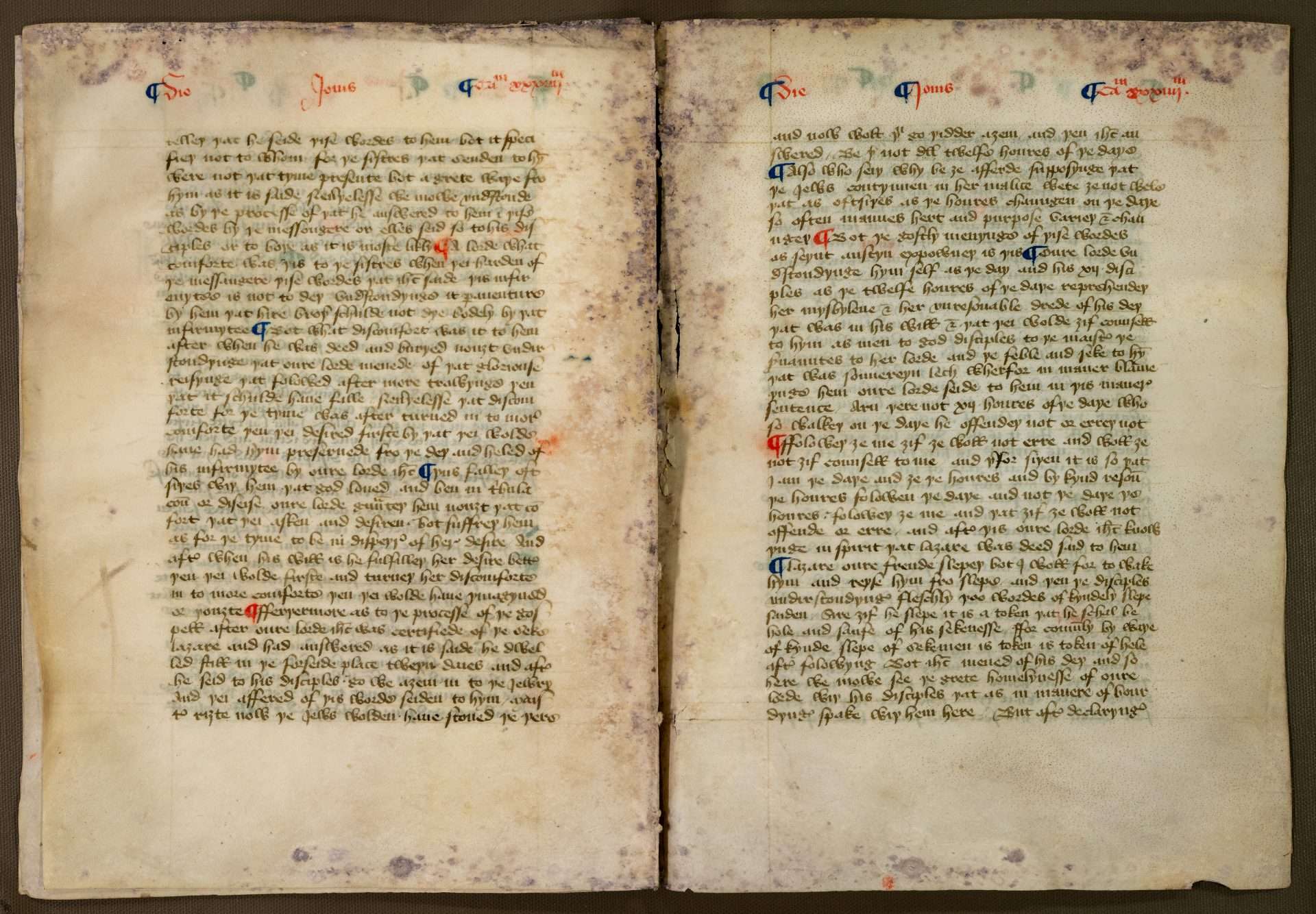
Courtesy of The Trustees of the Firle Estate Settlement and the University of Sussex
Pages 8-9 of The Keep Fragment showing thread binding from Chapter 34 on the Raising of Lazarus
Gage seems to have defied Henry VIII’s orders to save a book from destruction that defended Catholic theology.
The discovery of six lost pages of a medieval manuscript belonging to Sir John Gage, a key figure in the dissolution of the monasteries under King Henry VIII, shed a new light on the internal conflicts of this Tudor politician and courtier, who remained a Catholic while being a central enforcer of the English Reformation.
Researchers at the Universities of Sussex and Cambridge have reunited six pages in The Keep archive in Brighton with a manuscript at Yale University in the US of Nicholas Love’s early 15th-century Mirror of the Blessed Life of Jesus Christ, solving a cataloguing mystery that had stumped archivists for nearly a century.
This bookwent from being a bestseller in the early 15th century to a banned book during the Reformation, because it included a defence of the Real Presence of Christ’s body and blood in the Eucharist and of the importance of the sacrament of confession.
Scrolling through a digitised manuscript held by Yale’s Beinecke Library, the researchers found the gap where six pages belonged, just before a controversial passage on the importance of oral confession to a priest. The scribe’s handwriting and the content of the missing passage both proved the connection.
Dr Katie Walter from the University of Sussex said two possible owners of the manuscript before Gage were women Religious, suggesting the manuscript may have been in a monastic house before it came into his possession.
“The dissolution of the monasteries led to the destruction of many books but others were taken and then circulated through informal networks,” Dr Walter said. “Considering Gage’s active role in the dissolution, it’s very possible he acquired the book during this chaos.”
Dr James Wade of Girton College, Cambridge said, “One possibility is that John Gage went to a monastic library and brought it home. Another is that someone else smuggled it out, and it briefly circulated from hand to hand until Gage acquired it. The key thing is he kept it safe when he was meant to destroy books precisely like this one.”
Dr Wade said that even though 65 copies of Love’s text survive today, many more could have been destroyed in the Reformation: “It shows how popular it was, but it also shows how a work that became suspicious and dangerous for some could also be valued and preserved by others.”
Dr Walter said that although the early modern period is often associated with book burning and destruction, “This manuscript’s story goes a bit against that grain. It reminds us that people were also rescuing, valuing and caring for books.
“By keeping this book on his shelf, John Gage and his family were part of a much bigger secret effort to preserve Catholic literature and knowledge.”
Stay updated — add us as a preferred news source on Google:


Help us keep The Tablet’s voice independent, clear and far-reaching.
Founded in 1840, The Tablet is the leading independent English-language Catholic weekly, celebrated for great writing, astute analysis, brilliant arts and books reviews and trustworthy reporting from correspondents in Britain, Ireland, Rome and across the world.
Independent, high-quality journalism is at the heart of what we do. The Tablet does not have deep pockets and we are not funded by rich donors. If you appreciate our work please consider supporting The Tablet’s Development Fund. It only takes a moment and you can cancel at any time.
- Support with £5 per month
- Support with £10 per month
- Support with other amount.



