End global hunger, world’s biggest faith-based organisations urge


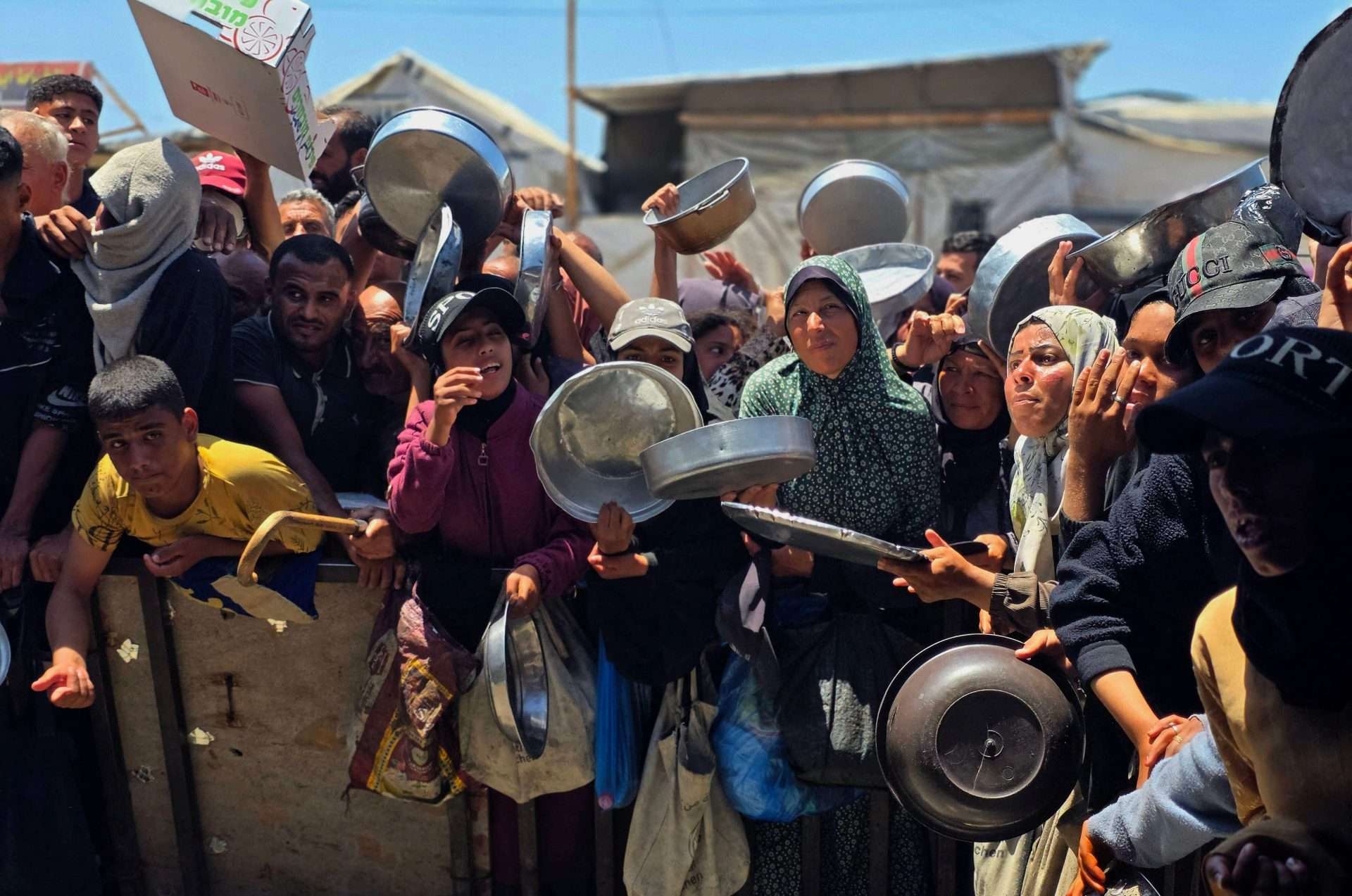
Displaced Palestinians Palestinians gather to receive hot meals distributed by a charity kitchen in Khan Younis, southern Gaza Strip, on 5 June, 2026. The food distribution comes amid ongoing shortages of food supplies caused by Israeli attacks and restrictions on aid entering the Gaza Strip.
IMAGO/Tariq Mohammad apaimages
‘Hunger is the outcome of multiple interconnected crises that reinforce one another. These include conflict, climate change, economic instability, and weakening social protection systems.’
The leaders of Caritas Internationalis, the World Council of Churches (WCC) and World Vision have come together to urge governments to address global hunger, stressing that it is not inevitable but driven by conflict, corruption and climate change.
The letter, signed by Dr Jerry Pillay, WCC general secretary, Alistair Dutton, secretary general of Caritas Internationalis, and Andrew Morley, president and CEO of World Vision International, warns that “hunger amid abundance” is a “moral failure”.
“No one should suffer or die, especially children, because political decisions prioritise war, division, and short-term interests over human life and the common good,” it says.
The three organisations appealed to governments to protect humanitarian access and uphold international humanitarian law, protect global food supply chains, safeguard child nutrition programmes, and prioritise peacebuilding over militarisation.
They marked World Hunger Day on 9 June with a webinar analysing the findings of the UN Food and Agriculture Organisation’s 2025 state of food security and nutrition in the world report and the Global Network Against Food Crises’ 2026 report.
Musamba Mubanga-Mtonga, senior advocacy officer at Caritas Internationalis – which brings together 162 national Catholic relief, development, and social service organisations operating in more than 200 countries – warned that acute food insecurity continues to affect an estimated 266 million people across 47 countries and territories.
She also said in the webinar that more than 35 million children that are suffering from acute malnutrition, including about 10 million experiencing severe acute malnutrition, and that famine has been confirmed in two contexts: Gaza and Sudan.
“These are not merely statistics, but behind every number is a person, a family, and a community struggling to survive and maintain dignity under increasingly difficult circumstances,” Mubanga-Mtonga stressed.
“The report confirms what our members in the different countries witness every day in communities across Africa, Asia, the Middle East, Latin America, and the Pacific, and the fact that hunger is no longer simply a consequence of food shortages,” she continued.
“It is the outcome of multiple interconnected crises that reinforce one another. These include conflict, climate change, economic instability, and also the weakening social protection systems that we witness every day.
“And one of the most striking findings in the report is that over 80 per cent of people facing agricultural insecurity live in protracted crisis contexts.
“This tells us that hunger is becoming increasingly entrenched, and communities are not experiencing temporary shocks from which they can recover from, but instead, many are trapped in cycles of vulnerability that are becoming harder to escape.
“The report also identifies conflict and insecurity as a primary driver of hunger in more than half of the affected contexts: countries that include Sudan, Gaza, South Sudan, Yemen and many other places where violence destroys livelihoods, displacing communities, and also in places where we have seen restrictions when it comes to humanitarian access.
“Climate change continues to intensify the existing vulnerabilities, of these affected, countries. For Caritas, this enforces the urgent need to move beyond short-term responses, but to invest more in adaptation, resilience, and locally-led solutions that strengthen communities before a crisis occurs.
“The findings also come at a particular challenge in geopolitical context around the world. We’re witnessing growing fragmentation, increasing geopolitical tensions, shrinking civil space, and also declining trust in multilateral cooperation.
“This report raises important questions about justice and responsibility. Those suffering most from hunger and climate impacts are often those who have contributed least to the underlying causes of this crisis, and these include the small-scale farmers, the indigenous people, women, and also youth.
“This requires renewed commitment to multilateral cooperation, increased investment in resilience and food security, greater support for local actors, and a shared recognition that hunger is ultimately a question of human dignity, justice, and our common responsibility to one another.”
The high costs of cuts in overseas aid
Stay updated — add us as a preferred news source on Google:


Help us keep The Tablet’s voice independent, clear and far-reaching.
Founded in 1840, The Tablet is the leading independent English-language Catholic weekly, celebrated for great writing, astute analysis, brilliant arts and books reviews and trustworthy reporting from correspondents in Britain, Ireland, Rome and across the world.
Independent, high-quality journalism is at the heart of what we do. The Tablet does not have deep pockets and we are not funded by rich donors. If you appreciate our work please consider supporting The Tablet’s Development Fund. It only takes a moment and you can cancel at any time.
- Support with £5 per month
- Support with £10 per month
- Support with other amount.

MOST READ ARTICLES
-
1
Pope returns to Vatican after hospital discharge
-
2
Diverse schools that are 100 per cent Catholic
-
3
Under endless skies
-
4
Battling confession fatigue
-
5
Nigerian bishop scorns suggestion of running in presidential election
-
6
Schismatic Spanish nuns strip contents of convent before eviction
FROM THE EDITOR'S DESK