Catholic bishops condemn ‘assault on the value of human life’


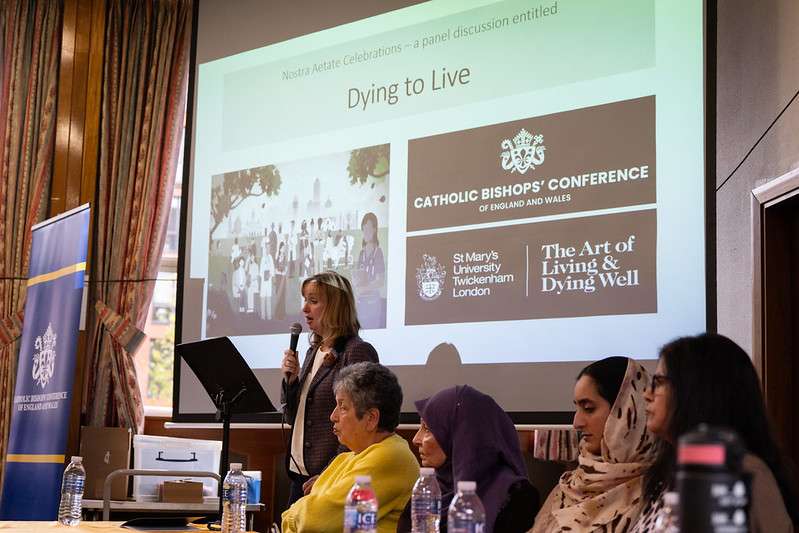
'Dying to Live' was a panel discussion that took place in the Grimshaw Room in St Chad's, Birmingham, on Sunday 26 October. It examined the religious and cultural practices which communities and individuals hold dear as they near the end-of-life with representatives from six religions: Islam, Hinduism, Buddhism, Judaism, Sikhism, and Christianity.
© Mazur/cbcew.org.uk
The Catholic bishops of England and Wales have described 2025 as a year ‘marked by an assault on the value of human life’
Meeting at Hinsley Hall in Leeds for their autumn plenary this week, the bishops focused on the dignity and protection of human life, in particular parliamentary moves to legalise assisted suicide and decriminalise abortion up to birth in some cases.
In a statement today, they expressed “deep sadness” at the continued passage through Parliament of the Terminally Ill Adults (End of Life) Bill which could legalise assisted suicide.
This act would devalue life and put the lives of the vulnerable at risk, they warned. “We have expressed our concerns on many occasions, highlighting the danger of coercive control and the pressure that will be put on vulnerable people who are ill, as well as the threat to the survival of care homes and hospices who oppose this legislation, especially where the mission and values of those institutions would prevent them from facilitating assisted suicide.”
The bishops said they were also “alarmed” by the amendment to the Crime and Policing Bill which proposes to decriminalise abortion up to birth in some circumstances, warning that it will “further endanger the life of the unborn child”.
Archbishopof Liverpool John Sherrington, lead bishop for life issues, said: “Hope has not been lost, but 2025 is marked by an assault on human life, both at its beginning and at the end, and that’s why the bishops have spent time focusing on the two bills in the House of Lords at the present time: the Terminally Ill Adults (End of Life) Bill and the Crime and Policing Bill.”
Archbishop of Westminster Cardinal Vincent Nichols in a separate statement reflected on the election of Pope Leo XIV, the State Visit of King Charles and Queen Camilla to the Holy See and the declaration of St John Henry Newman as a Doctor of the Church and co-patron of Catholic education.
He continued, looking forward, “Our eyes have been on the year 2033. Think of it, the 2000th anniversary of the Last Supper, the death of Christ on the cross, of the empty tomb being discovered and the Risen Christ meeting us, of his ascension into heaven, and maybe most of all, the 2000th anniversary of Him giving us our mission: Go out to the whole world, teach the good news.”
October next year will witness the next National Eucharistic Congress, Adoremus, in London that will see celebrations at both St. George’s Cathedral, Southwark, and Westminster Cathedral. A Blessed Sacrament Procession through the streets of the capital will take place from one to the other. The last Adoremus Eucharistic Congress took place last year at Oscott College in the Archdiocese of Birmingham.
Another key moment in the life of the Church will be the 200th anniversary of the Catholic Relief Act of 1829 that led to emancipation, which, Cardinal Nichols explains, “enabled Catholics again to take our place in society, to be servants in society, and to play our part in the common good and social cohesion of society”.
These events, Cardinal Nichols said, will lead us “to that great anniversary of 2033, when we will find again, I’m sure, in the power of the Holy Spirit, something of that original and so important mission given by Christ to all those who choose to follow him, to every baptised person: Go, serve, proclaim the good news.”
Stay updated — add us as a preferred news source on Google:


Help us keep The Tablet’s voice independent, clear and far-reaching.
Founded in 1840, The Tablet is the leading independent English-language Catholic weekly, celebrated for great writing, astute analysis, brilliant arts and books reviews and trustworthy reporting from correspondents in Britain, Ireland, Rome and across the world.
Independent, high-quality journalism is at the heart of what we do. The Tablet does not have deep pockets and we are not funded by rich donors. If you appreciate our work please consider supporting The Tablet’s Development Fund. It only takes a moment and you can cancel at any time.
- Support with £5 per month
- Support with £10 per month
- Support with other amount.

MOST READ ARTICLES
-
1
Pope returns to Vatican after hospital discharge
-
2
Diverse schools that are 100 per cent Catholic
-
3
Under endless skies
-
4
Battling confession fatigue
-
5
Nigerian bishop scorns suggestion of running in presidential election
-
6
Schismatic Spanish nuns strip contents of convent before eviction
FROM THE EDITOR'S DESK