Call to ‘rethink security’ at National Justice and Peace conference


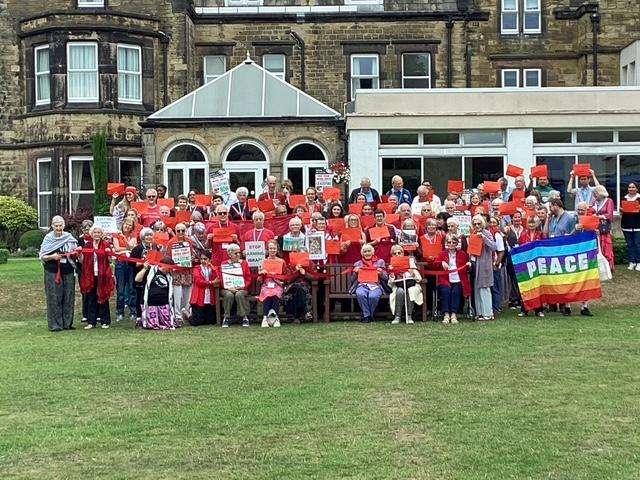
‘Red Line’ Gaza protest at NJPN Conference.
NJPN
A call to “rethink security for a just peace” was made at last weekend’s annual National Justice and Peace Network conference by the outreach coordinator of Rethinking Security, a network of organisations, academics and activists working together for security based on justice, cooperation and sustainability
Keynote speaker Dr Joanna Frew criticised the UK government’s current notion of national security as being “too state-centric”, justifying more military spending while “raiding” the overseas aid budget.
She suggested root causes of global insecurity, such as the climate crisis and extreme poverty, are receiving insufficient attention and explored what real security would look like in today’s world.
Dr Frew suggested an alternative vision of security based on Gospel values of loving enemies, welcoming the stranger, and Earth care as stewards of creation, for “there is no security without a viable planet”. In her view, “human rights and equality are integral to security”. She explained that follow-up resources are available on the Rethinking Security and Pax Christi websites.
The message was well received in a groupwork session on Sunday led by Brian O’Toole, director of the Presentation Interprovincial Justice Desk, who suggested that “we must build a new narrative, based on the common good and common sense”. Diocesan groups fed back ways to “challenge the creep of militarism in our country”, including exposing the arms trade and encouraging religious leaders to speak out more on peace. There was widespread criticism of the criminalisation of people campaigning for peace and environmental justice.
The annual National Justice and Peace Network (NJPN) Conference on 25-27 July in Derbyshire, took the theme: “Towards a Just Peace – Challenging the Inevitability of Violence.”
Among the 160 participants were Justice and Peace representatives from 17 dioceses in England and Wales, Justice and Peace Scotland, and religious orders, including Faithful Companions of Jesus (FCJ), St Joseph of Peace (CSJP), Presentation Sisters and Mary Ward Loreto UK.
Organisations running stalls included Cafod, Caritas Social Action Network, Laudato Si Movement, Archbishop Romero Trust, Columban Justice, Peace and Ecology and Christians Aware. Peace groups were there in force, particularly Pax Christi, Christian CN, and Peace Pledge Union. Petitions were signed on tackling international debt, dismantling nuclear weapons and greener banking.
Anne Peacey, NJPN chair, said the conference offered an opportunity “to commit to becoming peacemakers in our troubled world”. She said, “We thank God for the witness of Pope Francis and Pope Leo.”
Pope Leo sent a message to Pax Christi USA’s annual national assembly the same weekend, saying “efforts to promote nonviolence are all the more necessary” in a world facing serious challenges including war, division, and forced migration.
Gospel nonviolence was explained by Sr Katrina Alton CSJP, national chaplain to Pax Christi England and Wales. She suggested that Jesus’ way combines both the rejection of violence and emphasises the power of love and truth in action for justice, peace and integrity of creation. Sr Katrina told of her experience at a protest vigil at an arms fair at the Excel Centre in London where, as she knelt in prayer after throwing red paint over an arms poster to highlight the blood of innocents, a delegate whispered in her ear, “I fear you are right.” She pointed out how most casualties in modern warfare are civilians and that combatants are young people.
At a panel discussion on “just peace” on Saturday morning, chaired by James Trewby of the Columbans, Andrew Jackson, chief executive of Pax Christi England and Wales, spoke of the “deep spirituality in a commitment to nonviolence”. Bokani Tshdizu of Operation Noah reported her commitment to fly less and reduce her carbon footprint to try and protect “our beautiful world”. She said, “We must do more in the community, such as vigils, street protests, being active in our churches.” She asked, “Are we doing enough on racial climate justice?”
Speaking during the conference Mass, celebrated by Westminster priest Fr Joe Ryan, Ann Farr of Pax Christi International called for a just peace for Gaza. Particular concern for Gaza was expressed in a public “Red Line for Gaza” where conference participants wearing red lined up to urge decision-makers to end the killing of children in Gaza.
In messages written on red paper, they joined thousands in similar protests across the world, symbolising the many red lines Israel and its Western backers have crossed. The creation of mass starvation of Palestinians by deliberately blocking food deliveries and shooting unarmed civilians at distribution points was singled out for condemnation. There was a call for a ceasefire and for international law to be respected.
A wide range of conference workshops explored such issues as links between violence and environmental problems, “Investing in Peace through Climate Action” and “Listening to the voices of bereaved Israelis and Palestinians committed to working together for a just peace”. Quakers in Britain looked at how local interfaith and intercommunal relations in Britain are impacted by international conflicts. In this Jubilee Year 2025, the NJPN invited all to join them as “pilgrims of hope”.
Stay updated — add us as a preferred news source on Google:


Help us keep The Tablet’s voice independent, clear and far-reaching.
Founded in 1840, The Tablet is the leading independent English-language Catholic weekly, celebrated for great writing, astute analysis, brilliant arts and books reviews and trustworthy reporting from correspondents in Britain, Ireland, Rome and across the world.
Independent, high-quality journalism is at the heart of what we do. The Tablet does not have deep pockets and we are not funded by rich donors. If you appreciate our work please consider supporting The Tablet’s Development Fund. It only takes a moment and you can cancel at any time.
- Support with £5 per month
- Support with £10 per month
- Support with other amount.

MOST READ ARTICLES
-
1
Pope returns to Vatican after hospital discharge
-
2
Diverse schools that are 100 per cent Catholic
-
3
Under endless skies
-
4
Battling confession fatigue
-
5
Nigerian bishop scorns suggestion of running in presidential election
-
6
Schismatic Spanish nuns strip contents of convent before eviction
FROM THE EDITOR'S DESK