Archbishop Mullally echoes Pope’s call for AI regulation in Parliament


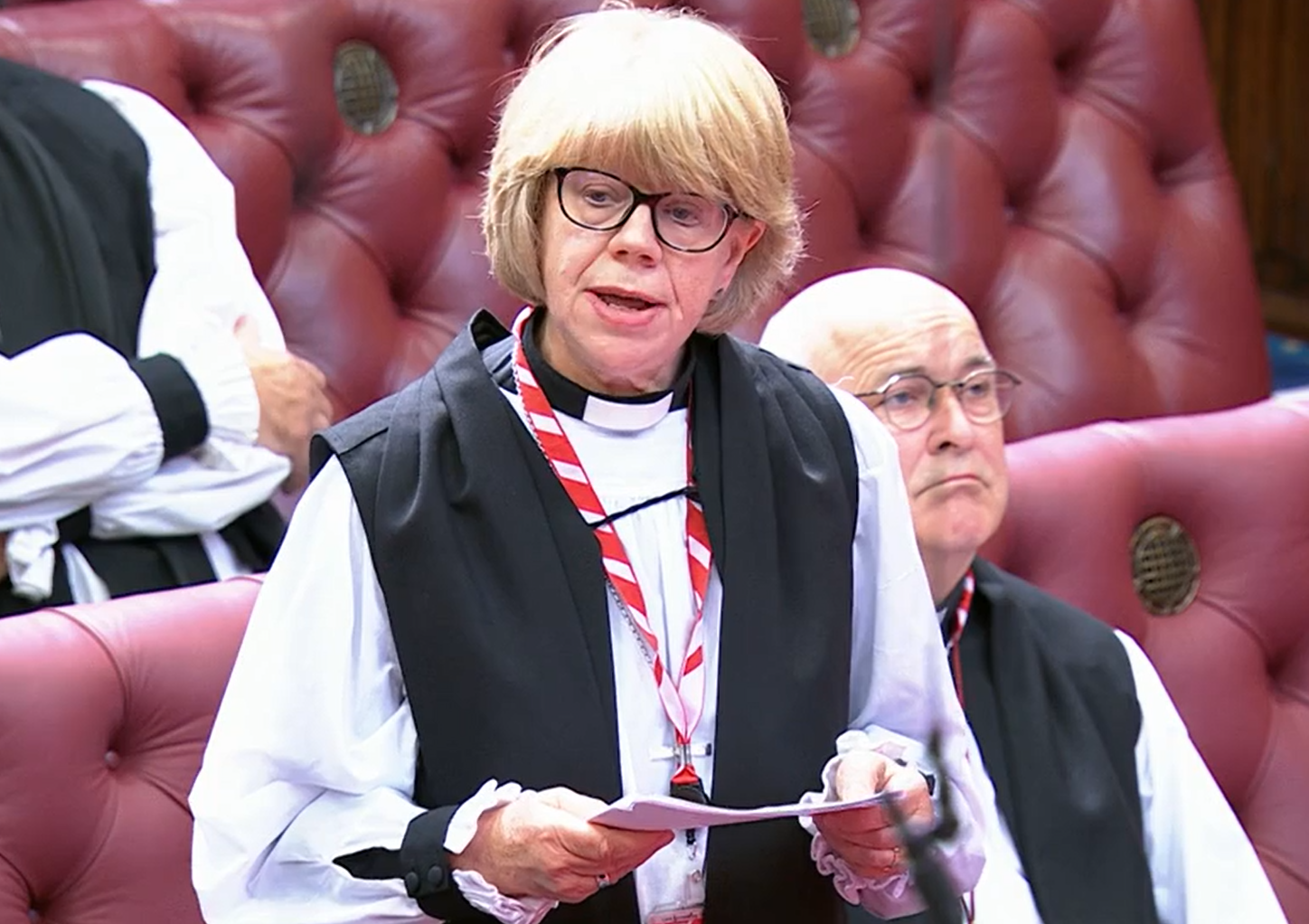
'[AI] matters for governments and policymakers, as they determine what should and should not be permitted and regulated,' the Archbishop of Canterbury told the Lords.
Parliament Live (screenshot)
‘Above all, we must put people – our common, glorious humanity – ahead of profit, convenience or technological progress at all costs.’
Archbishop of Canterbury Sarah Mullally called a debate on the impact of artificial intelligence on human relationships and society in the House of Lords this morning.
She warned the Lords that AI is being “unleashed” into society without the necessary “theological, philosophical and spiritual framework with which to make decisions about creating, controlling, using or directing it”.
Archbishop Mullally called for AI to be “designed, built, regulated and used” to “serve our glorious humanity and not to diminish it”, and referenced Magnifica Humanitas, quoting Pope Leo XIV’s plea that “humanity – in all its grandeur and woundedness, must never be replaced or surpassed”.
A nurse by background, Archbishop Mullally said AI can help to “enhance human dignity, to protect and uphold life” in fields such as nursing and medical care, where it is beginning to make childbirth safer, from automated ultrasounds to predictive tools for pre-eclampsia, to consistent foetal heartrate monitoring.
But she added that a robot or AI model should never replace human beings in some medical roles: “Sitting at the bedside of a patient to deliver very difficult news or supporting a woman through the delivery of her baby are deeply vulnerable moments where human touch, human eye contact, human emotional intelligence, are invaluable.”
She also warned that some uses of AI, “rather than enhancing human dignity, are providing new ways of degrading it or violating it”, referencing a report from Durham University stating that chatbots can facilitate violence against women and girls by allowing roleplays of incest, child sexual abuse and rape with few safeguards, risking the normalisation and legitimisation of such abuse.
“These harms are not simply the result of user misuse – AI platforms design choices, policies and governance failures are encouraging and enabling them, and existing regulation is wholly inadequate to prevent them,” Archbishop Mullally warned.
She told the Lords that this has implications for governments and policymakers, as they determine “what should and should not be permitted and regulated”, as well as for those designing, developing and building the technology: “there is no such thing as values-neutral technology”.
Archbishop Mullally also said that while AI can enhance human creativity and imagination and take away the burden of more repetitive and administrative tasks, it can also have “the opposite effect on our human abilities”.
She cited an article by Mary Harrington entitled “Thinking is Becoming a Luxury Good”, which explores evidence of human brain power decreasing, such as adult literacy scores levelling off and declining in the past decade in the majority of OECD countries, with some of the sharpest declines are among the poorest.
Archbishop Mullally said research shows that children who are exposed to more than two hours a day of recreational screen time have worse working memory, processing speed, attention levels, language skills and executive functions than children who are not.
She also referenced a study that showed that heavy users of AI struggle more with critical thinking: “they stop thinking for themselves and their capability atrophies”.
“The irony is that while AI might make us feel like we are more creative, at scale AI’s inherent nature means ideas will in fact become more predictable, unoriginal, homogenised,” Archbishop Mullally said.
She quoted the Pope’s advice in an address to young people at a National Catholic Youth Conference in Indianapolis: “Use it in such a way that if it disappears tomorrow, you would still know how to think, how to create, how to act on your own, how to form authentic friendships.”
“The human ability to think and create surpasses the capabilities of AI,” Archbishop Mullally continued. “We must work to ensure our human abilities are given space to grow and thrive, to be the thinking, creative beings God made us to be.”
She also expressed concern that “generative AI cannot tell right from wrong, fact from fiction”, because instead of truth it “produces a statistical echo of what has been said before, in material it has been trained on”.
“Even more concerning, is that AI can be weaponised by malign actors – it is the perfect tool for someone wanting to create fake news,” she said. “It has the power to manipulate what we see and what we believe, at a speed and scale never seen before. What is often presented as a tool in the democratisation of knowledge could all too easily become the tool of the autocrat.
“Without common truth, a flourishing common life becomes impossible. There is a serious risk this will lead to a fundamental breakdown in trust across society… Without a common understanding of truth, human relationships and the reciprocal ties which underpin our societal structures flounder.”
Archbishop Mullally concluded: “Technology this revolutionary must not simply be unleashed on our societies: it must be developed with us and for us – at a human pace, with human objectives.
“Above all, we must put people – our common, glorious humanity – ahead of profit, convenience or technological progress at all costs. To ensure that we harness AI to serve humanity, to be an extraordinary tool in the creation of a more just, abundant and hope-filled world.”
How do we make the disarmament of AI work?
Catholic AI creator says Leo XIV’s encyclical shows Pope aware how fast technology is evolving
Scotland’s bishops prepare guide to Pope Leo’s first encyclical
Stay updated — add us as a preferred news source on Google:


Help us keep The Tablet’s voice independent, clear and far-reaching.
Founded in 1840, The Tablet is the leading independent English-language Catholic weekly, celebrated for great writing, astute analysis, brilliant arts and books reviews and trustworthy reporting from correspondents in Britain, Ireland, Rome and across the world.
Independent, high-quality journalism is at the heart of what we do. The Tablet does not have deep pockets and we are not funded by rich donors. If you appreciate our work please consider supporting The Tablet’s Development Fund. It only takes a moment and you can cancel at any time.
- Support with £5 per month
- Support with £10 per month
- Support with other amount.

MOST READ ARTICLES
-
1
Pope returns to Vatican after hospital discharge
-
2
Diverse schools that are 100 per cent Catholic
-
3
Under endless skies
-
4
Battling confession fatigue
-
5
Nigerian bishop scorns suggestion of running in presidential election
-
6
Schismatic Spanish nuns strip contents of convent before eviction
FROM THE EDITOR'S DESK


