A pilgrim in the Eternal City on the Jubilee of Consecrated Life


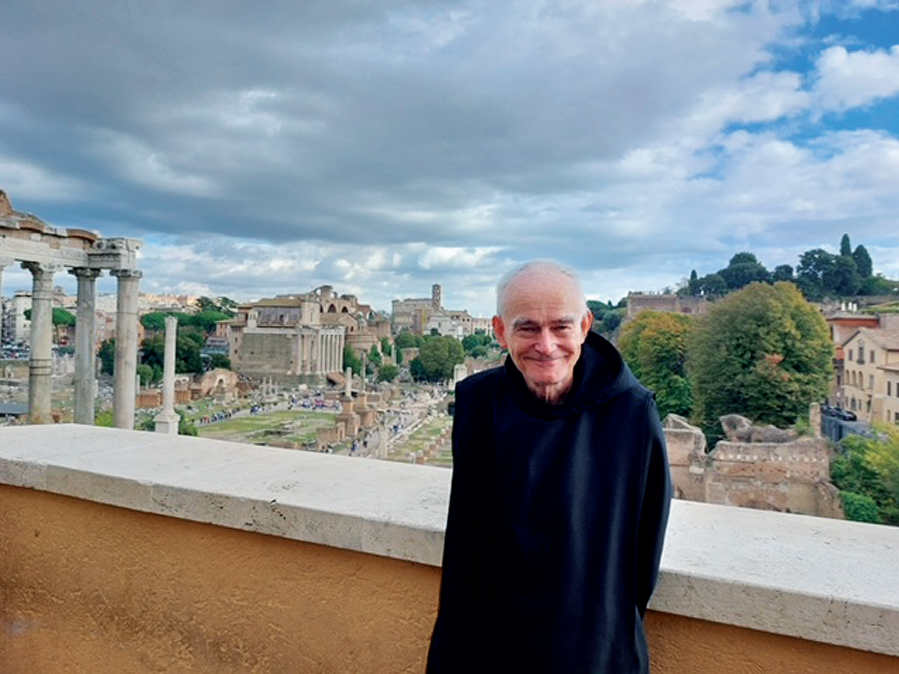
A minister to Jubilee pilgrims: Luke Bell
In Rome, a monk concelebrates Mass with the Pope, passes through the Holy Door, venerates relics, visits churches, seminaries and museums, and sits behind Charles at a service to mark the King being made a confrater
St Peter’s Basilica lacks the monastic restraint of the church where I usually worship. Emphasis rather than suggestion is its keynote. I entered it with a great throng, all of us screened for any metal on our persons; I beheld its magnificence, with pauses for prayer. And as I was going out, I noticed a little sign indicating the adjacent Holy Door. That entry was different. There were more rather than fewer people, yet their very number gave a sort of privacy. Extremes meet and the massed public made my prayer as private as it would be in the obscurity of my monastery. Yet, wherever it is, our prayer is that of the whole Church, and here the latter was more fully manifest.
The pilgrim route took us by a chapel where the Blessed Sacrament was exposed. Here it was possible to bow down before the Lord of all, the very goal and focus of every pilgrim, every hope. Beyond this chapel were the confessionals, signalling the infinite mercy of his presence among us. I saw a similar arrangement in my pilgrimages to the Basilicas of Santa Maria Maggiore and St John Lateran.
I was able to make these visits by staying as a minister to jubilee pilgrims for the month of October with my Benedictine brethren at another papal basilica, St Paul Outside the Walls. Here again, scale is significant: the pigeons flying about are no more intrusive than flies would be in an ordinary church. At its centre is the tomb of St Paul, complete with fetters he once wore, around which are nations more numerous than those he evangelised, forming crowds as large as those in St Peter’s. They manifest the global nature of the Church, as does the community of monks together here this month, which includes brethren of some dozen nationalities.
The whole world is in Rome, gathered as Church around a single person: Pope Leo. I concelebrated Mass with him for the Jubilee of Consecrated Life. I was also there for a general audience at which he spoke of how “the infinite thirst for fullness”, which is what I suppose brought us all there, is satisfied by Jesus risen from the dead, promising us abund ant life and “a deep and joyful calm”, the latter echoed in the gentle serenity of the Pope’s person.
A single person also embodies my nation, and I was privileged to be seated just behind him in the Basilica of St Paul at the ecumenical service to mark his being made a confrater, or spiritual associate, of the abbey. King Charles sat on a special throne, adorned with his coat of arms and the words ut unum sint. Cardinal James Harvey, of the basilica, gave a very moving address about the historic and now regrowing closeness of the Catholic Church and the United Kingdom. Choirs royal and monastic sang. This echoed the symbolism I saw outside the English College, where the papal flag and the Union Jack fly together.
Inside, I saw images of English martyrs painted only 10 years after their death. Earlier I had prayed by the relics of St Cyril – he of the alphabet – in the beautiful church of San Clemente, whose Irish Dominican rector chatted to me as he picked up litter outside. I had also revered St Cecilia’s body, entombed under her church in Trastevere, reliably witnessed as being incorrupt some 1,300 years after her martyrdom, as I was informed by an English nun there. In Rome, the martyrs are local: for example, St Ignatius of Antioch, whom we remembered at Mass at St Paul’s, died at the Colosseum, a few stops away on the Metro.
The Vatican museums witness to the history. Most moving to me were the earliest examples of Christian art in the Pinoteca. I saw first a mosaic of St Luke from the ancient Basilica of St Peter and shortly after that a beautiful depiction of St Eustochium. The icons glowed with the holiness that they represented. The early Christian sarcophagi in another museum resounded with the claim of immortality: presencing, as it were, those they entombed.
Just how colossal that in breaking of faith into the world was became clear to me through the exhibits in the Capitoline Museums. A metres-long fragment of a foot from a statue of Constantine indicated the greatness of the power that was conquered by the weakness in which St Paul found his strength. A statue showing a lion slaying a horse, already ancient before the Christian era, seemed to speak of the current Vicar of Christ confronting the culture of death riding its apocalyptic horse.
A faith which encompasses and transcends not only the world but also its history is pro claimed here in Rome, the Eternal City.
Luke Bell OSB is a monk of Quarr Abbey on the Isle of Wight.
Login
Please login to comment
0 Comments
Oldest

Help us keep The Tablet’s voice independent, clear and far-reaching.
Founded in 1840, The Tablet is the leading independent English-language Catholic weekly, celebrated for great writing, astute analysis, brilliant arts and books reviews and trustworthy reporting from correspondents in Britain, Ireland, Rome and across the world.
Independent, high-quality journalism is at the heart of what we do. The Tablet does not have deep pockets and we are not funded by rich donors. If you appreciate our work please consider supporting The Tablet’s Development Fund. It only takes a moment and you can cancel at any time.
- Support with £5 per month
- Support with £10 per month
- Support with other amount.

MOST READ ARTICLES
-
1
Pope returns to Vatican after hospital discharge
-
2
Diverse schools that are 100 per cent Catholic
-
3
Under endless skies
-
4
Battling confession fatigue
-
5
Nigerian bishop scorns suggestion of running in presidential election
-
6
Schismatic Spanish nuns strip contents of convent before eviction
FROM THE EDITOR'S DESK