News Briefing: Church in the World


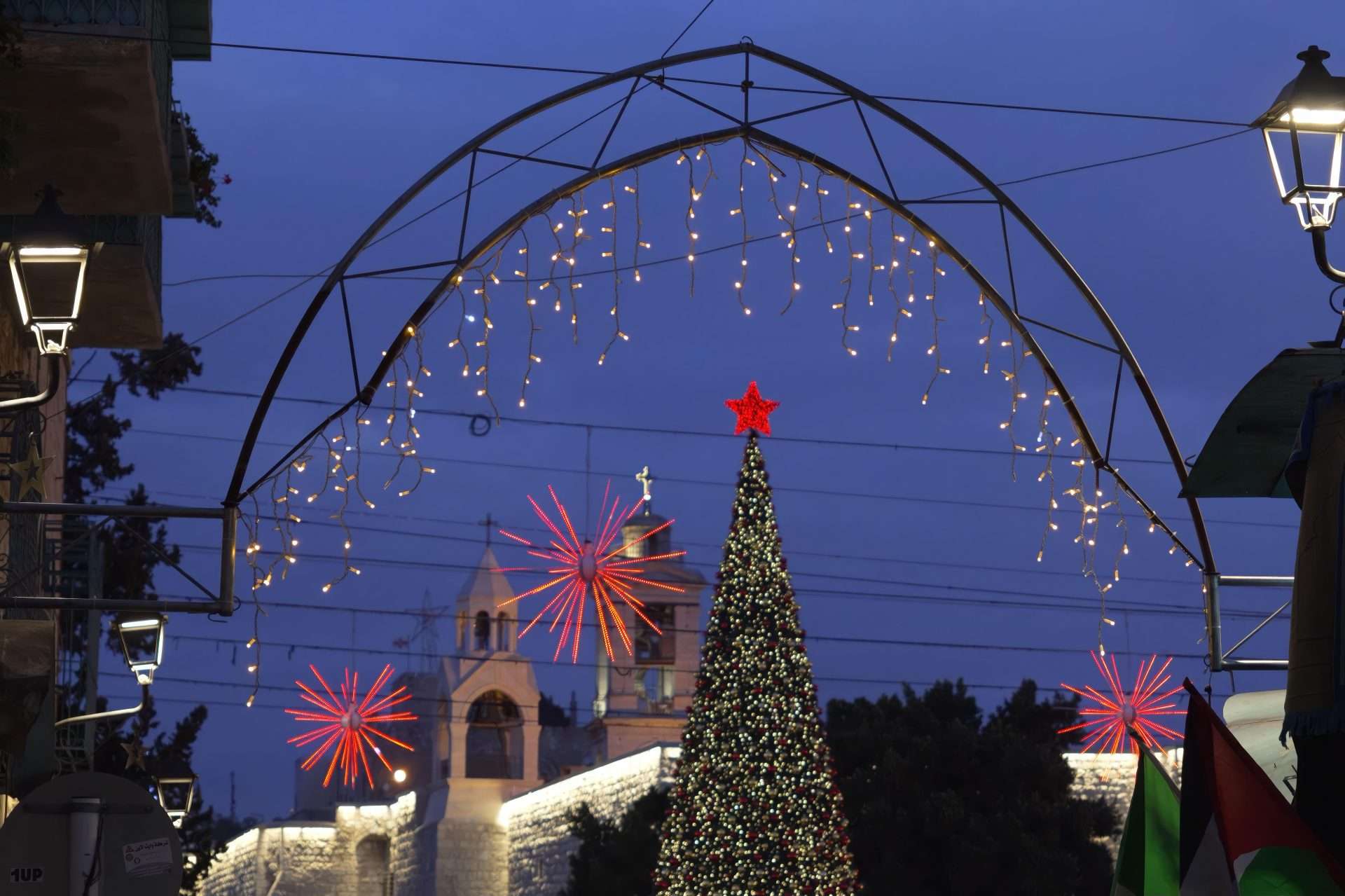
Bethlehem erected Christmas decorations for the first time in two years.
Eddie Gerald / Alamy
The Pope confirmed the appointment of Fr Francis Li Jianlin as bishop for the apostolic prelature of Xinxiang in China’s Henan province, after accepting the resignation of his predecessor Bishop Joseph Zhang Weizhu.
Local clergy “elected” Li as bishop in April during the sede vacante period after Pope Francis’ death. A Vatican statement reported his episcopal ordination on 5 December and said Pope Leo had appointed him on 11 August “in accordance with the Provisional Agreement between the Holy See and the People’s Republic of China”.
Zhang, 67, was an “underground” bishop ordained in 1991 without recognition from the Chinese authorities, who repeatedly detained him. On 6 December, the Vatican reported that the Chinese civil authorities had recognised “the episcopal dignity” of the now-retired Bishop Zhang.
The Committee for Ecology and Environment of Korea’s Catholic Bishops’ Conference signed a deal with the state-run Korea Energy Agency to collaborate in expanding the use of renewable energy.
The deal allows both organisations to undertake cooperative projects. These include increasing the supply of renewables for the Church, promotion and education work and expanding social participation to respond to climate change.
The Korea Energy Agency plans to provide consultancy and support for energy-efficiency construction on Catholic property. Subsidies are available for the installation of renewable energy facilities and support for the solar power generation industry in diocesan institutions.
South Korea has endured natural disasters including record-breaking heatwaves, wildfires and flooding that have killed hundreds of people and displaced thousands in recent years.
Pope Leo renewed his prayers for victims of flooding in Asia on Sunday as the death toll in Indonesia, Sri Lanka and Thailand exceeded 1,750. Speaking after the Angelus, he called for “concrete gestures of solidarity”.
In Indonesia, Capuchin friars in northern Sumatra welcomed displaced families into their monasteries. Fr Yoseph Norbert Sinaga, superior of the Capuchin Friars Province in Sibolga, said the humanitarian emergency continues because so many people are homeless.
“We are suffering from the lack of water and electricity,” said Fr Sinaga. “Wven we in the monasteries must collect water from springs in the forest.”
In Sri Lanka, churches and temples have become emergency relief camps after cyclone Ditwah brought heavy rains and landslides across the island nation. St Francis Xavier Church, Gurugalla, in the Diocese of Ratnapura is sheltering some 175 Buddhists, Muslims, and Christians. Two relief camps were set up at a church and Buddhist temple in Gurugalla.
In the Diocese of Chilaw, Our Lady of Mount Carmel Cathedral is sheltering around 800 people, and another 250 have taken refuge at St Anthony’s Church in Nainamadama. In the Archdiocese of Colombo, four parish churches have accommodated over 600 people.
Religious sisters joined thousands of climate activists in protests at Australia’s Port of Newcastle, disrupting the movement of coal ships during a mass civil-disobedience action. The “Rising Tide” protest in early December saw activists on kayaks obstructing the path of ships carrying coal.
The group Australian Religious Response to Climate Change said the annual protest involved Christians, Quakers, Buddhists and other faith groups. Sally Neaves, spokesperson for the Sisters of Mercy – who led prayers and hosted a stall – said members of the congregation joined the action to highlight Australia’s “long history of ignoring the impacts of burning fossil fuels” on vulnerable communities, including Pacific nations.
“We stand with those people and places under threat … and we stand with those calling for change for the sake of future generations,” Neaves said.
Nicaraguan authorities moved two Catholic lay leaders into house arrest after holding them in isolation in prison for nearly 16 months.
Carmen María Sáenz Martínez and Lesbia del Socorro Gutiérrez Poveda were arrested in August 2024 and detained in a maximum-security prison. Neither woman was ever charged, tried or sentenced for a crime, yet both were held incommunicado, without contact with their lawyers or family members.
Both women worked with the Diocese of Matagalpa, formerly led by the now-exiled Bishop Rolando José Álvarez Lagos.
Christian Solidarity Worldwide welcomed their release, but Director of Advocacy and Americas Team Leader Anna Lee Stangl said: “While neither woman should be under house arrest, this nonetheless marks an improvement … We call on the government of Nicaragua to grant them their full freedom without condition, and immediately to release all remaining political prisoners.”
In October, Pope Leo received the report “Nicaragua: A Persecuted Church” by researcher Martha Patricia Molina, which detailed more than 1,000 attacks on the Catholic Church by the dictatorship of President Daniel Ortega and his wife and vice president Rosario Murillo.
A survey by the Pew Research Centre found that levels of religiousness have been relatively stable in the United States over the past five years. The percentages of Americans who say they pray every day, that religion is very important in their lives, and that they regularly attend religious services have remained steady since 2020.
Pew found “no clear evidence” of a “nationwide religious resurgence”. On average, young adults remain much less religious than older Americans. While 59 per cent of the oldest Americans say they pray every day, only 30 per cent of young adults born between 1995 and 2002 say they do. While 43 per cent of the oldest Americans say they attend religious services at least once a month, only 26 per cent of young adults claim to do so.
The report also said that, despite anecdotal reports that young people are increasingly turning to traditional forms of Christianity, such as Orthodox Churches and Catholicism, the data shows that across all age groups “Christianity loses far more people than it gains through religious switching”.
The Archbishop of Washington Cardinal Robert McElroy announced he is “cancer-free” after surgery last month to remove a tumour.
“This week I received word from my doctor that my pathology report had come back, and it stated that the surgery had removed all of the cancerous tissue in my body,” McElroy said in a statement published at the archdiocesan website. He said he would not require any further treatments such as radiation or chemotherapy.
Last month, the 71-year-old cardinal announced that doctors had diagnosed him with “well-differentiated liposarcoma”, a form of cancer that typically does not metastasise.
“I give thanks to God who has sustained me through this journey. And I give thanks to all of you who have prayed to God for my healing. I believe those prayers were what led to this wonderful outcome. May the Lord bless you deeply during this joyous season of Advent,” McElroy said.
The town of Dolton, Illinois designated Pope Leo’s boyhood home as an historic landmark. Officials in the town just south of Chicago purchased the small brick house in July for $375,000. Mayor Jason House called the home one of the “most culturally and spiritually significant locations in the United States”.
Soon after the election of then-Cardinal Robert Prevost on 8 May, tourists started flocking to the house at 212 E. 141st Place. By declaring it an historic site, village officials hope to secure federal and state funding to preserve the site and make it a more viable tourist attraction.
Consultation with town residents will be solicited before plans are finalised on what precisely to do with the property. It is unclear if they will be collaborating with the Archdiocese of Chicago, which as a religious organisation operates within legal guidelines distinct from secular non-profit organisations.
Québec introduced a new bill that would bring in major limits on religious expression in public places, such as parks, and prohibit face coverings in schools, while also restricting the exclusive offering of religion-based menus, including kosher and halal meals, in public institutions.
The bill expands on a 2019 religious symbols law which prohibited the wearing of religious items by certain public employees in positions of authority. Canada’s Supreme Court will hear a legal challenge of that law early next year.
Québec’s Minister of Secularism Jean-François Roberge said the limits on public prayer were a response to recent protests in the province, where there has been debate over groups praying at pro-Palestinian demonstrations.
“It’s shocking to see people blocking traffic, taking possession of the public space without a permit, without warning, and then turning our streets, our parks, our public squares into places of worship,” he said.
The Dutch Council of State ruled that local authorities can restrict demonstrators outside abortion clinics as long as they provide space “within sight and hearing of clinic visitors”. In setting such a buffer zone, the highest administrative court in the Netherlands said “clinic visitors can decide for themselves whether or not they wish to engage in direct confrontation with the demonstrators”.
The ruling concerns four groups opposed to abortion, Schreeuw om Leven (“Cry for Life”) in Groningen, Pro Life Amsterdam in the capital and Donum Domini and Pro Life Heemstede west of Amsterdam. They had argued that the places for demonstrators were too far away from the clinics’ entrances.
Abortion has been legal in the Netherlands since 1984. The abortion rate in 2022 was 9.9 per cent, compared to 21.1 per cent the same year in England and Wales, a relatively low rate attributed to widespread sex education.
“A demonstration at an abortion clinic is more likely to lead to disorder than at other demonstrations. This is due to the location and the vulnerability of those attending abortion clinics,” the court said. “Mayors may, therefore, designate a location for the demonstration other than directly in front of an abortion clinic to prevent disorder.”
Notre Dame de Paris received a record 11 million visitors in the year since it reopened, equivalent to 50 people every minute.
Already the most popular monument in France before its 2019 fire, a jump in visitors was expected but not as high as has been registered from the pre-blaze total of about 8 million. More surprising were the 650 pilgrimages in the past year, a third of them from abroad, although the cathedral was not considered a shrine like the popular Marian sanctuary at Lourdes.
“Such pilgrimages to Notre Dame did not exist before,” said cathedral rector Fr Olivier Ribadeau Dumas, who previously held the same position at Lourdes. Demand for confessions, an activity more frequent at shrines, has also risen compared to pre-fire times, so that the cathedral had to recruit priests to act as confessors.
Being both an historical monument and a place of prayer, Notre Dame has separate reservation formalities for cultural visitors and Catholic pilgrims. Unlike many shrines, it is not associated with a miracle though it holds some famous relics such as the Crown of Thorns.
The Church of Sweden asked its parishes to stop inviting nuns from the St Elisabeth Monastery in Minsk because of their collaboration with the Russian state and support for its invasion of Ukraine. This followed Swedish reports that Orthodox nuns from Belarus were selling their handicrafts at the Täby parish, which had been inviting them annually since 2017.
Michael Öjermo, vicar of Täby parish, told the Svenska Dagbladet daily that the parish would break contact with the monastery. “Täby parish has no intelligence service, so to speak,” he said. “It’s not that easy to know everything. But we’re trying now.”
According to Lisa-Gun Bernerstedt, head of civil preparedness for the Church of Sweden, there may be around 10 or 20 parishes that work with the Minsk monastery.
Gintaras Sungaila, an Orthodox priest of the Constantinople Exarchate in Vilnius, told The Tablet: “They used to come here [to Lithuania] all the time, sell their products. They travel all over the world.” He continued: “Right after the start of the war in 2022, they were fully operating in Lithuania, but I’m not aware if there are any restrictions against them at present.”
Bishop Wojciech Osial of Łowicz accused the Polish government of breaking the law by halving weekly religion classes in schools without agreeing the changes with the Church. Osial, who chairs the Catholic Education Commission of the Polish bishops’ conference, made the claim at the presentation of a new core curriculum for Catholic education in schools on 4 December.
At the start of this academic year, the education ministry mandated that pupils should have only one hour of the municipally-funded and voluntary “religia” classes each week, instead of two. The classes largely teach the Catholic catechism and rarely include information on other religions.
Education minister Barbara Nowacka justified the decision saying two hours per week was excessive and pupils should spend more time on other academic subjects. Attendance at the voluntary classes has fallen in recent years and schools now have to offer an ethics class as an alternative.
The bishops of South Africa, Botswana, and Eswatini said their governments employ inadequate measures to address the high incidence of women killed by their partners. They called gender-based violence (GBV) a crisis in the region and appealed for family values that emphasise the protection of women.
The Southern African Catholic Bishops’ Conference (SACBC) issued an appeal to mark the 16 days of action against GBV held annually at the beginning of December. “In the three countries within the SACBC region, many assume the root of the problem is weak policy, weak institutions, and insufficient budgets,” it said.
The bishops said the family remains “the foundation of society” and criticised “incomplete” responses to the crisis. “Catholic Social Teaching reminds us that when societies are wounded, we must go to the roots of the wound,” the bishops said, adding that “violence against women grows in broken families”.
A bishop in Zambia appealed for respect for democratic values, after opposition parties accused the government of shrinking the democratic space. The country’s bishops recently joined civic society organisations to demand accountability after the government attempted to amend the constitution without consulting the public.
In an Advent appeal, Bishop Patrick Chilengwa Chisanga of Lusaka, the Zambian capital, called for the “reconstruction and reinforcement of all democratic structures that are currently falling into ruin due to narrow, short-sighted partisan political interests”. He continued: “As Zambia goes to the polls in the August 2026 general elections, the call to ‘Go and repair my Church’ becomes all the more relevant and urgent.”
Bishop Michael Bibi of Buea in Cameroon’s volatile South West region said it was “unfortunate” that the leading opposition figure Anicet Ekane died when he was “under detention for political reasons”.
Ekane, 74, died in military custody on 1 December, according to a statement from the defence ministry. He had been in detention for 38 days following post-election violence, having joined a coalition that backed Issa Tchiroma Bakary’s claim to have won the October poll against President Paul Biya.
In a television interview, Bibi dismissed claims that the Church in Cameroon was compromised by its close relationship with the state. “It’s a misconception that because you know somebody in government, because you relate with that person in government, then you cannot speak the truth,” he said.
The bishop also condemned the abduction of priests for ransom by separatist groups in his region.
Rwanda’s Prime Minister Justin Nsengiyumva praised the Catholic Church for leading the country’s rapid development. Speaking in 6 December during commemorations marking 125 years of the Catholic hierarchy in Rwanda, he said the Church had a key role in Rwanda’s emergence as a model of reconstruction following civil war and genocide.
“We wish to work together with the Catholic Church and other denominations to continue improving the education of Rwandan children, ensuring that no one is left behind,” Nsengiyumva said. “As we all know, when a child learns, the nation is built. When children do not study, the future is put at risk.”
Bishop Barani Eduardo Hiiboro Kussala of Tombura-Yambio said young people are crucial to building peace and saving South Sudan from returning to civil war.
During an Intergenerational Youth Peace Dialogue workshop in Yambio, Equitoria region on 2-3 December, he told participants that “a nation cannot build new roads on old wounds” and emphasised the critical need for historical healing in South Sudan’s peace process.
Years of fragile governance and scarce opportunities have left many young people feeling unseen, pushing them toward the false security of tribal identity, Hiiboro warned, calling on youth and elders to join dialogue circles and traditional reconciliation practices.
“Elders carry memory. Youth carry energy. Together they carry destiny,” he said, emphasising how trust between generations creates a foundation for sustainable peace.
“Before you change the world, you must first heal the world inside you,” he continued. “Many young people fall into conflict because they feel unseen, unvalued, ignored, powerless. But hear me clearly: If you do not love yourself, you will fear others. If you do not value yourself, you will attack others.”
Bethlehem erected Christmas decorations for the first time in two years, despite escalating violence in the West Bank. Israeli settlers attacked the Christian village of Taybeh last week, setting two cars on fire and a defacing a building with a threatening message on the night of 5 December.
Fr Bashar Fawadleh, parish priest of the Latin church of Taybeh, appealed for “stronger support to safeguard our people and our land”. He continued: “Taybeh is the last Christian village in the area, and we need global cooperation to help it survive.”
In Gaza, the Holy Family Parish – where 450 people still live – began preparations for Christmas amid continued Israeli airstrikes. On 6 December an explosion close to the parish destroyed a stained-glass window and other windows in the building. Since the US-brokered ceasefire was announced on 10 October, Israeli forces have killed more than 360 Palestinians in Gaza.
The UN Relief and Works Agency for Palestine Refugees (UNWRA) said large stocks of aid remain blocked from entering Gaza, causing a “critical humanitarian situation” affecting nearly 1.5 million Palestinians. About 9,400 children suffer acute malnutrition, while the health system has collapsed and water sources are contaminated – conditions now worsened by winter rains and flooding.
Pakistan’s parliament approved a bill on 2 December establishing a body to protect the rights of minority communities, defined as “non-Muslims” in the Constitution, more than a decade after the Supreme Court’s landmark 2014 judgment which ordered the formation of such a commission.
Civil society and human rights organisations have long demanded implementation of the ruling. The new law establishes a commission mandated to investigate rights’ violations, monitor policy implementation, advise government bodies, and promote minority welfare. The 18-member commission will include three Christians.
The Human Rights Commission of Pakistan welcomed the legislation, emphasising that the body must protect all religious minorities “equally, without exception or hierarchy”. It said the commission’s mandate must align fully with constitutional guarantees of religious freedom and non-discrimination.
The Archdiocese of Bangalore opened the Pope Francis Migrant Centre to support the displaced in Bengaluru, capital of India’s Karnataka state.
Inaugurated on 3 December by Cardinal Silvano Tomasi and launched in collaboration with the Scalabrinian Missionaries, the centre will provide temporary shelter, counselling, legal assistance, skills training, community building and emergency support for migrant families.
It is built on the premise that “a migrant should never feel alone. The Church must be a home that listens, protects, and walks with them”, said Archbishop Victor Henry Thakur of Raipur, chairman of the Conference of Catholic Bishops of India (CCBI) Migrants Commission.
The centre, close to the Yeshwantpur Railway Station, was opened on the feast of St Francis Xavier, who transformed the lives of tens of thousands in India, said Archbishop Peter Machado of Bangalore, who is also CCBI vice president.
“Every act of welcome is a living Gospel,” said Cardinal Tomasi. “The Church is alive here and now whenever she bends down to care for migrants.”
Fr Leonir Chiarello, superior general of the Scalabrinians, said: “For over 130 years, our mission has been to accompany migrants with compassion and professionalism. This centre continues that mission.”
Masses resumed at St Mary’s Cathedral Basilica, the seat of the head of the Syro-Malabar Church, after 1,000-day hiatus caused by protests.
Fr Thomas Mangatt, the administrator of the cathedral in the Ernakulam district of the Indian state of Kerala, celebrated Mass on the evening of 1 December, with morning and evening Masses on subsequent days – including one celebration of the “uniform mode” of the Holy Qurbana, the Syro-Malabar Mass, on Sunday.
This was a requirement of the agreement in the Archeparchy of Ernakulam-Angamaly, where protests against the uniform mode by clergy and laity led to violence and the police closure of the cathedral on 22 November 2022. The uniform mode approved by the Church’s synod requires the priest to face ad orientem during the eucharistic liturgy.
“The basilica administrator’s appeal before the concerned court confirmed that there is currently no order preventing the Mass, and if the church leadership permits there is no obstacle to offering the Mass,” said Riju Kanjookkaran, a spokesperson of the laity organisation Almaaya Munnettam.
Earlier in October, Archbishop Joseph Pamplany, the vicar of the archeparchy for Major Archbishop Raphael, wrote to the administrator directing him to ensure that Mass resumed in the basilica from the start of Advent. On 26 March 2024, following a petition by a group of Catholics, a local court said the church could open for services other than Mass.
Stay updated — add us as a preferred news source on Google:


Help us keep The Tablet’s voice independent, clear and far-reaching.
Founded in 1840, The Tablet is the leading independent English-language Catholic weekly, celebrated for great writing, astute analysis, brilliant arts and books reviews and trustworthy reporting from correspondents in Britain, Ireland, Rome and across the world.
Independent, high-quality journalism is at the heart of what we do. The Tablet does not have deep pockets and we are not funded by rich donors. If you appreciate our work please consider supporting The Tablet’s Development Fund. It only takes a moment and you can cancel at any time.
- Support with £5 per month
- Support with £10 per month
- Support with other amount.

MOST READ ARTICLES
-
1
Pope returns to Vatican after hospital discharge
-
2
Diverse schools that are 100 per cent Catholic
-
3
Under endless skies
-
4
Battling confession fatigue
-
5
Nigerian bishop scorns suggestion of running in presidential election
-
6
Schismatic Spanish nuns strip contents of convent before eviction
FROM THE EDITOR'S DESK