News Briefing: Church in the World


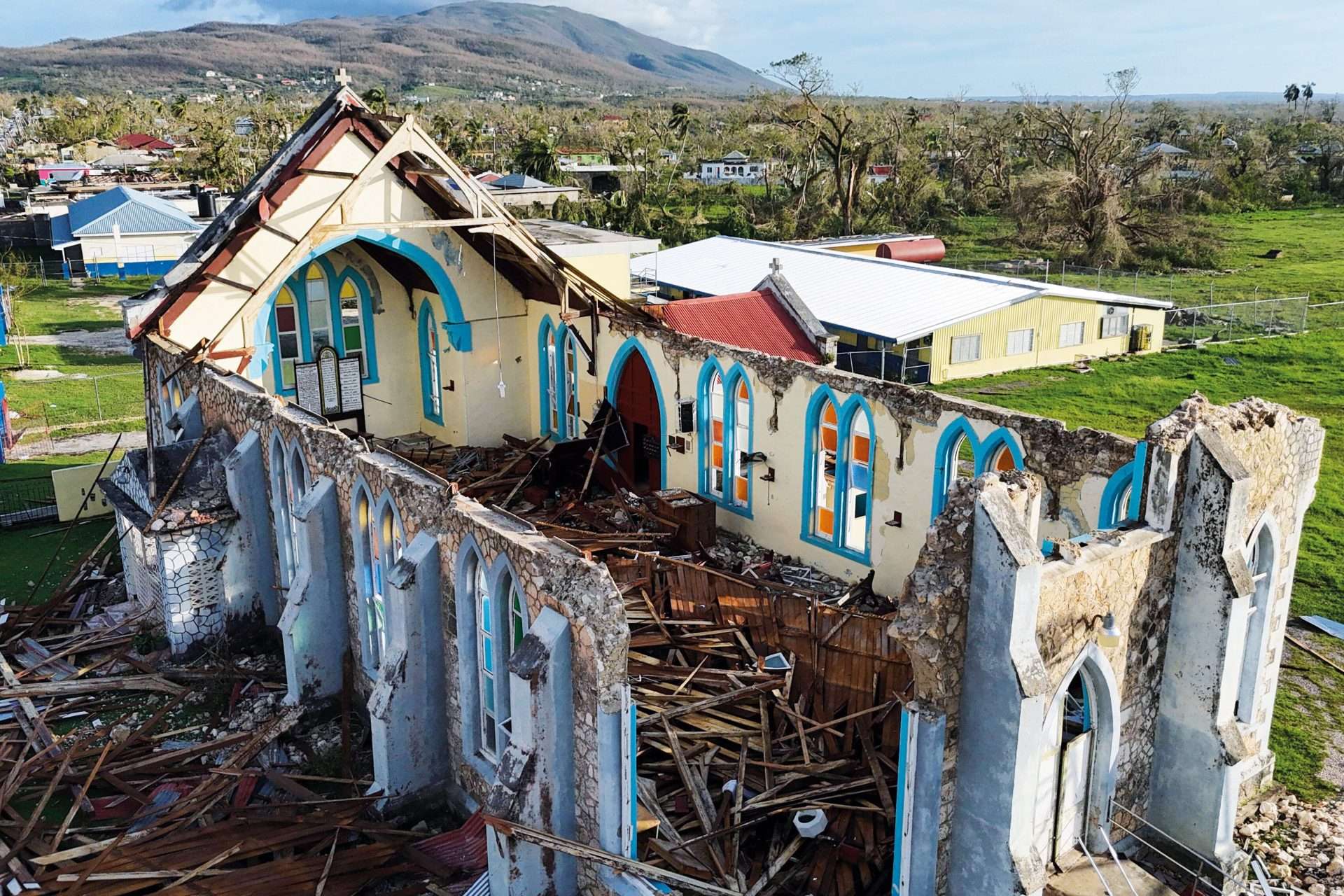
A church in Lacovia suffered severe damage when Hurricane Melissa hit Jamaica last week.
Matias Delacroix, AP / Alamy
Pope Leo assured victims of Hurricane Melissa of his prayers after it swept the Caribbean last week. “I encourage the civil authorities to do everything possible, and I thank the Christian communities, together with voluntary organisations, for the relief they are providing,” he said on 29 October.
In Jamaica, Dominican friars helped organise relief after Melissa hit with wind speeds of 185mph. Around 75 per cent of the country was left without electricity and farming areas were devastated. Fr Clifton Harris OP led a church team coordinating relief efforts in the west of the island, helping to organise communal meals in parishes and the repair of flimsy homes.
Cuba’s Conference of Catholic Bishops called Melissa’s impact there “a catastrophe of enormous proportions” and noted that this disaster adds “to the already difficult daily reality of our people”.
The hurricane damaged Cuba’s national Marian shrine when it struck the east of the country on 29 October. It “tore up the shrine” of Our Lady of Charity of El Cobre, according to its rector Fr Rogelio Dean. He reported that the 120mph winds damaged stained-glass windows and ripped masonry from the walls.
“Water came in, and well, it has been a very difficult time,” added Fr Dean in a message on social media, adding: “People have lost practically everything. We are experiencing a very painful situation right now.”
Catholic bishops, clergy, Religious and laity joined organised labour leaders from across the United States to mark the fiftieth anniversary of the Appalachian bishops’ pastoral letter “This Land is Home to Me”. The event at the pastoral centre in Pittsburgh, Pennsylvania on 25 October also marked the tenth anniversary of Laudato Si’.
“The question that faces you and I today, in a very particular way, is this: how do we lift up and care for creation and care for the workers in Appalachia?” asked the former Bishop of Pittsburgh David Zubik. Pittsburgh was one of 12 dioceses represented at the gathering.
Appalachia is among the poorest rural regions in the United States and its land has long been subjected to environmental degradation by extraction industries – the topics the bishops addressed in the historic 1975 pastoral letter.
Bishop Mark Brennan of Wheeling-Charlestown, West Virginia called for boycotts of companies that do not pay workers fairly and those with large discrepancies between the pay of executives versus workers. “The fruits of labour are not evenly distributed,” Brennan told the gathering. “We need to raise our voices and start boycotts.”
The Illinois Senate passed an assisted suicide bill 30-27 on 31 October, sending the proposal to Governor J. K. Pritzker who has 60 days to sign the bill into law or veto it. The Illinois Catholic Conference, representing the state’s bishops, opposed the legislation and said it would lobby to governor to veto it.
“With the passage of legislation to legalise assisted suicide in Illinois, the Illinois General Assembly has put our state on a slippery path that jeopardises the well-being of the poor and marginalised, especially those in the disability community, and will have foreseeable tragic consequences,” the conference said in a statement.
“With all the assaults on human dignity and the growing number of vulnerable people we see every day, sadly the leaders and members of the General Assembly who voted for this offer us suicide as its response.” It added that the legislature ignored the “real advances in palliative medical care as an alternative to assisted suicide”.
They noted the mixed signal the law sends at a time when teenage suicide is on the rise. Across the US, 11 states and the District of Columbia permit assisted suicide, while in New York proposed law also awaits the signature or veto of Governor Katy Hochul.
Abuse victims voted to approve a $230 million bankruptcy settlement with the Archdiocese of New Orleans. In a filing to a Louisiana court on 30 October, the archdiocese said 99.63 per cent of its creditors, who include hundreds of survivors promised payments based on the severity and effects of their abuse, had voted in favour of the settlement which includes an undertaking to release records on abuser clergy and to reform safeguarding procedures. Bondholders had objected to the settlement, accusing the archdiocese of securities fraud by withholding interest payments on its debt.
The Faithful Companions of Jesus elected Sr Patricia Binchy FCJ as their new general superior for a six-year term. She entered the society in 1973 and has served in countries including Ireland, England, France, Canada, Bolivia, Argentina and the USA. Binchy speaks several languages including Irish, English, Spanish, and French.
She led local communities in Salta, Argentina and Paris, and acted as province and area leader in the Americas and Europe. She was most recently general assistant in the society’s general council, working closely with the international coordinators of FCJ Companions in Mission.
The society elected three general assistants to serve in its general council: Sisters Afra Primadiana from Indonesia, Clare Hand from England and Judith Routier from the Channel Islands.
The Sagrada Família Basilica in Barcelona became the tallest church in the world after the first part of the cross was added to its central tower.
The central Tower of Jesus Christ now measures 162.91 metres tall and will eventually reach a height of 172 metres after the rest of the cross is added. Stone from a quarry in Lancashire was used to complete the basilica, designed by the Catalan architect Antoni Gaudi.
Although the first stone was placed in 1899, only one of a planned 18 towers had been built when Gaudi died in 1926. During the Spanish Civil War (1936-1939), anarchists set fire to the crypt, destroying plans and plaster models created by Gaudí to guide future construction.
The basilica is expected to be completed in 2026 to coincide with the centenary of Gaudi’s death. Ulm Minster in Germany, which stands 161.53 metres high, was previously the tallest church in the world.
The German bishops’ conference published a document on the “visibility and recognition of the diversity of sexual identities in school”.
Schools should be places “where children and young people find protection from discrimination and personal denigration, a place where they experience acceptance in their individual development and at the same time learn to accept others,” wrote Bishop Heinrich Timmerevers of Dresden-Meißen in the preface to “Created, redeemed and beloved”.
The document focuses on how to deal appropriately with queer people (including pupils, teachers and parents) in an educational and pastoral capacity, and how to shape school life accordingly. Timmerevers said he hoped “that this text may contribute to the further development of an educational climate and educational practice characterised by God’s compassion and kindness”.
It said RE teachers should present Church teaching on sexual morality in a nuanced way and adhere to the principle of controversiality: “What is controversial in science and society should also be treated controversially in the classroom.”
School leaders should understand their school as a “school of diversity”, and communicate and emphasise this. It also advises the formulation of rules for lavatories and changing rooms.
According to the current “Rainbow Index of Churches in Europe” (RICE), Germany has the “most queer-friendly Catholic Church” in Europe, due to the commitment of lay committees, Catholic associations and an established LGBTQ pastoral care service.
German public television broadcast a “queer service” from the Church of St Liudger in Münster as part of the regular schedule of televised Catholic services for the first time on 26 October.
Cardinal Claudio Gugerotti discussed the possibility of a papal visit to Belarus with Metropolitan Veniamin of Minsk and Zaslavl, the head of the Belarusian exarchate of the Moscow Patriarchate.
The cardinal, the prefect of the Dicastery for Eastern Churches and a former apostolic nuncio to Belarus, met Veniamin during a visit to the country last month. According to the exarchate, the metropolitan said that despite previous “difficult periods in the national history”, the relationship between Catholics and Orthodox “is developing positively”.
However, Veniamin said that the Orthodox majority meant any prospect of a visit by the Pope would need to be considered by the Synod of the Belarusian Orthodox Church and receive approval from Patriarch Kirill of Moscow, its canonical authority.
In his discussion with Gugerotti, Veniamin emphasised the importance of the Pope “not only as the head of the Vatican state” but “the head of the largest Christian denomination”. They also discussed the situation of Christians in the Middle East and concerns over freedom of religion in Ukraine and the treatment of the Moscow-linked Ukrainian Orthodox Church.
Cafod called for international solidarity to support aid workers in the Democratic Republic of Congo (DR Congo) during the Paris Conference on the Great Lakes Region on 30 October.
President Emmanuel Macron hosted the meeting for donor countries and UN leaders, addressing the devastating effects of global aid cuts in crisis-affected areas of the DR Congo and neighbouring countries. According to UN estimates, more than 21 million people need humanitarian assistance in DR Congo but supplies can support just 6.8 million people.
Caritas organisations have provided displaced people in the east of the country with hot meals, shelter and other forms of support, but report difficulties as further funding for vital health, food security and other essentials has decreased by around 60 percent. Support for Congolese refugees in Burundi and Uganda is also threatened.
Pope Leo called for an end to post-election violence in Tanzania where protestors clashed with security agents after disputed poll results were announced last week.
The country held elections on 29 October amid what opposition parties said was political oppression, with government critics abducted and killed by security agents. The incumbent President Samia Suluhu Hassan claimed a landslide victory after last week’s results, which activists dismissed. Demonstrators clashed with police during street protests and human rights monitors said scores of people died.
Speaking after the Angelus on Sunday, Pope Leo prayed for an end to the post-election violence. “After the recent political elections, clashes have broken out with numerous victims. I invite everyone to avoid all forms of violence and to follow the path of dialogue,” he said.
The Zimbabwe Catholic Bishops’ Conference (ZCBC) launched a mental health campaign to respond to growing drugs and alcohol abuse.
The Harare government has acknowledged widespread cases of substance abuse and launched its own anti-drug campaign, but critics said it has been poorly executed as there is little regulation of the manufacture of illicit alcoholic spirits.
“The issue of mental health has become a serious concern in Zimbabwean society,” said the ZCBC announcing the launch of the campaign last week. “The Catholic bishops have organised a training session on mental health, facilitated by experts in the field.”
Experts warn that Zimbabwe’s high levels of unemployment are driving substance abuse. “We have all kinds of illnesses not just physical but also mental,” said Bishop Paul Horan of Mutare, the president of the ZCBC.
Kenyan police released a nun from custody after a court ruled she was not connected to the murder of another nun.
Sr Anselmina Karimi, the administrator of a children’s home in the Diocese of Meru, in central Kenya, was found dead at her home on 12 October. Police detained Sr Caroline Kanjiru, a nun of the same diocese, for the purposes of their investigation and held her for 14 days. On 28 October a Meru court discharged her, saying there was insufficient evidence to link her to the murder, instead naming her a state witness.
Lead investigator Patrick Wachira from Kenya’s Directorate of Criminal Investigations (DCI) affirmed these findings. He explained that a comprehensive re-investigation, which included homicide analysis, call data review and witness interviews, yielded no connection to Sr Caroline. “We have concluded that the respondent is not connected to the murder,” he told the court.
Hundreds of people joined a Pilgrimage for Peace in Bethlehem on 1 November. Participants in the pilgrimage, organised by Ecclesial Movements and New Communities in the Holy Land, processed through the narrow streets of the old city.
At the Basilica of the Nativity, the Latin Patriarch of Jerusalem Cardinal Pierbattista Pizzaballa celebrated a Mass, and told them that “every Jubilee marks a new beginning in the life of the Church, calling us to live as children of God, not only to halt the devastation around us but also to help build the Kingdom of God”.
Palestinians olive harvesters faced continued attacks in recent weeks, including in the Christian town of Taybeh. Volunteers helped the Tent of Nations farm near Bethlehem with olive picking, despite new illegal settlements and outposts surrounding the Nassar family property.
Rabbis for Human Rights also joined Palestinian farmers during the olive harvest. “Two weeks into the olive harvest, we are witnessing a significant increase in legal and military abuses by authorities compared to previous years,” they said.
The Archbishop of Homs Jacques Mourad warned that the Church in Syria is “dying” due to declining numbers of Christians while the country is becoming “more and more like Afghanistan”. He said Syria did not “yet” suffer the level of violence of Afghanistan, “but we’re not that far off either”.
He said that neither the universal nor the local Church was managing to “stem” the Christian exodus because the causes were not related to the Church but rather to Syria’s “disastrous political and economic situation”.
Less than a year after the change of political regime following the flight of Bashar al Assad, Mourad said that the people of Syria continued to suffer “violence, reprisals, and tragic and regrettable events that undermine all the international claims and popular demands to put an end to this bloodbath”.
Mourad, who was kidnapped and tortured by Islamic State militants in 2015 and released after five months in captivity, urged the international community to “adopt a clear position regarding what is happening in Syria”. According to Aid to the Church in Need, there were approximately 2.1 million Christians in Syria in 2011 but by last year that number had declined to 540,000.
More than half of Jesuit buildings in western India now use only solar power after a campaign to cut fossil fuel use.
About 60 institutions “have achieved zero electricity bills and demonstrated that it is a viable project to save the only home we have – the fragile Earth”, said Fr Frazer Mascarenhas, coordinator of the Ecology Platform of Jesuit West Zone Provinces in India.
Mascarenhas reported that the region’s four Jesuit provinces launched the green project in June 2024, committed to becoming entirely solar-powered in their schools, colleges, residences, and other institutions within three years. The Goa province led the way and achieved almost a 90 per cent conversion to solar energy by April 2025.
“There will be eco-genocide if this heating of the Earth were to be ignored,” Mascarenhas said. “Clearly, the world needs to say no to fossil fuels.”
Church groups joined rescue operations across central Vietnam after torrential rains and floods killed at least 10 people and forced thousands from their homes. Many Church facilities were flooded, including Archbishop’s House and Pastoral Centre in the Archdiocese of Hue, while parishes on higher ground opened their doors to shelter displaced people after the rains began on 26 October.
Fr Philippe Hoang Linh, deputy director of Caritas in the archdiocese, said Church volunteers used boats to deliver food and drinking water to hundreds stranded in flooded homes. It was “a gesture of humanity that rekindles hope amid hardship”, he said.
Vietnam experienced severe rainfall and then flooding after hydropower plants released water from swollen reservoirs. About 100,000 houses in Hue and Da Nang were inundated, with floodwaters reaching up to four meters. More than 150 landslides were reported and 2,200 hectares of crops damaged. The Vietnamese government evacuated more than 21,000 people from high-risk zones.
Organisers of the 2027 World Youth Day (WYD) in South Korea unveiled plans for the event at the Catholic University of Korea on 27 October.
The WYD Local Organising Committee said it had “officially entered the full implementation phase of preparations”, and its chair Archbishop Peter Chung Soon-taick of Seoul said the announcement was “an earnest invitation to reflect together on the path that humanity is called to walk as one family under God”. He hoped Seoul in 2027 “will become a city of hope, a city of solidarity, and a city of mission”.
Bishop Paul Kyung-sang Lee, general coordinator of WYD Seoul 2027, said that the event, which takes the title “Take courage! I have overcome the world” based on John 16:33, will focus on the truth, love, and peace. The theme of Love will include care for creation and the “ecological conversion” urged in Laudato Si’. WYD will run from 29 July to 8 August 2027.
Stay updated — add us as a preferred news source on Google:


Help us keep The Tablet’s voice independent, clear and far-reaching.
Founded in 1840, The Tablet is the leading independent English-language Catholic weekly, celebrated for great writing, astute analysis, brilliant arts and books reviews and trustworthy reporting from correspondents in Britain, Ireland, Rome and across the world.
Independent, high-quality journalism is at the heart of what we do. The Tablet does not have deep pockets and we are not funded by rich donors. If you appreciate our work please consider supporting The Tablet’s Development Fund. It only takes a moment and you can cancel at any time.
- Support with £5 per month
- Support with £10 per month
- Support with other amount.

MOST READ ARTICLES
-
1
Archbishop of Cardiff-Menevia meets with other worldwide Catholic Church leaders to discuss liturgy
-
2
Let there be light
-
3
World Humanitarian Day: aid workers face a ‘crisis of protection’
-
4
Ruling allows French private hospitals limited exemption from assisted suicide
-
5
A tract for our times
-
6
The wisdom of the saints
FROM THE EDITOR'S DESK