The killing of the innocents


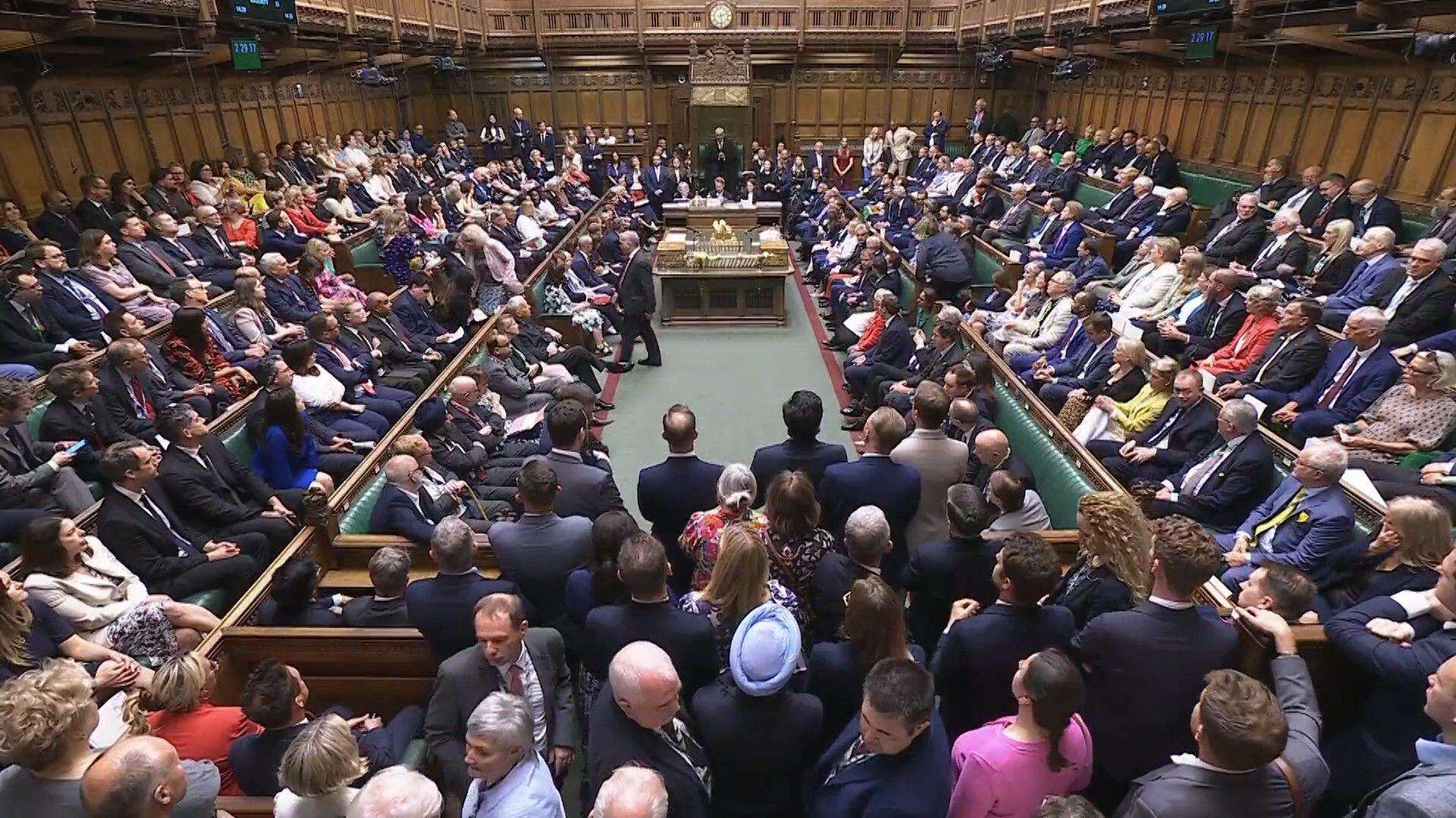
MPs in the House of Commons, London, following the announcement of the result of the vote on the Terminally Ill Adults (End of Life) Bill on 20 June.
Alamy
Is dialogue still possible across the widening abyss between those demanding untrammelled individual rights and freedoms and those whose bedrock values are defence of the sanctity of life and the protection of the most vulnerable?
Last week’s parliamentary votes to decriminalise abortion and to legislate for assisted dying opened up a fault line in British society so wide and deep it is difficult to know how to bridge it.
As a convert, I value the Catholic tradition’s respect for the mutually enhancing relationship between faith and reason, grace and nature. On matters relating to social justice, our capacity for reasoned reflection, guided by conscience, leads us toward principles that are intrinsic to our nature and capable of mediating between different worldviews in our quest to discern how best to serve the common good. Our natural capacity for choosing good over evil, right over wrong, is weakened but not destroyed by distorted desire (what Catholics call “original sin”). The disciplined search for the good life and the just society might entail disagreement and compromise, but without it there is no possibility of building a society capable of accommodating cultural and religious diversity, while ensuring protection for its weakest and most vulnerable members.
Liberal concepts such as autonomy, freedom of choice and individual rights sit uneasily within this framework, especially when social cohesion frays under the pressure of growing economic inequalities and the existential anxieties of modern life. Those who have the will and the means to protect their own interests adopt a ruthless creed of autonomous individualism behind a mask of euphemisms about “compassion” and “rights”. Christian MP Danny Kruger, a campaigner against the assisted suicide bill (to give it its proper name), tweeted, “These are apocalyptic times”. Like many others, he had muted his faith to avoid reinforcing the accusation that only religious bigots oppose such laws. This is not a religious versus secular issue. As with all complex ethical dilemmas, religious believers are divided on assisted dying and abortion, and some atheists are opposed to both. Some of the most eloquent opponents of the assisted dying bill have been secular feminists such as journalist Joan Smith and philosopher Kathleen Stock.
Catholic teaching prohibits all intentional killing of the innocent. The doctrine of double effect can help to navigate the most anguished dilemmas: if a death occurs as an indirect consequence of an action intended to save a life or alleviate the pain of a dying person, that is ethically permissible. For some, this is casuistry, but intentionality is a vital aspect in ethical decision-making. The resort to emotive language can divert scrutiny away from more questionable intentions, such as the need to cut the costs of social welfare and health care for those regarded as a burden on society.
After the assisted dying bill was passed, palliative care doctor and author Rachel Clarke tweeted that money would now be taken from the NHS and palliative care “to fund dying”. She wrote, “This is the care that so often helps patients feel life is still worth living. It’s so deeply worrying, gnawing at my heart.” Health secretary Wes Streeting expressed his fear that Parliament had made the wrong decision, pointing to concerns expressed by “the Royal College of Psychiatrists, the Royal College of Physicians, the Association for Palliative Medicine and a wide range of charities representing underprivileged groups in our society about the risks that come with this Bill”. Meanwhile, its supporters, including former Green Party leader Caroline Lucas and Humanists UK, gleefully celebrated their victory on social media with party popper emojis.
An open letter from women of different faiths pointed out that the proposed legislation could create a new tool to harm vulnerable women, particularly those being subjected to domestic abuse and coercive control. Domestic violence increases when women become pregnant or sick. Coercion takes many forms, and I suspect many dying people – even in loving households, let alone abusive ones – will now wonder at what point they have a moral obligation to stop being a burden to their family.
The proposal to decriminalise abortion, which was endorsed by a large majority, was put forward by Tonia Antoniazzi MP as an amendment to the Crime and Policing Bill. It was passed with no public scrutiny and hardly any parliamentary debate. As things stand, temporary legal approval during lockdown for home abortions at up to 10 weeks’ gestation using abortion pills and after telephone medical consultation has been made permanent, and abortion up to 24 weeks is legal with required medical approval. After that, it is legal until birth when deemed medically or psychologically essential for the mother or the unborn child. Recent disturbing cases of women being arrested for home abortions after 24 weeks led to the proposed decriminalisation of all self-administered abortions up to birth, though anyone assisting the process is liable to prosecution. Like the horror stories told by advocates of assisted suicide, the appeal to these rare and distressing cases has led to another disastrous situation. Hard cases make bad laws.
A late abortion entails giving birth to a baby that could probably have been born alive. A more extreme amendment proposed by Stella Creasy MP, which was not put to a vote, would have ended all legal restrictions on abortion and removed the offence of concealing the birth of a child by hiding its dead body. That is now a grey area, for what is a woman who self-aborts and gives birth to a dead or dying baby to do? She must go through the excruciatingly painful and dangerous ordeal alone and deal with the consequences, to avoid implicating anyone who helps her in what would then be a criminal act. The philosopher Kathleen Stock writes in UnHerd, the news and opinion website, of “this sudden glimpse of the cold libertarian priorities lurking behind a fluffy feminist curtain”. She continues: “For a few plain-speaking and unabashed freedom-lovers, backing decriminalisation means admitting that the painful deaths of other human beings will be a regrettable but necessary cost. But for abortion absolutists within mainstream feminism, intent on continuing to see themselves as caring people, an elaborate rhetorical game of hide-the-dead-baby has now begun.”
Like assisted suicide, the rhetoric of abortion is euphemistically veiled in the altruistic language of “compassion” or subsumed under the logic of “bodily autonomy” and the “right to choose”. The champions of these changes in legislation on abortion and assisted suicide are not themselves among the poorest or the most vulnerable. They are apologists for the new absolutist creed of autonomy and rights, which treats the body as private property and brooks no interference or legal constraint regarding the right to do as one chooses with that body.
Both these bills must go before the House of Lords. This institution – regarded by many as an anachronism – will now have to decide whether to protect the bedrock values which Western society has adapted but never abandoned over two millennia, or yield to a brave new world of rampant individual rights and diminishing responsibilities. As the Catholic Church increasingly finds its voice as the defender of the sanctity of every human life, across the killing fields of war, poverty, disease, the death penalty, euthanasia and abortion, Britain is accelerating in the opposite direction. Catholics must still seek reasoned dialogue across the widening abyss, but the challenges are becoming immense.
Tina Beattie is Professor Emerita of Catholic Studies, University of Roehampton, London.
Login
Please login to comment
0 Comments
Oldest

Help us keep The Tablet’s voice independent, clear and far-reaching.
Founded in 1840, The Tablet is the leading independent English-language Catholic weekly, celebrated for great writing, astute analysis, brilliant arts and books reviews and trustworthy reporting from correspondents in Britain, Ireland, Rome and across the world.
Independent, high-quality journalism is at the heart of what we do. The Tablet does not have deep pockets and we are not funded by rich donors. If you appreciate our work please consider supporting The Tablet’s Development Fund. It only takes a moment and you can cancel at any time.
- Support with £5 per month
- Support with £10 per month
- Support with other amount.

MOST READ ARTICLES
-
1
Would the Church miss us?
-
2
Nicaraguan bishops visit Rome as Ortega regime tightens grip
-
3
Church from the 1950s receives £1 million government grant for new roof
-
4
Pope Leo thanks staff at Mass in Gemelli Hospital
-
5
Henri Nouwen: Christ’s acrobat
-
6
Under endless skies
FROM THE EDITOR'S DESK


