News Briefing: Church in the World


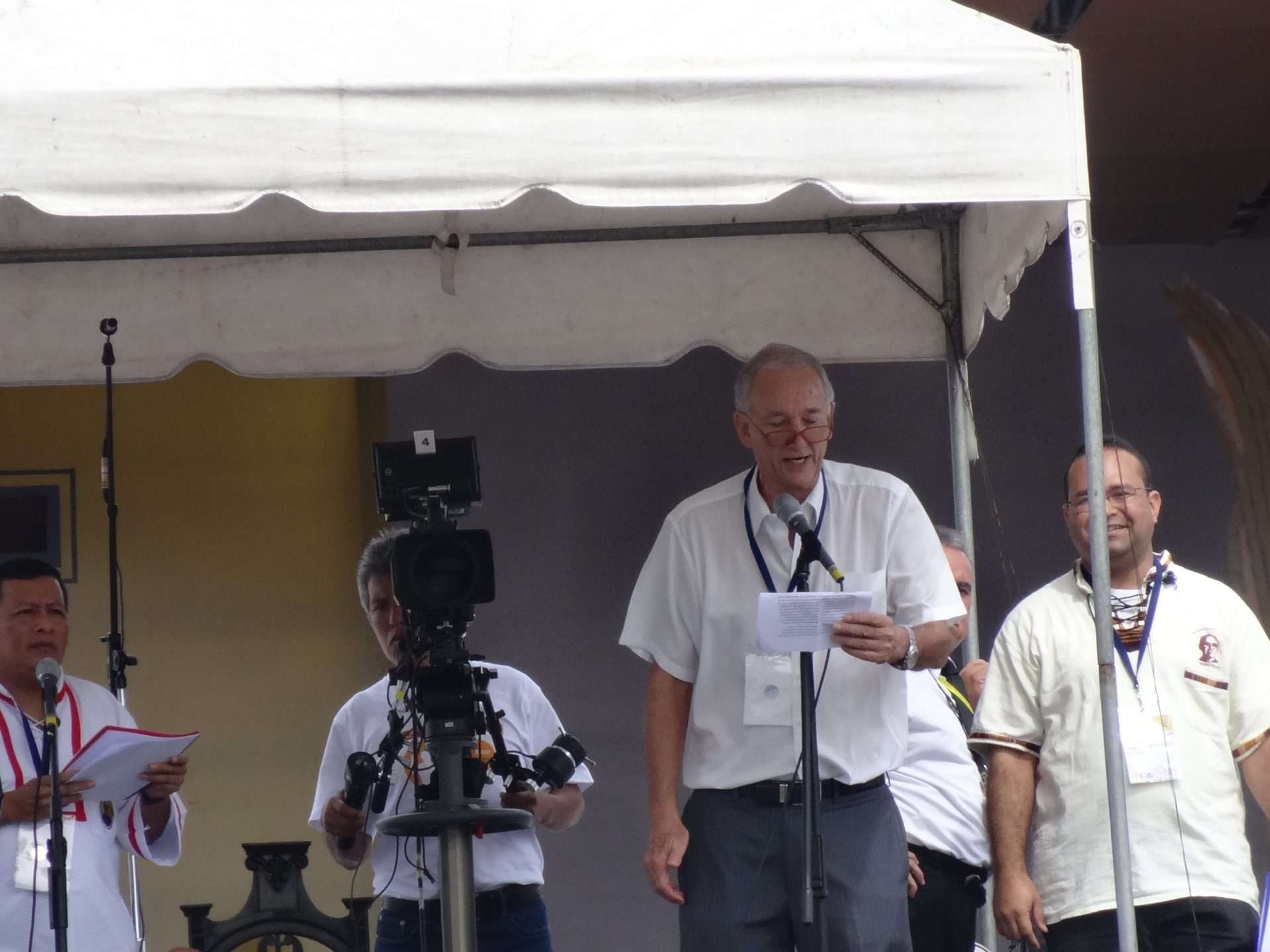
José María Tojeira SJ, who has died aged 78, speaking at the beatification of Oscar Romero in 2015.
John Donaghy / flickr | Creative Commons
The vice-president of the Italian bishops’ conference celebrated Mass for LGBT pilgrims in Rome for the Jubilee.
Bishop Francesco Savino of Cassano all’Jonio was the chief celebrant at a Mass in the Church of the Gesù on 6 September with more than 1,000 participants in the pilgrimage for LGBT Catholics and their family and friends. He prayed for deliverance “from any polemical or ideological temptation” and that Church leaders would “put living truth before dead truth”.
The pilgrimage, the first of its kind, also featured a prayers service at the church the previous evening and a procession to the Holy Door in St Peter’s.
The Jesus Bikers, a group of German motorcycle enthusiasts, presented Pope Leo with a custom-built papal bike. A group of 30 Jesus Bikers arrived in Rome on a Jubilee pilgrimage after a three-day day ride from Schaafheim in Hesse. Pope Leo met them at the end of his audience and blessed and signed the white BMW R 18 motorcycle before briefly climbing onto the seat to the bikers’ applause.
The bike will be taken back to Germany where it will be auctioned to benefit a charity supporting children working in mica mines in Madagascar through Missio Austria. Karl Wallner, the director of Missio Austria, said Pope Leo seemed to like the bike a lot and said he would like to ride it. “I think we might have the first motorcycling pope,” said Wallner. Pope Francis was an honorary member of the Jesus Bikers, which has over 100 members worldwide.
The Belgian bishops’ conference launched a special collection to clear the €800,000 debt outstanding after Pope Francis’s visit in September 2024. The two-and-a-half day visit to mark the six-hundredth anniversary of the founding of the university in Leuven cost more than €3 million.
Patrick du Bois, who was in charge of the logistics for the visit, said that the state paid for security on public roads, but “everything that happens inside a venue – stadium or basilica – is the responsibility of the local Church”.
He added: “The Vatican requires that all public acts of the Holy Father be filmed and that the images be made available at no charge to all media outlets worldwide. If local television refuses to produce these images, the bishops’ conference must hire private companies and assume the cost.”
Belgium’s bishops also paid the expenses of 65 Vatican personnel who visited the country.
France’s auditor general’s office found operating expenses for Notre-Dame de Paris are twice as high as before its 2019 fire and said funds must be found to pay them. The new expenses are estimated at €3.2 million from the Church and €2 million from public funds annually, it said.
Under the French system of legal laïcité, cathedrals belong to the state, which pays their upkeep as cultural monuments. The added expenses are due to the strengthening of security and public reception measures and increased visitor numbers, with the cathedral set for a record 12 million visitors this year.
The Church has refused a culture ministry proposal to charge tourists admission, saying vaguely that the expenses could be covered by donations. The report, which offered no solution but mentioned admission fees, came as France faces urgent budget problems.
Police in southwest France arrested three individuals suspected of stealing chalices, ciboria and patens in the region during a wave of worrying church break-ins that began in spring.
The three, arrested on 1 September with 34 sacred vessels they had taken that day, will be tried in late October for “28 acts [of] theft of property … accompanied by acts of damage”, said the prosecutor’s office in Dax, about 60km northeast of Biarritz.
The bishops of two local dioceses had voiced fears that tabernacles were forced open and vessels robbed to use the hosts in satanic rites. One even asked all churches to leave tabernacles open and remove consecrated hosts. But the three told police they had dumped the hosts, meaning they were mainly after the valuable gold in the vessels.
Rural French churches are easy prey for vandals stealing sacred art, statues or gold vessels because they are often empty and cannot afford surveillance systems.
Pope Leo sent a telegram to the Patriarch of Lisbon Cardinal Rui Manuel Sousa Valério to offer his “heartfelt condolences” to the families of 17 people who died in a tram crash in the Portuguese capital on 2 September.
A further 21 people were injured when the yellow-and-white funicular tram known as the Elevador da Gloria careened round the bend of a cobbled street, crashing into a building.
In a message signed on his behalf by the Secretary of State Cardinal Pietro Parolin, Pope Leo prayed for the complete recovery of the injured” and invoked “the strength of Christian hope for all those affected by this disaster”. He expressed gratitude to all involved in the rescue operations and gave his apostolic blessing, especially to the families of the deceased.
Belarusian authorities arrested a Polish Carmelite monk on suspicion of espionage. The Carmelites’ Polish province reported the arrest of Br Grzegorz Gaweł on 6 September, requesting prayers and “entrusting him to the intercession of Our Mother Mary, Advocate of the Holy Scapular”.
State outlets in Belarus said the 27-year-old had obtained secret documents relating to military exercises with Russia, and broadcast images of his arrest. A spokesperson for Poland’s intelligence services said they “do not use monks to gather information on military manoeuvres”.
Catholic school administrators across the United States announced changes to safety training and protocols for pupils and staff to react to a shooting in a church environment.
This came in the wake of the shooting at a school Mass in Minneapolis on 27 August in which two children died. Previous training taught pupils and staff what to do if a gunman entered their school building, through active shooter drills.
“We’ve been very explicit with our schools and our churches that they need to now consider, if they hadn’t before, the sanctuary as an area that could also be at risk,” said Paul Escala, schools superintendent for the Archdiocese of Los Angeles.
The Central American Jesuits announced the death at the age of 78 of Fr José María Tojeira on 5 September. He was the provincial in 1989 when members of the Salvadoran military murdered six Jesuit staff members of the José Simeón Cañas Central American University, alongside their housekeeper and her daughter in San Salvador.
He famously declared at the funeral: “They have not killed the Society of Jesus, they have not killed the José Simeón Cañas university.” As provincial, he initiated the legal process against the members of the armed forces responsible.
Fr Tojeira was born in Galicia in north-western Spain and arrived in Central America in 1969 as a Jesuit novice. He spent 16 years in Honduras before being transferred to El Salvador in 1985.
A Bolivian court sentenced two elderly Spanish Jesuits to a year in prison for concealing decades of abuse committed by their fellow priest Alfonso Pedrajas, who died in 2009.
The convictions of Marcos Recolons, 81, and Ramon Alaix, 83, on 2 September were Bolivia’s first successful criminal prosecution against high-ranking Jesuits implicated in hiding abuse cases. They were provincials of the Society of Jesus in Bolivia when the abuse occurred.
According to the court ruling, both Recolons and Alaix knew of Pedrajas’ behaviour, both from Pedrajas himself and from a number of his victims, but did not notify the authorities or file criminal complaints and, in some instances, pressured alleged victims not to make complaints.
The case came to light in 2023 with the publication of a diary belonging to Pedrajas, where he documented abusing at least 85 minors between 1972 and 2000. The diary was discovered by one of Pedrajas’ nephews in an attic in Madrid and he contacted the Bolivian schools where Pedrajas committed his crimes, the superiors of the Society of Jesus and then the media.
The Catholic Bishops’ Conference of the Philippines (CBCP) denounced the corruption of flood control projects worth billions of pesos, now the subject of a congressional probe after being exposed by President Ferdinand Marcos Jr.
The Bishop of Kalookan Cardinal Pablo Virgilio David, outgoing president of the CBCP, said government officials should be held accountable alongside private contractors in the flood control mess.
“True justice, however, demands more than punishment. It also calls for restitution: that stolen wealth be returned to the public coffers from which it was taken,” Cardinal David said in a statement.
The 66-year-old cardinal appealed to young people: “You hold the keys to a new culture. You live in the digital space where truth and lies battle daily. Use your platforms not only for outrage, but for vigilance. Expose injustice, share facts, demand reforms. Make corruption shameful again.”
The Philippines’ finance department said the national economy loses around £1.5 billion because of the corruption of flood control projects.
A Filipino priest who criticised former president Rodrigo Duterte is set to receive the Ramon Magsaysay Award, often called the Nobel Prize of Asia, in a ceremony on 7 November.
Fr Flavie Villanueva, a 54-year-old priest of the Society of the Divine Word, is known for sheltering the homeless and defending families of Duterte drug war victims. He said he would accept the award “on behalf of the thousands of homeless and those victims of social injustice” and hopes to fight the “pandemic of apathy” plaguing the world.
“I would point to the apathy, to the indifference, to the lack of basic care of people for their neighbour, especially the poor, as a serious problem,” Villanueva said, emphasising this as a reason why the Philippines remains “in a cycle of poverty”.
The Catholic Bishops’ Conference of the Philippines (CBCP) congratulated Villanueva on the award, named after the Philippines’ former president Ramon Magsaysay, who died in a plane crash in 1957 aged 49.
“In honouring Fr Flavie, the Ramon Magsaysay Award Foundation affirms what we in the Church have long recognised – that he is a prophet of our time, courageously standing with the poor, the oppressed, and the marginalised in the peripheries, and reminding us all of the Gospel’s unwavering call to defend human life and dignity,” said Cardinal Pablo Virgilio David.
The rectors and presidents of 28 Indonesian Catholic academic institutions warned of the danger of a split between politics and civil society as students led mass demonstrations outside parliament.
An open letter from the Association of Catholic Universities called for the right to protest, saying “any attempt to silence critical voices through authoritarian measures, media censorship, intimidation, or other forms of violence is an affront and a betrayal of democracy”. The police and armed forces “must end the repression and prioritise a more humane approach”, the letter’s signatories demanded.
Many of their students were involved in the protests outside the parliament building in Jakarta which began in August over a series of issues, including economic hardship, state-funded perks to parliamentarians and police violence. Amid rising food prices and unemployment, “instead of showing empathy and visionary leadership alongside the people, the political elites of the executive and legislative branches have displayed arrogance and indifference,” the letter said.
It warned that many policies harm the population, “such as the increase in property and building taxes in various regions, the extremely high remuneration of members of the House of Representatives, the persistent difficulties in accessing health care, and the use of law enforcement agencies for political purposes”.
Pope Leo received the Bishop of Hong Kong Cardinal Stephen Chow SJ at the Vatican on 2 September. Cardinal Chow said the Pope was “not entirely unaware of the Church in China” and the meeting “helped him gain a fuller picture and a better understanding of the current state of China-Vatican relations”. He said Pope Leo “recognises the importance of dialogue between the Church and the mainland authorities, and considers respectful communication as the priority in addressing challenges in China-Vatican relations”.
The apostolic nunciature in Astana joined preparations for the Congress of Leaders of World and Traditional Religions on 17-18 September. Kazakhstan’s government will again host the event, now in its eighth year as “a platform where the Church, together with representatives of various religious traditions around the world, testifies to the value of peace, mutual understanding, and harmony” according to the local authorities.
The government expressed gratitude to the Vatican for its participation, particularly through the collaboration of the apostolic nuncio Archbishop George Panamthundil and of institutions affiliated with the Holy See in the fields of education and science, such as the joint projects of Kazakhstan’s R.B. Suleimenov Institute of Oriental Studies with the Vatican Library and Apostolic Archives.
The bishops of the Maronite Church called for the full restoration of Lebanese sovereignty to advance a wider campaign of national reform. In a statement following their monthly meeting on 3 September, the bishops welcomed the United Nations’ decision to extend the mandate of its peacekeeping force in the south of the country for a further year, urging coordinated efforts with the Lebanese Armed Forces to guarantee control of its territory and to disarm groups with illegal weapons.
A diocese bordering Mozambique’s troubled Cabo Delgado province complained of squatters violently seizing Church property. Archbishop Inácio Saúre of Nampula reported on 3 September that intruders have cut down trees, damaged crops and threatened Church staff with machetes and spears.
“They threatened us and told us they were going to demolish the seminary,” he said, “and they also took away our animals that were raised by the seminarians.”
The appropriated land includes plots on which Mater Dei Monastery, two seminaries and St John the Baptist Church are located. The occupiers have built a mosque on land adjacent to one of the seminaries. Court rulings ordering the immediate eviction of the squatters have not been implemented.
Archbishop Saúre said he feared “an invisible hand linked to powerful people who are encouraging the current situation and the crimes being committed by the squatters”.
The Archbishop of Abuja Ignatius Kaigama issued a dress code for priests at formal liturgical ceremonies in his Nigerian diocese.
A pastoral letter signed by the archbishop and the chancellor of the archdiocese Fr Sam Tumba after the sixth General Assembly of the Archdiocese in late August directs priests to wear black shoes and trousers for liturgical functions.
“Priests should dress appropriately for liturgical functions including wearing black shoes and trousers instead of any other coloured footwear (such as sneakers, canvas or palm sandals) or coloured trousers for the celebration of the Mass,” it said.
The Catholic community in Sierra Leone mourned Fr Augustine Amadu, who was stabbed to death by armed assailants before a farewell Mass in his parish.
The attackers broke into his residence at the Immaculate Conception Church in Kenema on 29 August, which Fr Amadu was due to leave after five years to take up new responsibilities at St John’s Parish in Kailahun. Parishioners found his body as they arrived for Mass the next morning.
Church officials described the murder as “a dark and painful moment”. In a statement, the Archdiocese of Freetown said the Christian community was “saddened by the shocking news” of the killing of the priest.
The Interreligious Council of Sierra Leone said Fr Amadu was “a man of peace, compassion, and unwavering commitment to the spiritual and social upliftment of his community”.
It continued: “His untimely death is not only a devastating loss to the Catholic Church but also to the broader religious bodies and social fabric of Sierra Leone. We mourn the passing of a servant of God whose life was dedicated to fostering unity, hope, and moral guidance.”
According to the Diocese of Kenema, it was the first time a Catholic priest has been attacked and killed in such a manner in the country’s history.
The Symposium of Episcopal Conferences of Africa and Madagascar (SECAM) demanded accelerated global efforts to support African work to address the climate crisis. SECAM issued a statement on 7 September to coincide with the conclusion of the Africa Climate Summit in Addis Ababa, where governments and civil society met to determine financial commitments.
“SECAM insists that Africa must not merely be a recipient of external agendas but a full architect of its ecological future,” the bishops said. “Rural communities, rich in indigenous wisdom, are laboratories of integral ecology and must shape pathways to sustainable development.”
Developed countries have routinely failed to honour pledges to finance Africa’s climate response, resulting in missed opportunities to address a cycle of droughts and floods and save millions of lives, according to the bishops.
“The Church supports renewable energy, regenerative agriculture, and appropriate technologies that protect biodiversity and respect cultural heritage,” they said. “True solutions must integrate social equity, human dignity, and creation care, not short-term profit or ‘false solutions’ such as harmful offsets or extractive projects.”
Stay updated — add us as a preferred news source on Google:


Help us keep The Tablet’s voice independent, clear and far-reaching.
Founded in 1840, The Tablet is the leading independent English-language Catholic weekly, celebrated for great writing, astute analysis, brilliant arts and books reviews and trustworthy reporting from correspondents in Britain, Ireland, Rome and across the world.
Independent, high-quality journalism is at the heart of what we do. The Tablet does not have deep pockets and we are not funded by rich donors. If you appreciate our work please consider supporting The Tablet’s Development Fund. It only takes a moment and you can cancel at any time.
- Support with £5 per month
- Support with £10 per month
- Support with other amount.

MOST READ ARTICLES
-
1
Archbishop of Cardiff-Menevia meets with other worldwide Catholic Church leaders to discuss liturgy
-
2
Let there be light
-
3
World Humanitarian Day: aid workers face a ‘crisis of protection’
-
4
Ruling allows French private hospitals limited exemption from assisted suicide
-
5
A tract for our times
-
6
The wisdom of the saints
FROM THE EDITOR'S DESK