Pope appeals for ‘reason’ between Israel and Iran


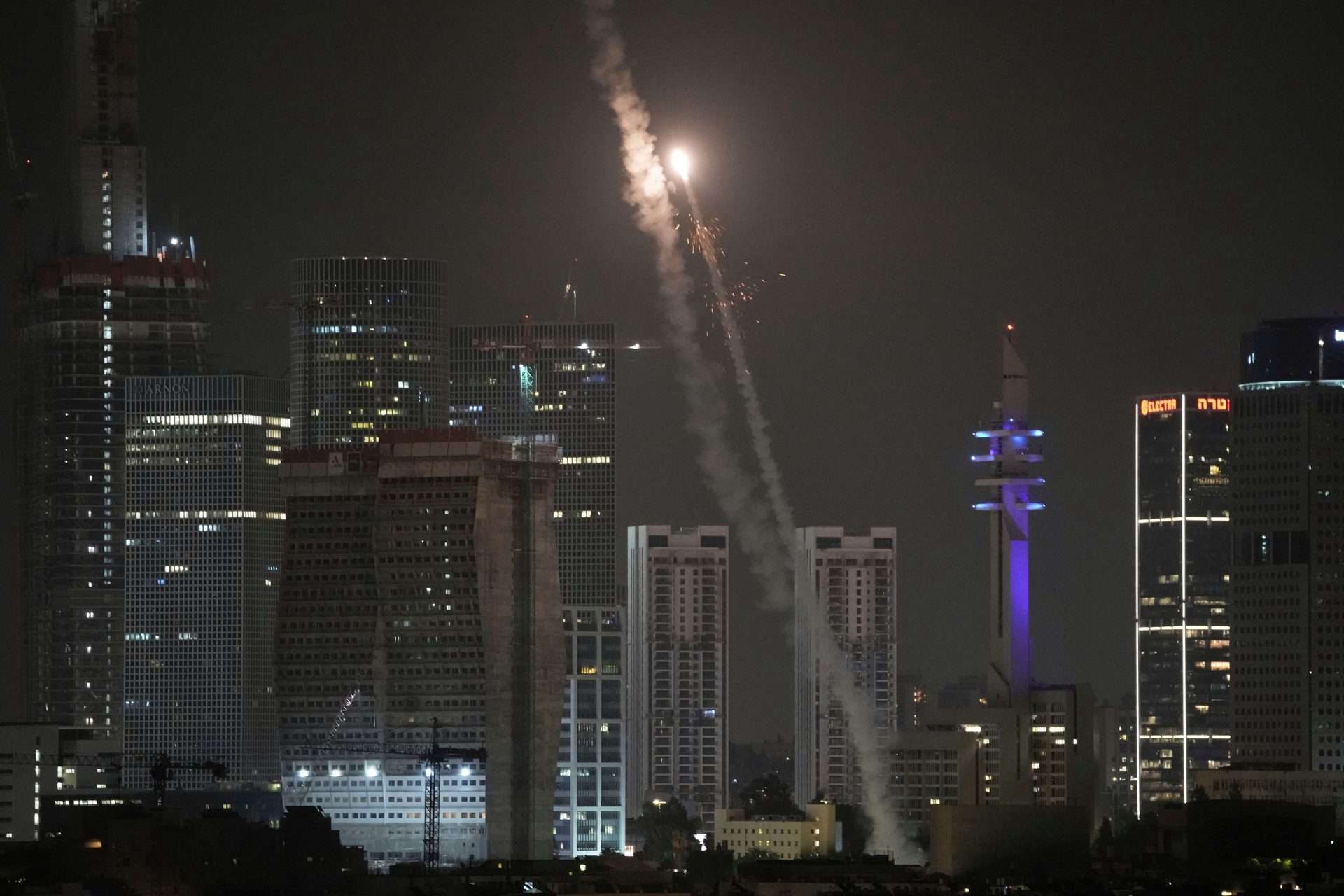
An Israeli air defence missile fired to intercept an Iranian airstrike above Tel Aviv on 15 June.
Leo Correa / Associated Press / Alamy
The Archbishop of Tehran-Ispahan Cardinal Dominique Joseph Mathieu prayed ‘that peace through dialogue based on a consensus will prevail’.
Pope Leo appealed for authorities in Israel and Iran to act with “responsibility and reason” after civilians in both countries were forced to shelter from airstrikes.
He called on the two nations to pursue dialogue and work towards a safer world “free from the nuclear threat”, insisting that “no one should ever threaten another’s existence”.
The Pope’s appeal on Saturday followed Israel’s strikes targeting Iran’s nuclear facilities and military bases the previous day and Iran’s retaliatory missile attacks. Hundreds of people have been killed in both countries.
In Iran, the Archbishop of Tehran-Ispahan Cardinal Dominique Joseph Mathieu expressed his sorrow at the violence. He prayed “that peace through dialogue based on a consensus will prevail”, and warned of the risk of a widespread conflict engulfing the Middle East: “The much-feared escalation seems to be materialising.”
The general secretary of the World Council of Churches (WCC) Dr Jerry Pillay condemned the Israeli attack on Iranian territory on 13 June as “an unlawful act that violates international law and the sovereignty of a nation-state”. He said “it challenges all efforts made through diplomacy and dialogue, and gravely undermines the pursuit of peace, justice, and human dignity”.
Pillay reiterated that the WCC rejects all forms of violence and escalation, “including deliberate attempts to set the region ablaze for political gain”. He suggested that “the only path to real and lasting security lies in the commitment to international law, mutual respect, and negotiated solutions … the peoples of the Middle East have suffered enough.”
He called upon the international community to hold accountable those who threaten peace, and to act urgently to prevent further escalation.
Pax Christi International, Caritas Internationalis and Anglican Pacifist Fellowship were amongst signatories to a Joint Open Letter to a High-Level Conference for the Peaceful Settlement of the Question of Palestine in New York 17-20 June.
The letter said that “a sovereign and unified Palestinian state must be recognised, one that coexists peacefully and securely alongside Israel, enjoying full legal and political parity in line with United Nations resolutions and international law”. This would include “the end of Israeli occupation, alongside the cessation of all settlement activity, as mandated by the Advisory Opinion of the International Court of Justice and relevant UN resolutions”.
It urged respect for international law, emphasising that actions that undermine peace – such as settlement expansion or annexation – “must be clearly and consistently opposed”. Benedictines for Peace, Franciscans International and Jesuit European Social Centre also signed the letter.
In a report from the Holy Land this week, Anglican priest Canon Richard Sewell, dean of St George’s College in Jerusalem, thanked those “who have sent messages of concern for us all here and with assurances of prayer for us and for the Land of the Holy One”. He reported that the “serious turn for the worse, with a full state of war with Iran” had frightened everyone.
He said the college has a bomb shelter in the basement and “we have been down there several times each day and night since last Friday”, though most of the violence was concentrated in coastal areas, around the airport and in the north.
“We pray for an end and a commitment to a negotiated settlement,” he said, adding that “Iran is also part of our Anglican Province and Archbishop Hosam has jurisdiction, so we also feel great concern for civilians in Iran and especially for the vulnerable Christians there.”
Sewell said he remained concerned for the people of Gaza “who are being starved and bombed with no shelters or defence systems”, while the West Bank “is being subjected to an almost total lockdown and suffers painfully in many diverse ways”.
Last week, the parish priest of the only Catholic Church in Gaza said hope was dwindling among the roughly 500 refugees sheltered there, including 50 children.
“While the bombings continue, unfortunately the situation will continue to worsen,” said Fr Gabriel Romanelli, adding that every bomb “means more death, more injuries, more destruction, less hope from a humanitarian point of view”.
Romanelli reported that people in Gaza are in urgent need of food, water, and medicine. He explained that “meat is difficult to find and food prices have grown exponentially, making even vegetables unattainable for most”. The flour they have managed to conserve “is so full of worms it must be sifted two or three times”.
On Monday, the UN human rights chief Volker Türk said Israel’s offensive in Gaza was inflicting “horrifying, unconscionable suffering” on Palestinians and urged government leaders to exert pressure on Israel’s government and the militant group Hamas to end it.
He spoke at the opening of the latest Human Rights Council session in Geneva, where he also raised concerns about escalating conflict between Israel and Iran.
Did fear pull the trigger in Iran?
Jerusalem Christians issue international ‘SOS’ for Gaza
Stay updated — add us as a preferred news source on Google:


Help us keep The Tablet’s voice independent, clear and far-reaching.
Founded in 1840, The Tablet is the leading independent English-language Catholic weekly, celebrated for great writing, astute analysis, brilliant arts and books reviews and trustworthy reporting from correspondents in Britain, Ireland, Rome and across the world.
Independent, high-quality journalism is at the heart of what we do. The Tablet does not have deep pockets and we are not funded by rich donors. If you appreciate our work please consider supporting The Tablet’s Development Fund. It only takes a moment and you can cancel at any time.
- Support with £5 per month
- Support with £10 per month
- Support with other amount.

MOST READ ARTICLES
-
1
Pope returns to Vatican after hospital discharge
-
2
Diverse schools that are 100 per cent Catholic
-
3
Under endless skies
-
4
Battling confession fatigue
-
5
Nigerian bishop scorns suggestion of running in presidential election
-
6
Schismatic Spanish nuns strip contents of convent before eviction
FROM THE EDITOR'S DESK


