‘Serious failures’ in assisted dying legislation


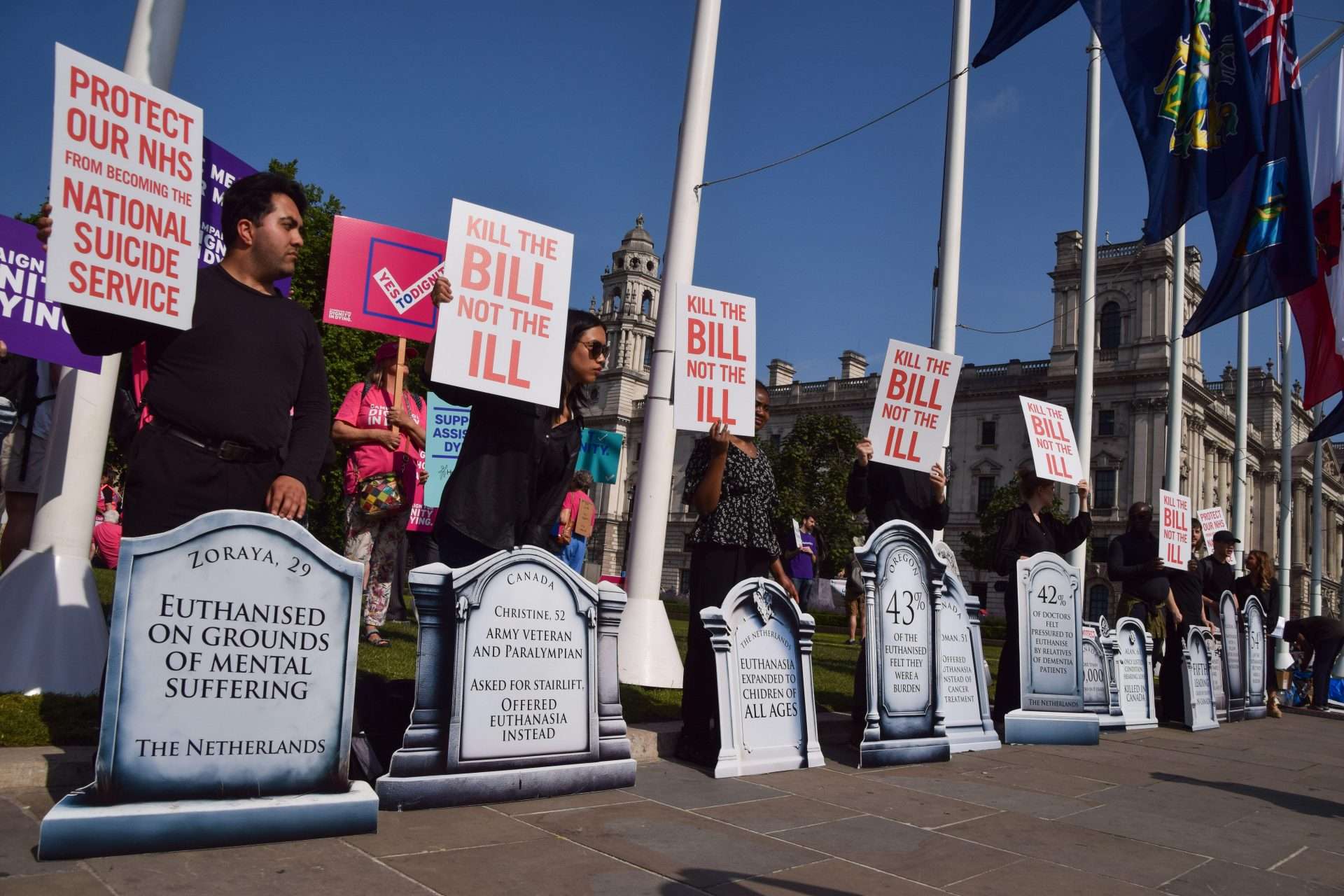
Opponents of the Assisted Dying Bill hold “Kill the bill not the ill” placards and cardboard “gravestones” in Parliament Square last week as MPs continued to debate the bill.
Vuk Valcic/Alamy Live News
The assisted dying Bill that is to receive its Third Reading and crucial final vote in the House of Commons on Friday still has serious safeguarding failures, according to a leading bioethicist
David Jones, Professor of Bioethics at St Mary’s University, Twickenham and Director of the Anscombe Centre, writing in a paper for Politeia, warns that the Terminally Ill Adults (End of Life) Bill falls dangerously short of providing the safeguards needed.
Without these, it is likely that the weak, the old, the disabled and those suffering from depression and mental illness may be induced or encouraged to kill themselves, he says.
Two of the royal colleges, the Royal College of Psychiatrists and the Royal College of Pathologists, and the British Geriatric Society, have stated that the Bill in its current form is not safe. So too has a coalition of eating disorder charities and more than a thousand doctors.
Jones warns that the arrangements for balance in terms of committee membership and witnesses called were not of the standard that accompanies a government bill. “The most prominent change, the dropping of the role of the High Court, represents a significant weakening of the safeguards promised in the Bill as introduced… The High Court has been replaced by a quango,” he writes.
Referring to the recent impact assessments by the Department of Health and Social Care, he also fears that trusts could promote assisted dying as “a potential reduction in spend”.
Speaking earlier to The Tablet, Jones noted that at Report stage, MPs have had less than 10 hours to consider 133 amendments – 64 on 16 May and 69 on 13 June. That is less than an average of five minutes per amendment. For most MPs there has been no opportunity for serious scrutiny of these amendments, he said.
“The first day of debate (16 May) ended with just one amendment being voted on, the amendment of Rebecca Paul which would have given some protection to hospices. Regretfully this was voted down. If the Bill passes hospices will not be able to prevent being turned into suicide clinics.”
He added: “The amendments to the Bill have not addressed the deep concerns that have been raised about the dangers of coercion and the provision of lethal drugs to people who have mental health conditions. The Bill as amended is not stronger but even weaker than when it was introduced. More is being left to the Secretary of State, and the role of the High Court has been replaced by a new quango – the office of the Voluntary Assisted Dying Commissioner. MPs must now ask themselves whether the actual Bill before them is safe to implement. With the Royal College of Psychiatrists, the Royal College of Pathologists and the British Geriatrics Society all coming out against the specifics of the Bill, and a coalition of eating disorder charities urging that it is not safe, MPs must think twice. This Bill is not safe.
Other organisations expressing grave concerns include the Conference of Religious England and Wales, where more than 70 leaders of religious congregations at its recent annual meeting expressed a united stance against Bill. Members met this week again for an online forum to continue the conversation, including lay colleagues in recognition that the Bill, if passed, would have “significant implications” not only for Religious but also for those they work with and care for.
“As the national conversation around assisted dying continues, the voices of religious women and men and their lay partners remain united in affirming life and compassionate care over legislative change,” the conference said.
Many also plan to attend a peaceful protest in London on 20 June, organised by Christian Concern. Further details are available on the CoR website. The regular online Care Forum, being held on 25 June 2025, will offer a follow-up opportunity to consider the outcome of the debate on Friday from where, if it passes, the Bill will progress to the House of Lords.
In addition, today and tomorrow, the House of Commons will consider amendments to the Crime and Policing Bill, two of which would aim to remove criminal penalties for illegal abortions from the law.
Anscombe Bioethics Centre said it opposes these amendments in the “strongest possible terms” as antithetical to the welfare and dignity of women and their unborn children. “By removing the legally mandated oversight of both law and medicine, both amendments increase not only the danger of coercion of women into abortion, as the police will not be able to investigate and detect such abuses, but also the risk of dangerous late-term abortion without medical supervision. At the same time, by mostly or entirely removing legal protections for the unborn, these amendments deny the basic humanity and dignity of some of the most vulnerable members of the human family,” Jones said.
Stay updated — add us as a preferred news source on Google:


Help us keep The Tablet’s voice independent, clear and far-reaching.
Founded in 1840, The Tablet is the leading independent English-language Catholic weekly, celebrated for great writing, astute analysis, brilliant arts and books reviews and trustworthy reporting from correspondents in Britain, Ireland, Rome and across the world.
Independent, high-quality journalism is at the heart of what we do. The Tablet does not have deep pockets and we are not funded by rich donors. If you appreciate our work please consider supporting The Tablet’s Development Fund. It only takes a moment and you can cancel at any time.
- Support with £5 per month
- Support with £10 per month
- Support with other amount.

MOST READ ARTICLES
-
1
Church warns Zambian government against division after archbishop’s arrest
-
2
Breaking up … for now
-
3
A craving for beauty
-
4
The technological paradigm, AI and the human person
-
5
Bishops demand security investment to promote ‘common good’ in Nigeria
-
6
Rival church occupies Kyiv monastery in latest blow to Moscow-linked Orthodox
FROM THE EDITOR'S DESK