Pope Francis brings ‘message of peace’ to Asia on longest journey


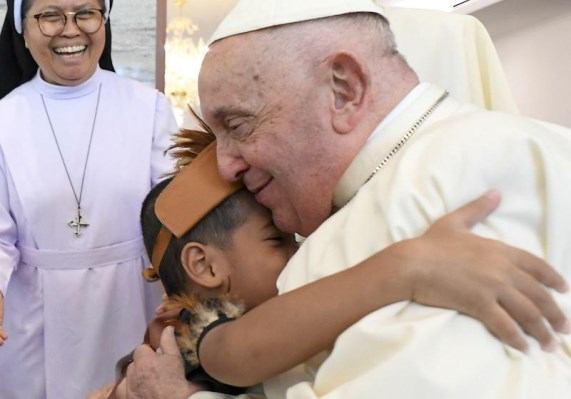
Pope Francis met orphans, homeless and migrant children at the apostolic nunciature on his arrival in Jakarta.
Abaca Press / Alamy
Pope Francis departed on the longest journey of his pontificate on Monday, to visit Indonesia, Papua New Guinea, Timor-Leste and Singapore.
On Sunday he entrusted his journey to Our Lady before the icon Salus Populi Romani in the Basilica of St Mary Major in Rome, as is his custom on all visits.
The Holy See’s secretary of state Cardinal Pietro Parolin said the Pope would aim to bring “closeness” and a “message of peace” over the 12-day trip, addressing themes including inter-religious dialogue and care for the environment.
The Archbishop of Jakarta Cardinal Ignatius Suharyo Hardjoatmodjo said the Pope’s visit to the Indonesian on 3-6 would be “a blessing for the Indonesian nation in general and Catholics in Indonesia in particular”, welcoming the translations of Pope Francis’ teaching and studies of his life and pontificate published ahead of his arrival.
Cardinal Suharyo noted the importance of the Pope’s visit to the Istiqlal Mosque and the nearby Cathedral of Our Lady of the Assumption, linked by an underpass known as the “Tunnel of Friendship”, symbolic of the harmony between Indonesia’s Muslim majority and Catholics who make up three per cent of the population.
The cardinal announced the visit would feature a declaration by the Pope and the Grand Imam of the Istiqlal Mosque, Nasaruddin Umar, in the spirit of the 2019 Abu Dhabi document. Around 80,000 people were expected to attend a Mass at the Bung Karno stadium on 5 September, with many more invited to view the liturgy and receive communion at their parish churches.
“Catholics are believers – they do not just belong to a religion,” said Cardinal Suharyo. “Religion can easily be used for political, economic, and other interests.” He said it should instead foster fraternity and compassion.
“Compassion will encourage believers to act on the question: what should we do to make our environment more humane – one of the signs of the presence of the Kingdom of God?”
In an interview ahead of the visit, Cardinal Suharyo said that widespread corruption belied Indonesians’ claim to be religiously observant, and obstructed economic growth. “If there is no corruption, Indonesia would have become a prosperous country,” he said.
Fr Antonio Spadaro SJ, an adviser to the Pope, said the Indonesian Church sought to act as a “leaven” in trying to serve the “common good”.
In Papua New Guinea, where Pope Francis was due to arrive on 6 September, the Archbishop of Port Moresby Cardinal John Ribat described the papal visit as “a light of hope that brings peace”. Huge numbers planned to come to Port Moresby from across the region, he said, and the diocese was organising accommodation for them in schools and parishes.
Pope Francis was to meet the bishops of Papua New Guinea and the Solomon Islands on 7 September, together with priests, deacons, consecrated men and women, seminarians and catechists. Later that day, the Pope was to hold an audience marginalised and disabled children.
“We are hoping that the presence of the Holy Father will bring something that is good, something that is positive, something that is peaceful, something that unites all of us, and also that renews us to start working together again, building Papua New Guinea in a new spirit: a spirit of peace, a spirit of forgiveness and a spirit of love,” said Cardinal Ribat.
The Pope was due to meet Timor-Leste’s Prime Minister Xanana Gusmao and President Jose Ramos-Horta during his visit on 9-11 September, coinciding with the twenty-fifth anniversary of the country’s vote for separation from Indonesia. Both Gusmao and Ramos-Horta were leading figures in the independence movement.
The Archbishop of Dili Cardinal Virgilio do Carma da Silva said the visit “will bring hope to the Christian faithful and set them on the path to inculturate the Gospel in their society”, with pilgrims from across the region expected to attend an outdoor Mass on 10 September.
“The Pope’s visit to Timor-Leste will be an important event for building the faith and affirming the cultural and religious identity of the Timorese people,” said Cardinal da Silva.
Observers said the final stage of the Pope’s journey in Singapore – where three-quarters of the population is ethnically Chinese – would serve as a signal to Beijing as the Vatican continues to work on its 2018 agreement with the Chinese government on the appointment of bishops, due for renewal next month.
Last week the Vatican announced that the Chinese government had recognised Bishop Melchior Shi Hongzhen of Tianjin, who has not joined the state-sponsored Chinese Catholic Patriotic Association (CCPA). It described this as “a positive fruit of the dialogue established over the years between the Holy See and the Chinese government”.
The 95-year-old as Bishop Shi, appointed to the Diocese of Tianjin in 2019, had been considered a priest by the Chinese authorities, which until now were not believed to have acknowledged any bishop outside the CCPA. A Vatican delegation met him in 2022 during a visit to China to negotiate the biennial renewal of the provisional agreement.
Stay updated — add us as a preferred news source on Google:


Help us keep The Tablet’s voice independent, clear and far-reaching.
Founded in 1840, The Tablet is the leading independent English-language Catholic weekly, celebrated for great writing, astute analysis, brilliant arts and books reviews and trustworthy reporting from correspondents in Britain, Ireland, Rome and across the world.
Independent, high-quality journalism is at the heart of what we do. The Tablet does not have deep pockets and we are not funded by rich donors. If you appreciate our work please consider supporting The Tablet’s Development Fund. It only takes a moment and you can cancel at any time.
- Support with £5 per month
- Support with £10 per month
- Support with other amount.

MOST READ ARTICLES
-
1
Nun girl summer: ‘You are so good at that’
-
2
Cinema: The nuns’ story
-
3
Whisper it loud – the ‘still small voice’ of God is what we really want to hear
-
4
Pope Leo XIV: A good family is the best way to prevent drug addiction
-
5
Bishops offer ‘message of hope’ to Venezuela with prayers for prisoners
-
6
New bid for Orthodox reconciliation in Ukraine as winter strikes continue
FROM THE EDITOR'S DESK