News Briefing: Church in the World


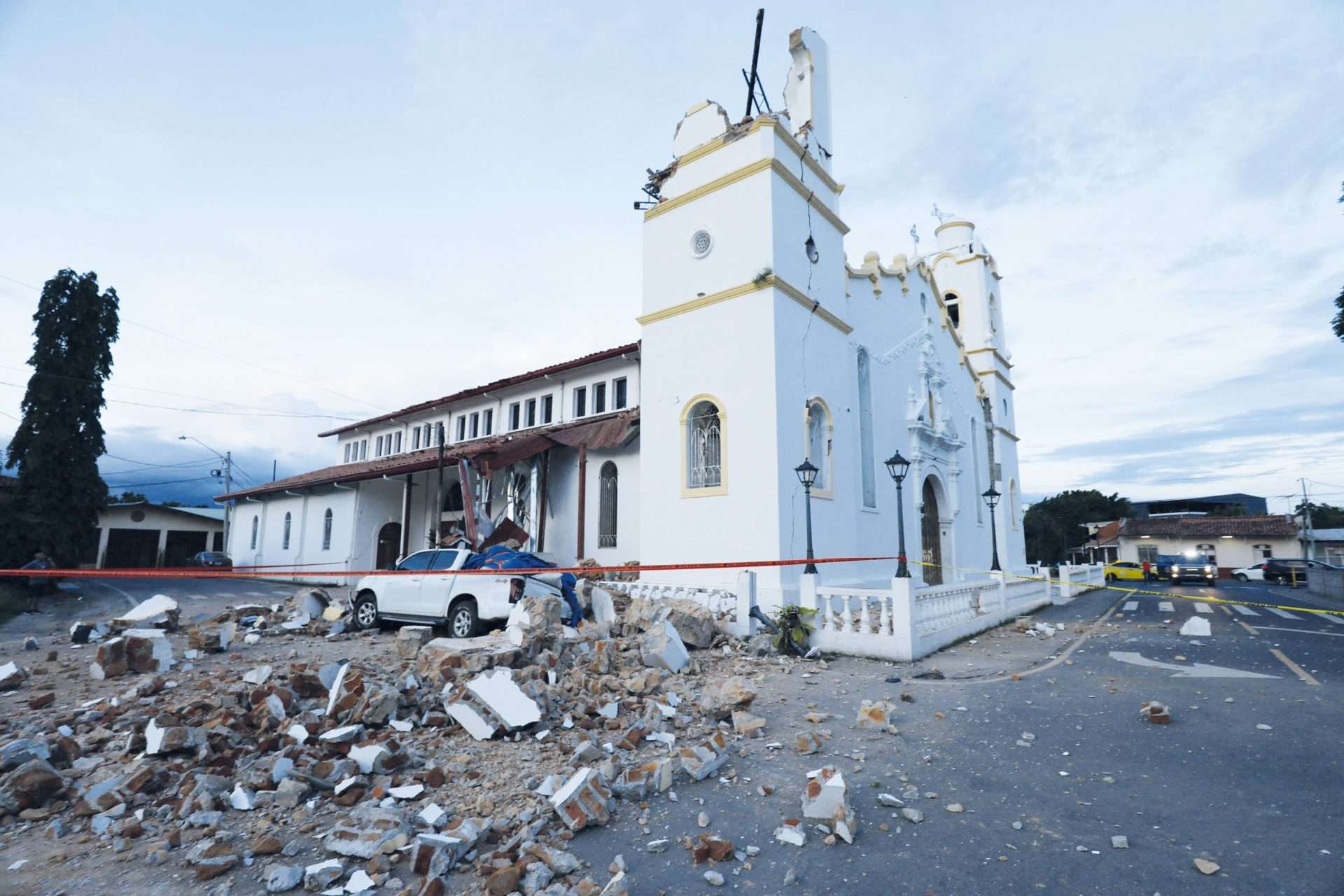
One of the 13 churches in southern Panama damaged by the earthquake last week
Daniel Gonzalez / Xinhua / Alamy
Pope Leo affirmed that the death penalty is “inadmissible” in Catholic teaching “because it is an attack on the inviolability and dignity of the human person”.
In a social media post on 10 October, the World Day Against the Death Penalty, the Pope said: “The common good can be safeguarded and the requirements of justice can be met without recourse to capital punishment: effective systems of detention have been developed that protect citizens while at the same time do not completely deprive those who are guilty of the possibility of redemption.”
The previous day, Church leaders had condemned the United States government’s plans to broadcast the military execution of a convicted terrorist on 3 December.
After the US Department of Defence confirmed that it would livestream the execution of Nidal Hasan at Fort Hood – the army post in Texas where the military psychiatrist killed 13 people in a jihadist attack in 2009 – the president of the US bishops’ conference Archbishop Paul Coakley of Oklahoma City expressed “shock and great sorrow”, calling the decision “a barbaric promotion of a culture of death”.
He said public execution “will only further undermine the moral fabric of our nation and be a blight on the conscience of its people”. The Holy See’s Secretary of State Cardinal Pietro Parolin said the decision was “truly incomprehensible”, adding that it was “certainly unacceptable to turn death into a spectacle”.
The Diocese of Phoenix, Arizona joined 18 other dioceses taking part in the US Conference of Catholic Bishops’ inaugural Laudato Si’ Leadership Cohort. Inspired by Pope Francis’ 2015 encyclical, the cohort provides tools, expertise and accompaniment for diocesan leaders to create achievable plans to implement the teachings of Laudato si’ with the hope of transforming communities.
The Diocese of Phoenix’s action plan, which is set to be implemented in 2027, was released on 4 October, the feast of St Francis of Assisi. The plan focuses on seven goals: response to the cry of the earth, ecological economics, adoption of sustainable lifestyles, ecological education, ecological spirituality, community resilience and empowerment and response to the cry of the poor.
In the document’s opening “Statement on Care for Creation”, Bishop John Dolan encourages, “every parish, school, ministry, family and individual through the Diocese of Phoenix to embrace this Laudato si’ action plan with generosity and confidence.”
The Archdiocese of St Louis filed a lawsuit against the Trump administration on 5 October, alleging that detainees at an immigration detention facility in Missouri are being deprived of their right to speak privately to priests or receive the sacraments.
In a statement announcing the suit, which named both local and federal officials including Homeland Security Secretary Markwayne Mullin, archdiocesan officials challenged the detention site’s “no contact” policies.
“The Saint Genevieve Detention Centre currently prohibits Catholic priests from offering, and Catholic detainees from receiving, the sacraments of confession and communion. Priests are also not permitted to say Mass,” the archdiocese said.
“Offering and receiving these sacraments is a central tenet of our faith. Catholics receive the real presence of Christ in the Eucharist, and the deprivation of these sacraments imposes real and immediate harm on Catholic detainees and priests.”
On its website, Immigration and Customs Enforcement (ICE) says clergy may visit detainees at any time provided they notify the sheriff’s office. The suit alleges ICE is not enforcing its own policy. The majority of the roughly 150 detainees held at the facility are Hispanic Catholics, the diocese said.
The bishops of El Salvador asked Pope Leo to declare St Óscar Romero a Doctor of the Church. In a statement on 4 October, the Salvadoran bishops’ conference said they had made the request at an audience with Pope Leo on 11 September during their ad limina visit to Rome. They also asked the Pope to visit their country.
The conference president Archbishop José Luis Escobar Alas of San Salvador reported that Pope Leo received their request with “a very positive and welcoming attitude”, and discussed his personal devotion to Romero – the Archbishop of San Salvador martyred in 1980 and canonised by Pope Francis in 2018. However, Archbishop Escobar noted that “both decisions require a process of consultation and discernment before a definitive response can be given”.
The Bishops’ Conference of Panama sent a message to the nation saying “you are not alone” after an earthquake measuring 7.7 in magnitude injured around 30 people and damaged at least 13 churches and 900 homes in southern Panama.
They emphasised the faith and generosity of the Panamanian people, noting that the country has always been able to rise again after difficult times “because, whenever a brother or sisters suffers, there are always hands ready to help”. The bishops urged everyone to show this solidarity “that defines our people, ensuring that no one remains indifferent to the suffering of others”.
In their statement, the bishops also urged the Panamanian people to “keep calm, take care of each other and follow the guidance of the relevant authorities, shunning information that has not been verified and which can increase anxiety”.
They asked that they take particular care of children, the elderly, the sick, the disabled and vulnerable families, urging parishes to become wherever possible “true homes with open doors”.
An Australian court sentenced the former Bishop of Broome Christopher Saunders to six-and-a-half years in prison for the sexual abuse of two young men. The Western Australia district court sentenced Saunders on 7 October following his conviction on 13 August on 13 charges of sexual assault against the two Aboriginal men.
In a statement, the current Bishop of Broome Tim Norton SVD acknowledged “the courage and integrity of victims, survivors and other witnesses who came forward to express their truth”. He said the diocese had “a responsibility to consult with local people about rituals and processes that may begin to address in contextual ways” the anger and grief caused by the crime.
The Archbishop of Perth Timothy Costelloe SDB, president of the Australian bishops’ conference, said its members “reaffirm and renew our commitment to the work of healing, reconciliation and renewal” for the effects of abuse.
A militia aligned with the military junta in Myanmar occupied two churches for a ceremony involving alcohol and dancing in a sanctuary, drawing condemnation from religious freedom advocates.
Members of the Shanni Nationalities Army (SNA), a proxy force aligned to the ruling junta’s Northern Regional Command, are accused of occupying Nant Mun Baptist Church and the St Joseph’s Catholic Church in Nantmun town in Kachin State. Christian Solidarity Worldwide (CSW) said the SNA militia picked the churches deliberately.
Troops reportedly looted St Joseph’s and a local commander continues to use one of its buildings as a military headquarters. The Revd Lakang Dau Qae, general secretary of Kachin Baptist Churches USA, told CSW that the ceremony was “an insult to Kachin Christians and to the Kachin people”.
CSW President Mervyn Thomas said converting a house of worship into a military venue and allowing deliberate acts of disrespect inside the sanctuary was “a grave violation of freedom of religion or belief”. He accused the junta of attacking religious spaces to intimidate ethnic and religious minority communities, and called for financial sanctions against those orchestrating the abuses.
Pope Leo expressed his solidarity with Christians in the Middle East suffering “war, unrest, religious extremism and economic distress”.
In an address on 10 October to the Synod of Bishops of the Greek Melkite Church of Antioch which was meeting Rome, the Pope said: “Through you, I would like to say to your beloved Church: I am with you. The entire Catholic Church is with you.”
The same day, the Dicastery for Eastern Churches announced that the Pope had approved funding for scholarships for “particularly needy Christian families in Lebanon, Syria and Iraq” to pay school and university fees.
The dicastery said Pope Leo wished “to show his closeness and that of the whole Catholic Church to the faithful sorely tested by the conflicts and instability those countries suffer”. Pope Leo said the purpose of the scholarships was “that Christian families will have the assistance required to remain in the Middle East and maintain a Christian presence”.
The Latin Patriarch of Jerusalem warned that “nobody is talking about peace anymore” in Israel. Cardinal Pierbattista Pizzaballa told Vatican News that there had been “considerable fragmentation within Israeli society” since the Hamas attack on 7 October 2023 and the start of the war in Gaza, driving “a general sense of disorientation and perhaps also some anger towards the world”.
The patriarch continued: “In Israel, people no longer talk about peace processes, nor do they believe that a two-peoples, two-state solution is possible.” He said that the humanitarian situation in Gaza has not improved since the October 2025 ceasefire, while the West Bank the Christian community is threatened by “this total absence of law and respect for the law”.
The Ghana Catholic Bishops’ Conference issued a new appeal to the government for “decisive and transparent action” against illegal mining, locally known as “Galamsey”. In a statement after a meeting with President John Dramani Mahama and civil society organisations last week, the bishops described the situation as nothing less than “a public health and human rights emergency”.
They cited findings from the recent Mercury and Heavy Metals Impact Assessment conducted by Pure Earth and the Environmental Protection Agency, together with the testimony of the UN Special Rapporteur on Toxic Substances, which presented “an alarming and irrefutable picture: Ghana is poisoning its own life-support system”, they said.
“The evidence is stark: mercury and arsenic levels in some communities exceed safe limits by hundreds of times. Rivers, soils, and crops are contaminated; over half a million farmers have been displaced; and children are already bearing the scars of toxic exposure. Our water, our food security, and the very future of our nation are at stake.”
The bishops urged the president to ensure “clear benchmarks that will trigger a state of emergency; visible prosecution of kingpins, including those named in official reports; the establishment of promised fast-track courts; measurable performance indicators for local authorities and security services; and protection for communities and traditional leaders who resist galamsey, alongside accountability for those complicit”.
They continued: “Your Excellency, credibility is now as important as policy. Our people must see that no one is above the law, and that economic expediency cannot outweigh the sacred right to clean water, safe food, and a healthy environment. To delay is to risk complicity in what is fast becoming an ecocidal tragedy of monumental proportions.”
The Archbishop of Pamplona and Bishop of Tudela Florencio Roselló offered to act as a “channel for complaints” for survivors of abuse outside church settings in the northern Spanish region of Navarre.
He said he had already been in touch with two such survivors. He urged the regional government of Navarre to create a law for survivors abused outside the Church “because they do exist”.
“I have experience of helping victims. For those from within the Church, my door is and will continue to be open,” said Roselló.“We will continue to help any who come to us.”
He has previously said that had he been abused in the Church, he would struggle to trust in the Church: “I have listened to victims and read witness statements that are very strong and plausible. The victims deserve to be totally respected. I favour everything being clarified and the victim being placed in the centre.”
The Diocese of Luçon in western France held a Mass of reparation after a video appeared online showing youths overturning the pulpit of a local church, dancing on its altar and singing a rap song of praise to Satan and to two infamous Islamist terrorists.
A video of the profanation, which occurred in the Vendée town of Soullans on 4 October, subsequently went viral, turning the incident into a local political issue. The oldest of the six youths was 14.
Soullans Mayor Vincent Jolly appealed for people not to resend the video, saying that “only amplifies tensions and further exposes the minors involved”. The youths “did not fully grasp the consequences of their actions”, he said. Bishop Renauld de Dinechin of Luçon, whose diocese expressed “its sadness and condemnation of these acts”, said the reparation Mass on Monday evening.
The incident would probably not have aroused as much attention without the song’s praise of Mohammed Merah, killed in a police shootout in 2012, and Salah Abdeslam, now serving a life sentence as the only survivor of a group that killed 130 people in Paris in November 2015.
Church profanations are widespread in France.Tabernacles in two churches in the Archdiocese of Lille were broken into on 2 October and ciboria holding consecrated hosts stolen in an almost unreported incident.
The French bishops’ conference signed an agreement with a state agency to combat cult-like sectarian abuses by exchanging information and sharing best practices in awareness raising and training. It was the third French religious organisation to sign such an agreement with the so-called Miviludes agency in a year, after the Protestant Federation and the council of Catholic male and female religious.
The Archbishop of Marseille Cardinal Jean-Marc Aveline, the conference president, said this was part of the bishops’ commitment “to prevent and combat all situations of control, including sexual, physical, spiritual and psychological abuse”. Miviludes said that “vigilance and the fight against cult-like practices do not contradict the freedom to believe or practise one’s religion – on the contrary, they constitute a fundamental guarantee of it”.
Established in 2002, Miviludes used to monitor cult-like activity independently but saw its work doubled after the Covid lockdowns. It shifted toward working as partners with religious groups and saw these agreements grow. It found the lockdowns fostered the spread of “new gurus” spreading conspiracy theories and offering cult-like options that jeopardised citizens’ health and finances. Exchanging information with religious groups allows both sides to identify cult-like behaviour earlier and act against it.
Fr Anatol Parakhnevich was arrested in mid-March and held in a remand centre run by the Belarusian state security agency, the KGB. The Katolik.Life news site reported on 6 October that his trial for “high treason” hand begun behind closed doors.
The 66-year-old was the parish priest of Olkovichi, in the Vileyka district, in the Minks region. Since there was no official information regarding the charges, locals assessing available evidence concluded that the grounds for their priest’s arrest may have been his efforts to preserve the memory of Polish citizens who died during the first half of the twentieth century in the territory of present-day Belarus.
Christian Vision, a platform that monitors religious persecution in Belarus, notes that “in 2022, state propaganda had already mentioned [Parakhnevich] in a negative context after he took part in a reception marking Poland’s Constitution Day at the Ukrainian Embassy in Minsk, attempting to portray this as something suspicious”.
Based on information from local Catholics, Katolik.Life also reported that Fr Parakhnevich openly opposed Russia’s attack on Ukraine, condemned the war and called for peace and repentance.
Pope Leo appealed to Russia and Ukraine “to allow the safe transport of grain through the Black Sea”. Speaking after the Angelus on Sunday, he said that the war “in tormented Ukraine continue to cause suffering beyond its borders, especially in the poorest countries where so many people depend on grain imports”.
Strikes on shipping have made it impossible to insure commercial vessels to transport grain from Black Sea ports in Ukraine and Russia, leaving much of this year’s harvest in stockpiles. Collapsing domestic prices mean many farmers may not sow crops for next year. “The daily bread of millions of people cannot be held hostage by war,” the Pope said.
The government of Armenia announced plans to tax the Armenian Apostolic Church. Church activities, donations and religious objects are largely tax exempt, but in a recent interview finance minister Vahe Hovhannisjan said that “the Church should pay taxes like everyone else”.
Hovhannisjan said the Church may receive more support than its tax income “if their programmes are of strategic importance for the state and society”. On 6 October, a consultation of lawyers and human rights experts met Catholicos Karekin II in Etchmiadzin to discuss the National Assembly’s initiatives against the Church. Proposals included using domestic and international legal mechanisms to protect the rights of the Church.
On 9 October, a meeting of bishops under Karekin II issued a statement condemning the state’s attempts to control the Church: “The ruling political force is attempting to interfere in the internal life and self-governance of the Armenian Church by resorting to all manner of unlawful measures, repression, and the deliberate creation of obstacles to Church activities.”
It continued: “We demand that every member of our Holy Church entrusted with state authority refrain from any unlawful actions and from abusing their official position … The Mother See of Holy Etchmiadzin will remain firmly committed to defending the rights of the Armenian Church and its faithful flock through all lawful means.”
An international academic conference opened in Tbilisi on 11 October marking 1,700 years since the proclamation of Christianity as the state religion in Georgia.
The “God, Homeland, Man” symposium running this week aims to explore Georgia’s Christian heritage, its historical, cultural and spiritual significance, and to highlight its role in the development of world civilisation with presentations by Georgian and foreign scientists, historians, theologians, cultural figures and clergy.
Alongside representatives of other religious denominations, Bishop Giuseppe Pasotto, apostolic administrator of the Caucasus, and the apostolic nuncio Archbishop Ante Jozić, were present at the opening, according to catholic.ge, the official website of the Catholic Church in Georgia.
In his opening address, which explored the topic of faith in the modern world, the Catholicos-Patriarch of All Georgia Shio III also addressed citizens living in Russian-occupied territories: “Today, our thoughts and prayers are especially directed toward the people living in Abkhazia and the Tskhinvali region.
“These ancestral historical lands of Georgia, through the faith of Christ and love, must peacefully continue their existence alongside the motherland. With God’s help, this will come to pass, and brotherly unity and love will once again be restored between us.”
Georgia declared Christianity its state religion in 326AD, after the convert King Mirian III of Iberia asked Roman Emperor Constantine to send clerics who would help to baptise his population.
Stay updated — add us as a preferred news source on Google:


Help us keep The Tablet’s voice independent, clear and far-reaching.
Founded in 1840, The Tablet is the leading independent English-language Catholic weekly, celebrated for great writing, astute analysis, brilliant arts and books reviews and trustworthy reporting from correspondents in Britain, Ireland, Rome and across the world.
Independent, high-quality journalism is at the heart of what we do. The Tablet does not have deep pockets and we are not funded by rich donors. If you appreciate our work please consider supporting The Tablet’s Development Fund. It only takes a moment and you can cancel at any time.
- Support with £5 per month
- Support with £10 per month
- Support with other amount.

MOST READ ARTICLES
-
1
Pope returns to Vatican after hospital discharge
-
2
Diverse schools that are 100 per cent Catholic
-
3
Nigerian bishop scorns suggestion of running in presidential election
-
4
Under endless skies
-
5
The grotesque abuse of factory farming
-
6
‘Peace does not mean ignoring injustice’ says bishop in war-torn Ethiopia
FROM THE EDITOR'S DESK


